

Prediction Market Derangement Syndrome
Prediction markets have caused FOMO in legacy operators, but how the major players are approaching the highly controversial offerings differs.
DraftKings and FanDuel began their lives as gray-market daily fantasy sports operators. Of the two, DraftKings was by far the more aggressive. Now it is a regulated, licensed, publicly traded company, but we still see glimpses of its DNA in its approach to prediction markets.
FanDuel and DraftKings both addressed the elephant in the room last week, and like the two companies’ history, it was DraftKings that was far more willing to push the envelope than FanDuel [bold mine]:
“We see Predictions as a significant incremental opportunity. We are excited about our pending launch of DraftKings Predictions and its potential to expand our total addressable market. In the coming months, we expect DraftKings Predictions to enter many states with sport event contracts, unlocking a new customer base and revenue stream.”
DraftKings is excited and taking the plunge into sports contracts via prediction markets, despite warnings from several state regulatory bodies.
The rest of the statement might explain why:
“Nearly half the country’s population remains without access to legal online sports betting, but there are several other companies offering federally regulated Predictions in all 50 states. As growth in Predictions continues, this may also motivate more states to legalize online sports betting and iGaming with reasonable regulation and taxation.”
“We will be thoughtful in how we launch DraftKings Predictions and do so in a way that is respectful of other stakeholders. As such, we plan to focus on the states where we do not offer Sportsbook, which is also where we believe the vast majority of the financial opportunity exists.”
FanDuel CEO Amy Howe told InGame that the company will be ready to offer sports contracts, but is not making that decision just yet:
“We have, obviously, important relationships with state regulators – we’re in 24 different states today. And so it was important to us to be able to do this the right way and manage the important relationships we have in the 24 states that are currently legal.
“But at the same time, if there is an opportunity to participate in the remaining 50% and offer consumers a product, then we wanted to be able to do that the right way as well.”
“We’ll give ourselves the flexibility to be able to pivot based on how we see the regulatory environment,” Howe says.
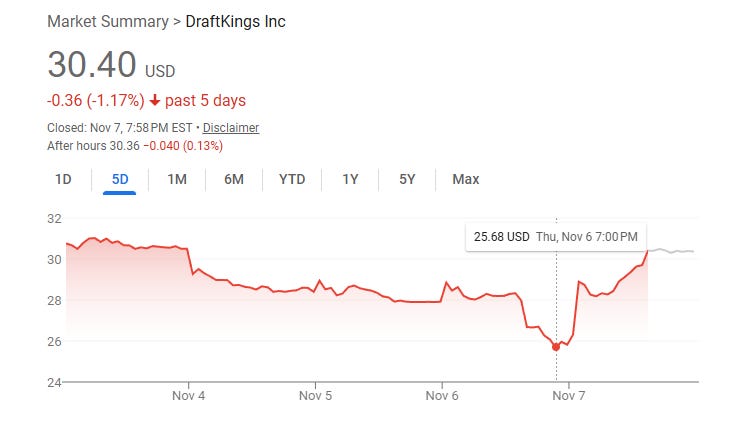
I’m wondering if DraftKings' decision has anything to do with its tumbling stock price? Traders have overreacted to prediction markets, and I wonder if DraftKings and others believe the poison is the cure and are overreacting in kind to stop the share-price bleeding (from nearly $50 per share in August to under $26 on Thursday, rebounding to $30 at close on Friday).
Bark or Bite?
As I said on X, we are about to find out if the states that have cautioned their sports betting licensees about offering sports betting through prediction markets, even in other jurisdictions, are bark or bite.

First, there is the overarching question of what DraftKings is doing that runs afoul of regulations. DraftKings Prediction is a CFTC-certified exchange.
That said, getting on the bad side of state regulators is not a strategy I would advocate. Gambling regulators strive to maintain a non-adversarial relationship with the companies they oversee, and companies understand that this means exercising caution when interacting with regulators.
If DraftKings goes through with sports contracts, that unwritten compact is broken. Recent warnings from states such as Nevada, Arizona, Ohio, Illinois, New York, and Michigan underscore this tension. These regulators have explicitly cautioned licensees against participating in prediction markets, viewing them as a potential means to circumvent state gambling laws.
DraftKings’ strategy to limit the launch to non-sportsbook states (such as California, Texas, and Georgia) may mitigate some licensing risk, but it doesn’t eliminate it.
Offering event contracts in one state could still jeopardize licenses elsewhere if regulators see it as undermining their authority.


The big question is what authority a state regulator would have to revoke a license? As Richard Schuetz often notes, licenses frequently come with a broad reputational clause, and several states have warned licensees, ‘not to go there.’
Nevada Gaming Commission Regulation 3.090(1):
“No license, registration, finding of suitability, or approval shall be granted unless and until the applicant has satisfied the Commission that the applicant: (a) Is a person of good character, honesty, and integrity; (b) Is a person whose background, reputation and associations will not result in adverse publicity for the State of Nevada and its gaming industry; and (c) Has adequate business competence and experience for the role or position for which application is made.”
And Arizona, which, as noted above, warned operators not to offer sports contracts via prediction markets:
Arizona A.R.S. § 5-1305(B)(5) (Grounds for Disqualification from Employment or Licensure):
“Is a person whose prior activities, criminal record, if any, or reputation, habits and associations pose a threat to the public interest or to the effective regulation and control of gaming or create or enhance the dangers of unsuitable, unfair or illegal practices, methods and activities in the conduct of gaming or the carrying on of the business and financial arrangements incidental thereto.”
And then there is Massachusetts, where M.G.L. Chapter 23K, §12 specifically references business activity in other jurisdictions:
“In determining the suitability of the applicant, the commission shall evaluate and issue a statement of findings of how the applicant’s overall reputation satisfies the requirements of this section including, without limitation: (i) the integrity, honesty, good character and reputation of the applicant… (iv) whether the applicant has a history of compliance with gaming licensing requirements in other jurisdictions…”
Still, even if state regulators don’t have any recourse, pissing off a state regulator is also going to rile up state lawmakers, and if you thought the climate was intense now, just wait until states start coming for two pounds of flesh instead of the usual one.
And what about tribes? Tribal gaming compacts often grant exclusivity over certain forms of wagering, and prediction markets could be seen as encroaching on that territory. What happens if a tribe in one of these states sends a cease-and-desist letter or sues DraftKings? If the thought process is to build a user base in California, you'd better hope you can get into California (hello, bad actor, tainted asset clauses!) if it ever legalizes sports betting/online casino.
Bottom Line: DraftKings’ aggressive DNA might win short-term gains, but alienating tribes could backfire spectacularly. If they launch a prediction market in California, any lingering chance of a compromise is gone.
Are We Even Sure There Is an Opportunity?
As I’ve said repeatedly, if everyone has a prediction market, and there are sportsbooks and DFS sites, what is the opportunity? Because it appears that the sports betting pool of gambling is being split into numerous segments, not to mention the B2C and B2B aspects of prediction markets.
In the last couple of weeks:
Truth Social is teaming up with Crypto.com.
We have new prediction market entries, left, right, and center. [Full List Here]
Polymarket is starting a price war.
Still, to date, the rise of Kalshi has had zero impact on sports betting revenues.
DraftKings CEO Jason Robins echoed this sentiment in a recent CNBC interview, stating that prediction markets aren’t luring customers away from sports betting.
Yet, the company is pushing ahead, acquiring Railbird and planning a full launch of DraftKings Predictions, complete with sports event contracts, in the coming months.
FanDuel, meanwhile, is partnering with CME Group and could roll out its own sports-linked contracts by year’s end, though they’re playing it more conservatively.
I think there is a very irrational belief that sports betting (in all its forms) will continue to grow unabated, making enough room for everyone. But at some point, the novelty will wear off, and growth will stagnate. Something new will emerge that captures the attention and money of the masses.
Prediction markets might seem like the next big thing, but with regulatory battles raging and the market flooded with competitors, jumping in might backfire.
“If FanDuel, DraftKings, BetMGM, Caesars, bet365, and Underdog can all offer prediction markets on sports, then it’s just another product in a crowded marketplace that is also competing against traditional sportsbooks, DFS, sweepstakes, and everything else. The advantages of being a prediction market evaporate, and it becomes a battle of UX, marketing budgets, and brand recognition.”
Going a step further, if prediction markets are officially greenlit everywhere, what does DraftKings promote in, say, Massachusetts, its sportsbook and its prediction market?
I feel like DK is going to fumble hard on this path. I don’t know how, but they can find a way.