

A Neutral Party
In a guest post, Phillip Atkinson, CEO of Unrational Games, questions whether prediction markets are truly agnostic to the outcome.
The Bulletin Board
THE LEDE: Guest Column: Are prediction markets “agnostic to the outcome?”
ROUNDUP: A look at the stories you may have missed.
VIEWS: True or false: The AGA’s $1B prediction market claim.
AROUND the WATERCOOLER: Underdog ready to ramp up its PM offerings.
STRAY THOUGHTS: When memories lie.

Whether you’re looking for market research, legislative arguments that land, increased brand awareness, or responsible gaming strategies, Straight to the Point can help with honest, balanced, no-nonsense analysis of the situation.
Reach out for more information: Straight to the Point Consulting.
The Lede: Are Prediction Markets Really Agnostic?
This is a guest post by Phillip Atkinson, the CEO of Unrational Games. The article was originally published on X and is reprinted here with permission from the author.
‘Neutral’ is the most expensive word in the gaming industry.
Yesterday I saw a tweet (since deleted) which argued that prediction markets are neutral because, in their ideal world, trades would have fairly uniform aggregate outcomes such that no one really won or lost, and as players traded the platform would gradually consume their account balances via fees. In a narrow technical sense, that’s accurate. The message was consistent with PMs trying to position themselves as somewhat more virtuous than their traditional counterparts. But on closer inspection, it reveals an important subtlety in how parts of the gaming industry actually work - one the PMs prefer not to be explicit about.
This type of ‘agnostic to the outcome’ positioning is not unique to PMs - it’s also true for a poker site (which I obviously know intimately). In poker, if you could engineer a situation with parity of skill, where everyone won a bit and lost a bit, never cashed out, and just slowly eroded their bankrolls into the rake, that would indeed be the ideal scenario for the operator. In fact, poker sites over recent years took explicit steps to try and do that in the name of ‘ecosystem health’, albeit to no externally obvious benefit.
Of course, that scenario is entirely fantastical. You never get parity of ability. People get on hot runs and bad ones. They cash out after big wins, and they stop playing after big losses. Crucially, such a scenario requires all participants to be indifferent to the rake or fees they’re paying, which absolutely isn’t the case for a core cohort of customers in any actual gaming product I’ve ever been near.
The base of the pyramid
One thing that’s true about poker sites, and almost certainly true about PMs, is that a large portion of revenues comes from a relatively small percentage of the customer base - the whales. That’s also true for games in general and for sportsbooks, but the difference for a poker site or a PM is that their presence is a necessary condition for the ecosystem to function. On a poker site, that’s generally the people who play the most. They do tend to get the biggest rewards to keep playing - but in aggregate they still contribute more than anyone else, and I’ve not yet seen any data that suggests the situation is different for a PM. The ultimate viability of one of these sites rests on liquidity, which is driven by a small percentage of customers, the majority of whom require a specific version of the product/service.
So while it is technically true to say that a poker site or a PM is agnostic to the outcome of any particular game or trade, they are not at all agnostic about the experience of their most important customers. To be so would be to be agnostic about the success of the business.
The person you sit beside
How to square the circle of catering to the ecosystem while also relying on a specific cohort within it was one of the fundamental problems poker had as well, and I think PMs are already facing it, albeit at a different stage of their ecosystem lifecycle. Inside PokerStars at the end of the boom period (which was teeming with serious poker people, many of whom drove the product design) I used to describe it as ‘building for the person you actually sit beside rather than the one you want to sit beside’. The optimal product for your most valuable customers is not the product that’s optimal for the players they want to play/trade against, and the operator always ends up quietly choosing - which means they’re not really neutral at all.
One key aspect of that most important cohort is that they are mostly (but not universally) price and outcome sensitive - by which I mean that if they can’t make winning trades or be net winners at the poker tables, they will take their liquidity somewhere else. Part of that whole calculation is who they’re playing or trading against, how much the rake/fees are, product features etc. Their behaviour feeds into the marketing approach, the product design, the CRM - basically everything.
To build is to choose
So yes, you can claim that PMs are neutral, but they need to feed the monster that feeds them, and everything is downstream of that tenet. When you design a PM product with an API, you are not neutral (especially if it gives privileged access/data). When you allow players to massively multi-table a poker site, or to use certain third-party tools to profile opponents, you are not neutral. When your fee or rake schedule varies between groups, you are not neutral.
Recently I was clearing out some files and stumbled across an old org chart from Scheinberg-era PokerStars. What is obvious from looking at it now, and remembering the big strategy/planning meetings about marketing etc., was just how ruthlessly efficient and effective it was at finding, opening and developing new markets. Everything was sequenced - local partnerships, regulatory outreach, media, marketing and product. It was a system designed to keep the player/money flow going in the right direction, and it was exceptional at it. But efficiently opening new markets is running to stand still - there are only so many of them, and ultimately you have to find a way to achieve long-term balance in the product.
PokerStars, and the poker sites in general, never found that balance. Indeed, you could argue their business model made it impossible. In the end, this was one of the underlying forces that (somewhat) fatally damaged online poker. PMs might be stuck on the same railway tracks.
STTP Note: You can watch Phillip’s appearance on the Straight to the Point Talking Shop Podcast here:
Roundup: So Much News; So Little Newsletter Space
Colorado Gov. signs gaming reform bill [SBC Americas]: “Colorado Gov. Jared Polis has signed an expansive sports betting bill that implements new responsible gaming standards and procedures for operators and bettors in the state. Polis signed Senate Bill 26-131 on Monday, a measure making sweeping changes to Colorado’s sports betting market by adding new requirements aimed at protecting bettors in the state. The bill includes a landmark provision for regulated gaming in the U.S. related to how sportsbooks communicate with bettors.” Previous STTP coverage of the Colorado bill.
Rep. Titus calls for IG investigation of CFTC [SBC Americas]: Rep. Dina Titus is asking US Inspector General Christopher Skinner to begin a formal investigation into the CFTC’s regulatory position on prediction markets. “The Commission’s recent actions raise significant concerns regarding statutory compliance, federal/state/tribal balance, and resource allocation,” read Titus’ post on X on Monday.
More prediction market insider trading allegations [The Guardian]: “Federal authorities are investigating whether George Santos, the disgraced former Republican congressman from New York, engaged in insider trading by betting on a prediction market on his own attendance to the State of the Union address, multiple news outlets reported on Tuesday. Santos allegedly placed a bet on Kalshi, a popular online prediction market, over whether he would be in attendance at Trump’s State of the Union address in February, according to NPR, which first reported on the investigation citing anonymous sources.” More from The Event Horizon:

Views: Where the AGA PM Numbers Come From
As I’ve reported in the past (here and here), the American Gaming Association (AGA) has a page that tracks the tax revenue states are losing because of prediction markets; a number that has crossed $1 billion per the AGA.
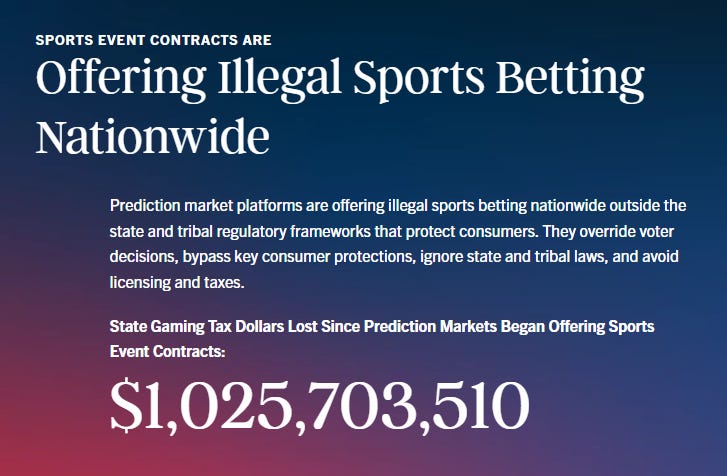
I’ve seen a lot of pushback on the AGA number on social media, and also from industry media, as there is a fundamental misunderstanding of what the AGA is measuring.
As I noted back in April, when people first started questioning the number:

Apparently, it is that hard to understand, because everyone keeps making the same strawman cannibalization, argument.
So, where is the AGA getting what seems to be one of the most misunderstood numbers in the industry from? It’s not pulling it out of its ass the sky, and for an industry that routinely hypes up handle and trading volumes, it shouldn’t be hard to figure out:
The organization IS NOT measuring cannibalization of state-regulated sportsbooks; it IS measuring what prediction markets would pay states if they were taxed like licensed sportsbooks, using prediction markets’ own trading volume numbers — the AGA halves trading volume to come up with an equivalent handle number.
CFTC Chairman Michael Selig sat down with CNBC earlier this week for an interesting interview, and one of the few times he has received pushback from the interviewer — AGA President and CEO Bill Miller was on CNBC last week.
Around the Watercooler
Social media conversations, rumors, and gossip.
Underdog (a newsletter sponsor) appears to be ready to make its prediction market move:

And its starting from a position of relative strength:

Stray Thoughts
Never (fully) trust a memory.

 | A guest post by
|