

A New Dawn
The ESPN Bet era is officially over, but can theScore Bet change Penn's online fortunes?
The Bulletin Board
THE LEDE: Penn rebrands to theScore Bet, officially moving on from ESPN Bet.
NEWS: Kalshi has a day with an $11B valuation and deals with Solana and CNN.
VIEWS: The question of our time: Where does a bet take place?
AROUND the WATERCOOLER: ESPN to feature DK’s prediction market, while it runs AGA anti-PM ad.
STRAY THOUGHTS: Measurable progress.

Sponsor’s Message: Increase Operator Margins with EDGE Boost Today!
EDGE Boost is the first dedicated bank account for bettors.
Increase Cash Access: On/Offline with $250k/day debit limits
No Integration or Costs: Compatible today with all operators via VISA debit rails
Incremental Non-Gaming Revenue: Up to 1% operator rebate on transactions
Lower Costs: Increase debit throughput to reduce costs against ACH/Wallets
Eliminate Chargebacks and Disputes
Eliminate Debit Declines
Built-in Responsible Gaming tools
To learn more, contact Matthew Cullen, Chief Strategy Officer, Matthew@edgemarkets.io
The Lede: Can theScore Bet Succeed Where Barstool and ESPN Bet Could Not?
ESPN Bet is officially no more, having been replaced across the country by theScore Bet on Monday.
Per the press release from Penn, the company “has completed the rebrand of its online sports betting (OSB) platform to theScore Bet and has successfully launched its OSB product in Missouri.”
The only change for customers was the branding (like a business getting a name change and a new logo). Account information, including login credentials, funds, and existing bets were automatically transferred from ESPN Bet to theScore Bet:
“Existing customers were able to access the rebranded app this morning using their login credentials after a seamless overnight transition. All account settings, open wagers, and responsible gaming tools remain the same.”
The big question is can theScore Bet do for Penn what Barstool and ESPN Bet could not? And no, that doesn’t mean compete with DraftKings and FanDuel, which was always a pie-in-the-sky type dream that cost Penn billions of dollars and several years. The question theScore Bet is trying to answer is, can it integrate with and benefit Penn’s existing land-based casino business?
That is a question the entire industry is trying to solve, as no one (outside of Circa and Prime Sports) wants to stand out from the crowd; everyone wants to copy the success of DraftKings and FanDuel.
Most of the differentiation in the US sports betting sector is simply a willingness to spend. The product is always the same and the target audience is always the same, or in the case of Prime Sports, an audience DraftKings and FanDuel really don’t want.
Penn is definitely going to pull back on the spending reins, but it will be interesting to see if they try to differentiate through product or target audience.
As I wrote when Penn and ESPN dissolved their agreement:
“You have to know who you are, and Penn is a successful regional casino operator. Its leadership and executive team were built with that in mind. To be successful in the online arena, you need to be 100% focused on that. That’s not in Penn’s DNA, and now, it looks like the company is going to do a proper reset.
“As Penn CEO Jay Snowden said: ‘We are realigning our digital focus to leverage the strength of our U.S. iCasino and Canadian operations, while continuing to use OSB to drive both the acquisition of customers with significant lifetime value and unique cross-sell opportunities across PENN’s retail and digital assets.’
“This is the key for land-based operators in the digital realm. Don’t try to own the digital space; use it to boost your land-based properties. You don’t have to win online to win online. A 3% market share can be huge if you aren’t spending hundreds of millions in marketing to acquire it.”
For instance, one of the more interesting parts of the 60 Minutes segment on Polymarket was Anderson Cooper’s shock at seeing and hearing about the numerous markets available (10,000 according to CEO Shayne Coplan).
Cooper’s reaction is typical; most people don’t have the time or desire to learn how to use your product and to then navigate it on a daily or weekly basis. There’s a market out there for customers who find sports betting too time-consuming.
News: Prediction Markets Keep Making Waves
Surprise! There’s a lot of prediction market news to get caught up on.
We’ve got the official announcement (TechCrunch reported this a while back) that Kalshi raised a billion dollars at an $11 billion valuation:

Kalshi also signed a deal with Solana:
“Kalshi bettors can now buy and sell tokenized versions of their wagers on Solana, the company told CNBC exclusively on Monday. It’s the latest sign the prediction market company is deepening its push to win over the same cryptocurrency holders that have pumped billions of dollars of digital assets into its rival Polymarket.”
The Solana deal brings Kalshi on-chain, giving a foot in the door of Traditional Finance (TradFi) and Decentralized Finance (DeFi). As Dustin Gouker put it in his Event Horizon newsletter:
“The growth of prediction markets on-chain and Kalshi’s move here create a conundrum around know-your-customer protocols for sports and sports betting. A really good turn of phrase that someone told me (but they didn’t want to be quoted): ‘The anonymity of crypto is entirely at odds with the sunlight that integrity requires.’”
And, according to Axios, it also inked a deal with [checks notes] CNN?
“CNN has struck a partnership with Kalshi, the world’s largest global prediction market company, bringing Kalshi’s data to its journalism across its television, digital and social channels, executives tell Axios.”
According to Axios’ reporting, in addition to on-air references, the deal will see Kalshi’s data featured on a real-time data ticker, but the biggest integration will be on the political side, as CNN chief data analyst Harry Enten (a Steve Kornacki-level rising star in the space), “will tap into real-time insights from Kalshi in his reporting on air, both via linear TV and CNN’s new streaming subscription service.”
STTP Thoughts: The CNN deal is one of those moments where it feels like prediction markets have broken through… but I’ll have more thoughts on that in an upcoming feature column.
Views: The Big Question: Where Does a Bet Take Place?
Where exactly does a bet take place? This question lies at the heart of contentious battles between tribes, states, and even prediction markets. And truth be told, we are no closer to answering this question than when it was first raised decades ago.
There are two recent developments on this front, but first, let me recap the Seminole Tribe’s compact with Florida, which reignited this debate.
The Seminoles’ Huge Win
In 2021, the Seminole Tribe of Florida signed a 30-year compact with Florida that granted the tribe exclusive rights to online sports betting statewide, something tribes in other states only accomplished by becoming commercial operators.
So what was different in Florida? Bets are deemed to occur at the server, so if the server is on tribal lands, the bet is taking place on tribal lands.
However, there is an important caveat to the Seminole’s compact: “As STTP has noted in the past, the legal footing requires the compact (and state law) to explicitly state that betting occurs where a server is located.”
If you want a deeper dive into this argument, I wrote a feature column on “where does a bet take place.”

Ok, on to the more recent news.
Kalshi and California Tribes
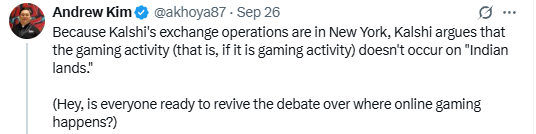
In its argument against California tribes, Kalshi argued that it doesn’t fall under the Indian Gaming Regulatory Act (IGRA): “IGRA regulates the conduct of gaming activity ‘on Indian lands’ — that is, gaming operations physically conducted on a tribal reservation. UIGEA regulates gaming activity that can be accessed via the internet in a state or reservation where it is unlawful, unless such activity constitutes derivatives trading subject to the CEA.”
Kalshi is also arguing that bets placed by users on tribal lands do not constitute doing business there, arguing that it “does not maintain an office on Indian lands. Kalshi does not house servers on Indian lands. Kalshi does not employ personnel on Indian lands. Kalshi conducts no business whatsoever on Indian lands.”
Colorado Tribes
This same fight is playing out in Colorado, where the Southern Ute and Ute Mountain Ute tribes sued Colorado in 2023, claiming the state blocked their statewide online sports betting by requiring bets only on tribal lands.
A federal judge dismissed the case in October (the tribes have appealed), saying that bets occur where the bettor is located, allowing state oversight off-reservation: “If the bettor is on Indian land, the gaming activity is on Indian land,” Judge Gallagher wrote in his opinion. “If the bettor is off Indian land — for example, in Denver — [IGRA] does not apply.”
In his opinion, Judge Gallagher invoked previous cases involving land-based gambling that focused on the bettor, not the casino:
“In online gaming, the most closely analogous activity to rolling dice, betting chips, spinning a wheel, or playing cards is clicking a button to place a wager, setting the wager in motion. Therefore, the Court holds that online class III gaming activity occurs where the bettor, not the server, is located when he or she initiates the wager.”
Bottom Line: We’re no closer to answering the “where does a bet take place” question, but it’s being asked more often.

SPONSOR’S MESSAGE - Underdog: the most innovative company in sports gaming.
At Underdog we use our own tech stack to create the industry’s most popular games, designing products specifically for the American sports fan.
Join us as we build the future of sports gaming.
Visit: https://underdogfantasy.com/careers
Around the Watercooler
Social media conversations, rumors, and gossip.
A story in two parts:


Stray Thoughts
I’ve had several passions over the years. It started with basketball, then weightlifting, then poker, then martial arts. I was discussing it recently and realized they all had a common thread.
In basketball you either stay on the court or you don’t. No one cares if your team leads the league in second-quarter three-point percentage.
In weightlifting, you’re either getting stronger or you’re not. Powerlifters don’t get points for doing X number of reps of some rare accessory exercise.
In poker, you’re either a winning player, or you’re not. No one cares what your 3-bet percentage is from the cutoff.
And in combat sports, you’re either getting knocked on your ass (or choked) or you’re not. Your ability to jump rope or do burpees is meaningless.
There isn’t much gray area in any of these endeavors. Progress is measurable and hard to fake.
Maybe your second quarter three-point percentage, ability to do an accessory exercise, cutoff 3-bet percentage, and your cardio habits can tell us something about your performance, but then again, maybe they don’t.
Think about that the next time someone touts some oddball number or announces some flashy development. Ask yourself, what’s the number, or numbers, that matter?