

Below The Mendoza Line
Kalshi's court record includes a big victory in the 3rd Circuit, but it's overall record is below the Mendoza Line.
The Bulletin Board
THE LEDE: Catching up on Kalshi’s (many) court cases.
BEYOND the HEADLINE: Toothpaste does in fact go back in the tube.
ROUNDUP: A look at the stories you may have missed.
ALTRUDA ANALYZES: Michigan online casino revenue, June 2026.
AROUND the WATERCOOLER: Wisconsin’s election laws vs. Kalshi.
STRAY THOUGHTS: Weekly Legislative Updates + Weekender.

Sponsor’s Message: Play’n GO is launching into land-based casinos.
After more than 20 years at the forefront of iGaming, Play’n GO is bringing its world-famous games to land-based spaces, too.
Play’n GO’s unrivalled portfolio of some of the world’s most played online casino games is now available for physical casinos, giving operators the opportunity to harness the power and growth of online casino to bring a new demographic of players into their brick and mortar spaces for the very first time.
With cabinets already placed with one of the biggest casino chains in the world, Play’n GO’s CEO Johan Tornqvist said “We are bringing the best of online casino content and features to casino floors worldwide.”
For more info, visit www.playngo.com
The Lede: Kalshi’s Court Record Is Below the Mendoza Line
Publisher’s note: I updated the court case record from 19 out of 23 state wins, to 21 out of 26.
Kalshi has taken several losses in court, most recently in Washington, where a state court granted a preliminary injunction earlier this week, finding that Kalshi conducts illegal gambling activities in violation of Washington law and that the Commodity Exchange Act (CEA) does not preempt state gambling laws. The injunction will not take effect until at least August 5, 2026, while the court considers further briefing on its precise language and scope (geofencing will be a key issue). Attorney General Nick Brown is also seeking restitution, disgorgement, and civil penalties.
This latest ruling elicited this response from the Kalshi comms team:


McGavick’s tweet is an almost comical summation of the current legal situation for two reasons.
Reason #1: Remember the Wins; Forget the Losses
First (I’ll get to the second reason in a moment), it’s akin to saying, “The Brooklyn Nets won many games last season, including beating the Boston Celtics.” The Nets were 20-62, and I guess 20 could be considered many depending on your purview, and they did beat the Celtics. Still, no one would consider the Nets season a positive on-the-court performance.
As attorney Daniel Wallach recently noted:


Further, Kalshi has been outright blocked in two states, Nevada and Michigan (with some disagreement over the means Kalshi is using to block Nevada), while several others have agreed to withhold enforcement until the appeals process plays out.
Here is a very brief summary of the New Jersey (3rd Circuit) case Kalshi likes to cite while ignoring every negative ruling from my Prediction Market Tracker for Forecast Tier subscribers:
Kalshi sued the Division of Gaming Enforcement after a cease-and-desist, securing a preliminary injunction in 2025. The 3rd Circuit upheld it 2-1 on April 6, 2026. This was the first federal appellate ruling holding that Kalshi’s sports event contracts are CFTC-regulated “swaps” subject to exclusive federal jurisdiction and preempting state gambling laws, and thereby allowing continued operations in New Jersey with no restrictions imposed.
Previous STTP coverage of the New Jersey ruling.
That is not what judges ruled in the two states that Kalshi must geofence:
Kalshi filed a preemptive federal suit after Nevada sent a cease-and-desist letter. Kalshi initially won a preliminary injunction in April 2025, but the same judge dissolved it in November 2025, ruling sports-related contracts resemble illegal betting. Nevada extended a preliminary injunction in April 2026 barring Kalshi from offering sports, election, or entertainment event contracts without a gaming license — a similar ruling was issued against Polymarket in June. Kalshi is abiding by the order (although Nevada disagrees with its method of blocking access). Kalshi appealed to the 9th Circuit, where arguments were heard in April 2026. A decision would create a circuit split with the 3rd Circuit.
Previous STTP coverage of the Nevada ruling.
Michigan AG Dana Nessel sued Kalshi seeking an injunction and abatement for alleged illegal gambling. After a federal court remanded the case to state court, Ingham County Circuit Court Judge Rosemarie Aquilina granted a temporary restraining order barring Kalshi from offering/advertising sports event contracts to Michigan residents, requiring licensed third-party geolocation, with potential $120,000/day fines for noncompliance. This is the second state court-ordered restriction; Nevada is the other.
Reason #2: No One Is Arguing That
As I said, there are two reasons the tweet is comical, so let’s circle back to the McGavick tweet, and the statement that, “States don’t have jurisdiction to regulate prediction markets.” That is an accurate assessment, but has literally nothing to do with the legal fight. States aren’t looking to usurp the CFTC’s authority and become the regulators of prediction markets. They are arguing that prediction markets added a product (sports contracts) that they aren’t authorized to offer. While some states have included elections and entertainment contracts in their filings, the genesis of the lawsuits was sports.
Even a CFTC-registered platform like Kalshi is not immune to state enforcement when courts conclude that its sports event contracts fall outside the federal framework or constitute gambling under state law.
Funnily enough, Kalshi used to hold the same perspective on sports:


This doesn’t speak to how the courts will eventually rule. As I often point out, New Jersey lost every PASPA court battle except for one: The 2018 Supreme Court decision.
Beyond the Headline: Toothpaste Does Go Back In Tubes… Occasionally
Too big to fail. The horse has left the barn. The genie is out of the bottle. You can’t put toothpaste back in the tube. These refrains are commonly invoked to explain why prediction markets will still be a thing no matter how the court cases eventually play out.
I disagree. Toothpaste does go back in the tube; it’s just extremely messy.
You can squeeze a lot of it back in if you’re willing to make a giant mess on the counter, waste a fair amount of time, and accept that the tube will never look or work quite the same again.
Prediction markets, no matter how big they get in the short-term, are not an unstoppable force of nature. It’s a relatively new, still-unproven industry operating in a legal gray area.
The “can’t put it back” argument assumes that once liquidity, user habits, and cultural acceptance reach a certain level, reversal becomes impossible. History suggests otherwise. Markets, platforms, and entire categories of financial activity have been heavily restricted or functionally eliminated before. The process is rarely clean, and it usually creates collateral damage, but it happens.
As I’ve said in the past, prediction markets may well survive in some form, but the idea that sports contracts on these platforms are now too big, too useful, or too culturally embedded to be meaningfully constrained feels more like a Stuart Smalley exercise in repeating positive affirmations than reality.
Alcohol: Remember Prohibition? Alcohol (far more popular than betting) was prohibited via Constitutional Amendment (the 18th Amendment) and then repealed in the same manner (the 21st Amendment). Bottom Line: Whenever someone says that can’t possibly happen, remember that the US prohibited the sale of alcohol not in the distant past, but just 100 years ago! Prohibition had a 13-year run, and was then repealed.
Napster: I previously compared Kalshi to Napster, the peer-to-peer (P2P) file-sharing service: “Launched in 1999 by Shawn Fanning, Napster… democratized access to music, bypassing record labels and putting music catalogs at every internet user’s fingertips. It also spawned a number of copycats, like LimeWire. But the music industry wasn’t thrilled about the unauthorized sharing of copyrighted material, leading to epic court battles… The courts sided with the music industry, rejecting fair use claims, which ultimately led to Napster’s shutdown and bankruptcy.” Bottom Line: Napster had a brief moment in the sun before it was shut down.
Initial Coin Offering: In 2017, hundreds of ICOs raised billions of dollars. And then regulators stepped in, declaring many of them illegal securities offerings, and effectively ending the unregulated “wild west” version of cryptocurrencies almost as fast as it had taken off — of course, now we have memecoins. Bottom line: It didn’t take long before regulators looked at these markets, and said, “Hold on a minute.”
Bucket Shops: Something closer to home for prediction markets would be bucket shops, popular from the 1870s to the early 1920s. Bucket shops were essentially early prediction markets, as they allowed people to wager on stocks, commodities, and other events without owning or delivering the underlying assets. They were gradually prohibited through a combination of actions — state laws, court battles, and a 1905 Supreme Court decision. Bottom Line: Bucket shops had a 50-year run, and were not too big to fail.
Roundup: So Much News; So Little Newsletter Space
Turning Stone puts the finishing touches on $400M expansion [Syracuse.com]: Despite all the talk about online being the future, the land-based casino industry is alive and well: “After years of planning and construction on the $400 million expansion [at Turning Stone Casino], the new 258-room Crescent Hotel opens today followed by the opening of Salt, a steak and seafood restaurant on the hotel’s seventh floor next Wednesday, July 22. The full project includes an in-house health center and expansive new conference facilities set to open around Labor Day.”
Pennsylvania casinos fund community projects [Trib Live]: As I’ve discussed in multiple podcasts (here and here), land-based casinos’ impact cannot be measured in tax revenue alone. Case in point, Pennsylvania: “Without the help of a state-mandated Local Share Account funded by gambling revenue, Westmoreland County’s 65 municipalities might not be able to renovate critical infrastructure, replace aging police vehicles or invest in stormwater and sewer repairs, state Sen. Joe Pittman said Thursday… Dozens of local officials gathered Thursday at Hempfield’s Live Casino Pittsburgh to recognize the $17.2 million distributed in the county through the Local Share Account.”
BetHog shifting focus to AI dealer product [Casino Reports]: Earlier this week, BetHog announced it will shutter its crypto casino, BetHog, and focus entirely on the AI dealer product, Sentient Studios and becoming a B2B supplier. “We only really made the decision very recently,” BetHog cofounder Nigel Eccles (a FanDuel cofounder) told Casino Reports. “With the level of interest we are now seeing in AI dealer, we felt we needed to make the decision.”
Crypto.com receives $400M investment from Citadel [Complete iGaming]: “US-based market-making firm Citadel Securities has invested US$400 million into cryptocurrency exchange Crypto.com at a US$20 billion valuation. The funding represents Crypto.com’s first “institutional funding round” since its founding in 2016. According to the companies, these funds will support Crypto.com’s expansion into tokenized securities and derivatives as blockchain-based products continue to develop.”
Altruda Analyzes: Michigan Online Casino Revenue, June 2026
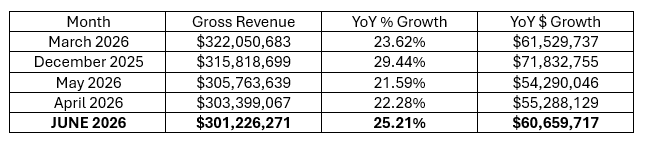
The Michigan Gaming Control Board reported $301.2 million in gross internet casino revenue for June on Tuesday, marking a seventh consecutive month with at least 20% year-over-year growth.
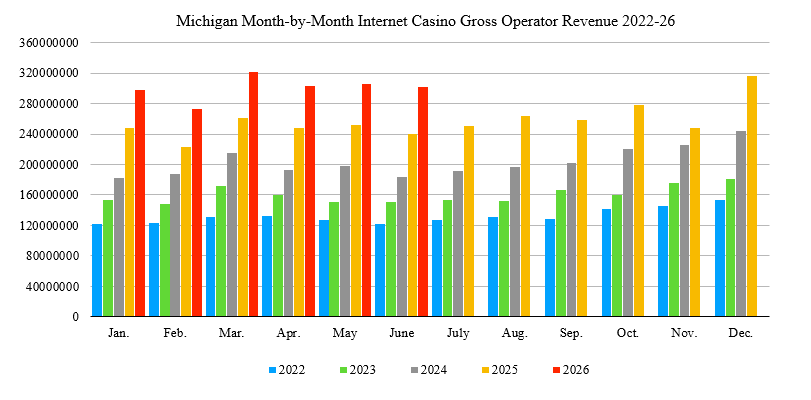
It was the fourth straight month operator winnings topped $300 million before deductions and fifth time overall. The 25.2% increase from June 2025, sharply boosted by the arrivals of Hard Rock and bet365 in recent months, was the largest in terms of percentage in the calendar year.
The state was able to levy taxes on $289.2 million in adjusted gross revenue, re-directing $60.8 million to state coffers. The City of Detroit received $13.5 million in receipts, and tribal disbursements for the month totaled $8.4 million.
BetRivers Shows Staying Power at No. 4
Around the Watercooler
Social media conversations, rumors, and gossip.
Things are somehow getting wackier and wackier:


As I said on X, if everything you do results in a court date, maybe you’re the problem (and yes, Joe Brennan’s line is better):


More from Dustin Gouker:

Stray Thoughts
After playing around with Substack’s new content blocks I will be rolling the Weekly Legislative Updates (currently Sunday, for paid subscribers) into the Weekender (currently Friday) and moving it to Saturday.