

Breaking The Code
Kalshi did something sportsbooks have been unable to do on Sunday: Turn the Oscars into a legitimate betting market.
The Bulletin Board
THE LEDE: Kalshi generated significant betting interest on the Oscars.
ROUNDUP: A look at the stories you may have missed.
PREDICTION MARKET ROUNDUP: PM-focused news.
NEWS: How much of Illinois’ sports betting happens in Chicago?
AROUND the WATERCOOLER: Rules for thee…
STRAY THOUGHTS: You wanna dance?

Sponsor’s Message: Increase Operator Margins with EDGE Boost Today!
EDGE Boost is the first dedicated bank account for bettors.
Increase Cash Access: On/Offline with $250k/day debit limits
No Integration or Costs: Compatible today with all operators via VISA debit rails
Incremental Non-Gaming Revenue: Up to 1% operator rebate on transactions
Lower Costs: Increase debit throughput to reduce costs against ACH/Wallets
Eliminate Chargebacks and Disputes
Eliminate Debit Declines
Built-in Responsible Gaming tools
To learn more, contact Matthew Cullen, Chief Strategy Officer, Matthew@edgemarkets.io
The Lede: Did Kalshi Solve the Awards Show Enigma?
My theory, which I’ve previously laid out in the newsletter, is that prediction markets need sports in the short-term, but sports are merely a bridge to something much grander; long-term success will come from other markets: Like the Oscars.
This year, Kalshi’s trading volume on its Oscars’ markets exceeded $100 million.

Those are well below Super Bowl numbers:

That said, sportsbooks also offer Oscars wagers, and Kalshi’s numbers dwarf what is historically wagered on sportsbooks, where awards shows are seen as low-exposure entertainment prop markets with bet limits and very few participants.
In a 2025 ESPN column on Oscars’ markets, DraftKings oddsmaker Johnny Avello, said the Oscars generates a similar amount of handle to an average NASCAR event — no direct data is available for NASCAR, but in Illinois, total motor-racing handle was $9.6 million for the entirety of 2024.
That said, sportsbooks have, more so in the past, used award shows to generate buzz and grab some earned media. The hope, which I suspect hasn’t come to fruition, was that people interested in putting a few dollars down on the Oscars would then stick around and bet sports, a category they probably have zero interest in, or they would already be active users. It’s the equivalent of a gym running a free pizza night promotion thinking some of the people will join.
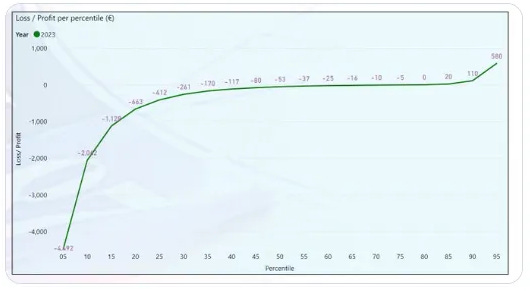
What ends up happening is Oscars bettors turn into, what Eilers & Krejcik Gaming’s Alun Bowden calls a customer that is “a total waste of time,” evidenced by the chart below that shows 80% of new customers cost an online betting site money:
Kalshi doesn’t have that problem. If it creates a customer interested in betting on the Oscars, it has numerous other entertainment markets for them to play around with after that.
While I didn’t think the Golden Globes-Polymarket mashup was a good idea (as it was too in-your-face), Kalshi has subtly made some very good marketing choices around the Oscars.
“Though the Oscars haven’t officially partnered with any prediction market companies, on Friday, Kalshi announced that it is working with Rotten Tomatoes to “provide real-time prediction market data” that will be incorporated into the review aggregator’s editorial and social coverage. Kalshi says that its data won’t have an impact on Rotten Tomatoes’ scores, but the companies believe this information will offer “an additional layer of fan insight to awards season.”
I also ran into a Kalshi ad read (cued up below, about 30 minutes in) on a popular movie reaction channel, with nearly 1.5 million subscribers. Unlike the typical sportsbook ads I run into on YouTube channels, this one was organic and likely resonated with the audience.
This is where Kalshi and other prediction markets diverge from sportsbooks; they don’t have a core product they are trying to sell.
Roundup: So Much News; So Little Newsletter Space
Wisconsin Governor undecided on sports betting bill [WBay.com]: Wisconsin Gov. Tony Evers is uncommitted on the sports betting bill passed by the legislature this week, telling local press, “I’ll have to take a look at what the bill actually says, but also talk to those people from whichever tribal nations haven’t signed on where they are at. And so, we’ll be doing some talking with tribal leaders, and hopefully we can get something done.”
Most sports leagues stay quiet on potential prop betting bans in New York [Sports Betting Dime]: Ask and you shall not receive. As STTP reported in February, New York regulators asked for input from professional sports leagues on potential prop betting market restrictions. The response, as Sports Betting Dime’s Robert Linnehan reported, was underwhelming: “New York State Gaming Commission Chair Brian O’Dwyer today revealed the commission received only three responses to letters sent to over 100 professional sports leagues asking for input on certain markets or bet types they feel should be restricted, limited, or excluded in the state.” STTP Thoughts: As I said on X, “If you’re a sports league the only wrong answer to this question is no answer, which assures you get 1) zero input in the process, and 2) are complicit in any blame handed out.” As Linnehan noted in a tweet: “O’Dwyer said there may come a time when the commission believes prop bets are too susceptible to manipulation to allow to continue being allowed in NY. Without league input on what markets are most susceptible, the commission may prohibit ALL prop bets in the state, he warned.”
Gambly and Unabated merge to form new company [InGame]: “Gambly and Unabated today announced a merger to form Gambly Ventures, Inc., combining Gambly’s AI-powered betslip platform with Unabated’s sports betting data and tools. The deal is designed to serve both casual bettors looking for ChatGPT-style convenience and serious bettors who rely on advanced market data and betting models.” In a press release, Cal Spears, who will serve as CEO of the merged entity, said, “After a few challenging years for the affiliate industry, the opportunity ahead is being underestimated. Prediction markets are raising billions, and legacy operators are preparing to enter more than 20 new states. With Gambly’s AI tools and Unabated’s data infrastructure, we’re positioned to capture that growth.”
PBS to air sports betting special dubbed, Gambling With Your Life [PBS]: PBS’s “Breaking the Deadlock: Gambling With Your Life,” debuts March 24th. “Online sports gambling has exploded. Should it be further regulated? What does it mean for college athletic programs and professional sports? How is AI transforming it? What is the public health impact?” In addition to sports betting, prediction markets will be a topic of conversation the panelists that includes, Daniel Wallach, Stephanie Ruhle, Sen. Richard Blumenthal, Tiki Barber, Jonathan Cohen, and Shawn Fluharty.
Quote of the Week: “The second thing they ask about is, we need some protection, some parameters around sports gambling. Because what is hitting young people because they made or missed a free throw is absurd. It’s absurd. And I hope our governmental leaders take both of those issues seriously.” SEC (Southeastern Conference, not the Securities Exchange Commission) Commissioner Greg Sankey
Prediction Market News Roundup
Kalshi closing in on partnership with Fox [Front Office Sports]: “Fox Corporation and Kalshi are in serious talks for a significant partnership, sources told Front Office Sports. If the deal is finalized, it is expected to encompass Fox News and Fox Weather but not include Fox Sports programming, sources said. Spokespeople for Fox and Kalshi declined to comment.” Matthew Wein (podcast guest #52) does a good job tracking these news and sports partnership deals here.
CFTC is already getting comments on its proposed prediction market rules [CFTC]: The public comment period opened on March 16 (it closes on April 30) and people are already weighing in, with five submissions at the time of writing. Previous DSTTP coverage of CFTC guidance and proposed rulemaking can be found here.
Senators ask CFTC to prohibit PM contracts on military actions [Press Release]: In a letter to the head of the CFTC, Senators Jack Reed and John Hickenlooper wrote: “To address dangerous national security, market integrity, and immoral outcomes, the CFTC must enforce the law and immediately halt trading in event contracts tied to U.S. military operations. Given the high potential for insider trading and evidence that insider trading did in fact occur in the “Iran strike” contract on Polymarket, we urge the CFTC to investigate this matter on platforms that the agency regulates and ultimately bring big cases to punish significant wrongdoers.”
Another federal bill to rein in prediction markets [Press Release]: US Sen. Chris Murphy and Rep. Greg Casar introduced the Banning Event Trading on Sensitive Operations and Federal Functions (BETS OFF) Act earlier this week. The bill seeks to “ban wagering on government actions, terrorism, war, assassination, and events where an individual knows or controls the outcome.” The bill is co-sponsored by Sen. John Hickenlooper and Reps. Yassamin Ansari, Gabe Amo and Rashida Tlaib in the House. A press conference was held to announce the legislation. By STTP’s count, this is the sixth prediction market bill introduced in 2025-2026 (plus one failed draft amendment). STTP tracks these efforts for Forecast Tier subscribers.
Sponsor’s Message: Promoting a sustainable, entertainment-first global gaming industry.
Play’n GO is celebrating its 20th anniversary in 2025. Drawing on that experience from the dawn of the iGaming industry through to today, Play’n GO designs and creates world-class slot games in the online casino space.
Play’n GO wants to see a sustainable industry that puts players first. To realize that vision, Play’n GO:
Creates games designed to be entertaining and fun first
Actively lobbies for increased regulation to keep players safe
Refuses to make games that feature mechanics that we believe to be predatory, such as those that allow players to pay hundreds of times their normal stake to buy into the bonus round directly (‘Bonus Buy’ games)
Now live in over 35 regulated territories around the world, including all US and Canadian iGaming jurisdictions, Play’n GO is the leading provider of entertainment to the online casino industry.
For more info, visit www.playngo.com
Quick Hitter: Chicago Generates 1/4 of Illinois Sports Bets
Some great reporting from Chris Altruda over at InGame whose Freedom of Information Act (FOIA) request gives us a look at the impact of the Chicago sports betting tax passed last year.
Per Altruda: “A fulfilled Freedom of Information Act request submitted by InGame to the City of Chicago Department of Finance shows the city collected more than $3.7 million in sports betting tax receipts in January for the first month the levy was enacted.”
As Altruda notes, “FanDuel and DraftKings are paying 52.25% in taxes on all Chicago-based revenue,” broken down as a 40% state tax, a preexisting 2% local tax, and the newly enacted 10.25% city tax.
Also of interest, Altruda’s FOIA request sheds some light on how much sports betting is taking place in Chicago, with $36.4 million in adjusted gross revenue in Chicago in January accounting for around 27% of statewide sports betting revenue ($137 million) for the month.
Around the Watercooler
Social media conversations, rumors, and gossip.
Posted without comment:

And in the “rules for thee but not for me” category, we have this:

And that call elicited the following response from former New Jersey AG Matt Platkin:

Stray Thoughts
In the self-protection community, there is a pre-fight period known as the “Monkey Dance,” a term popularized by Rory Miller in his book Meditations on Violence.
The Monkey Dance is the ritualistic posturing that often happens before a real fight breaks out between young males: Chests puff up, threats are hurled, there is a lot of commotion, and big movements, all with the goal of getting the other person to back down. It’s essentially what happens in the wild when two primates try to prove who is in charge, the first step is intimidation, winning the fight without fighting and avoiding doing permanent damage to each other.
Now, if someone is a solo dancer, and the person they are trying to intimidate is stoic and staring them down, you can be fairly certain that person is the dangerous person in the encounter. One person is insecure, the other knows what they are capable of doing if the fit hits the shan.
The perfect example of this was the drunk golfer who monkey danced his way into the fists of former NHL enforcer Nick Tarnasky (and a lake).
So why am I posting this? There is a lot of dancing on social media by prediction markets and their supporters about the situation in Arizona (and elsewhere). Dustin Gouker wrote about something similar in his Closing Line newsletter yesterday.
