

Burning Down The House
Prediction markets are peer-to-peer, but increasingly the "peer" on the other end is looking more and more like a sportsbook.
The Bulletin Board
THE LEDE: How peer-to-peer are prediction markets?
ROUNDUP: A look at the stories you may have missed.
NEWS: EKG adds a new prediction market headwind to the list.
AROUND the WATERCOOLER: LV hotel cancels prediction market conference.
STRAY THOUGHTS: Take a breath before you hit send.

SPONSOR’S MESSAGE - Underdog: the most innovative company in sports gaming.
At Underdog we use our own tech stack to create the industry’s most popular games, designing products specifically for the American sports fan.
Join us as we build the future of sports gaming.
Visit: https://underdogfantasy.com/careers
The Lede: How Market Makers are Becoming the House
We are being told the fundamental difference between prediction markets and sportsbooks is that there isn’t house, prediction markets are a peer-to-peer offering.
When the existence of Kalshi’s trading arm was first highlighted by Sportico’s Dan Bernstein, the company argued it was a separate, arm’s-length, liquidity provider that was losing money. But as my regular readers know, always add the word yet to these comments.
As I said at the time:
“That Kalshi Trading isn’t profitable doesn’t mean much.
“First, it’s not profitable now. As Brett Maverick (Mel Gibson) says in the movie Maverick, “I promise I’ll lose for at least an hour.” This isn’t some altruistic company propping up prediction market customers, long-term the goal is to make money; it said as much in its CFTC filing.
“Second, as I noted in the previous section, sometimes it’s in a company’s interest to lose money, and Kalshi Trading filling orders during a period where the parent company is scaling seems like a good time to deploy that strategy.”
Fast forward a few months, and it becomes very clear that the “fundamental difference” between sportsbooks and prediction markets is disappearing.
Our core business is strong, and profitability is inflecting. That gives us the firepower to press our advantage in Predictions. With our Super App, market making capabilities, proprietary exchange, and combos coming together, we intend to establish a leadership position in Sports Predictions before year-end.”
And in the company’s Q1 business update:
“We have also launched market making, which unlocks access to an additional layer of the value chain. Market making is already generating a positive return for us. In the coming weeks, we expect to launch our proprietary exchange and to begin offering combos. Together, these moves will accelerate innovation, improve the customer experience, and strengthen our economics.”
Flutter CEO Peter Jackson:
“We believe our world-class, proprietary pricing capabilities can also unlock a significant market-making opportunity. In April, we began trialing market-making services on a major, third-party prediction market platform. Early indicators have been encouraging, and we expect to launch our market-making platform in the coming months.”
And in response to a question from Oppenheimer & Co Managing Director Jed Kelly:
“Jed, you are right, that market making is an exciting opportunity, and I think it is a great way to showcase the quality of our pricing capabilities that we have in the business more generally. When we think about the opportunities, it is principally around combos, and we are going to be market making on as many platforms as we can. I think it is a good opportunity for us to monetize our pricing expertise in doing so.”
This is a very similar argument to third-party proposition players in California.
California law explicitly bans cardrooms from acting as the “house.” It’s card games are supposed to be peer-to-peer with a rotating deal so that no player is able to take advantage of the house edge. That’s easy for poker, but not so much for blackjack or baccarat. To make those games commercially viable cardrooms contract with licensed Third-Party Providers of Proposition Player Services (TPPPs). These are independent, state-licensed companies that send professional “proposition players” to the tables. The TPPPs come armed with serious bankrolls and volunteer to take the dealer position on almost every hand. They pay out the winners, collect from the losers, and essentially become the de-facto house.
It’s regulatory word salad: the game is still legally “player-banked,” yet in practice it functions exactly like a traditional casino table game because a well-capitalized third party is always there to take the other side of customer bets.
Sound familiar?
Just like Kalshi once argued its trading arm was a separate, arms-length liquidity provider, DraftKings and Flutter are now openly talking about injecting their market-making capabilities into prediction markets. The platform can still market itself as peer-to-peer, but the “fundamental difference” that supposedly separates it from a sportsbook is evaporating in real time, exactly the way the player-banked fiction in California cardrooms has been sustained for years through TPPPs.
Roundup: So Much News; So Little Newsletter Space
Virginia online casino champion raided in FBI probe [Fox 5]: One of the biggest supporters of online gambling in Virginia had their offices raided: Virginia’s “Federal agents conducted the raid at the office of L. Louise Lucas, a Democrat who serves as Virginia Senate President Pro Tempore. The FBI served multiple search warrants at the office in Portsmouth, Virginia, approved by a federal judge. Sources told Fox News that the warrants are tied to a major corruption investigation. Agents also reportedly searched a nearby cannabis dispensary in connection with the probe.” STTP Thoughts: If this has anything to do with gambling it could derail future efforts, as a bribery probe in Indiana has hampered efforts for several years and turned gambling expansion into a third-rail issue.
Kalshi inks deal with Madison Square Garden [Press Release]: Kalshi has signed “a multi-year partnership with The Garden and MSG Networks, including naming Kalshi an Official Prediction Market Partner of Madison Square Garden… As part of this partnership, Kalshi will entitle the sixth-floor concourse of Madison Square Garden, the Kalshi Concourse… Kalshi will also create interactive digital activations on the concourse to bring fans closer to the brand.”
Who will testify at the upcoming Commerce subcommittee hearing on sports betting/prediction markets? [Senate.gov]: Straight to the Point reported on an upcoming congressional hearing on sports betting and prediction markets a week ago, and with the hearing just over a week away, we now know who will be testifying: Mr. Bill Miller, President & CEO of the American Gaming Association; Ms. Mary Beth Thomas, Executive Director of the Tennessee Sports Wagering Council; Mr. Scott Sadin, Co-Founder & CEO of IC360; Hon. Patrick McHenry, a Senior Advisor for the Coalition for Prediction Markets; and Dr. Harry Levant, the Director of Gambling Policy for the Public Health Advocacy Institute.
Quote of the Week: “Prediction markets are aging me more than Covid… I’ve viewed prediction markets as a three-act play. Act one: We’re going to allow sports predictions. Act two is a five-reel slot powered by predictions and online gaming in all 50 states. Act three is physical games, where you’ll have predictions casinos sitting in Hawaii, Las Vegas, Texas, everywhere.” ~ Mike Dreitzer, Chair of the Nevada Gaming Control Board (NGCB) at the Economic Club of Las Vegas STTP Thoughts: Pretty safe to say Dreitzer doesn’t take prediction markets at their word that they will stay out of casino games.
News: More from EKG’s Prediction Market Monitor
Eilers & Krejcik Gaming recently released its inaugural Prediction Market Monitor (key findings and purchase options here), a 47-page breakdown of the prediction market landscape.
As I noted last week, three findings jumped out at me, as Straight to the Point has touched on all three in the past:
The Opportunity
The Headwinds
The Competitive Landscape
Last week, I looked at the opportunities (or lack thereof), for prediction markets. Today I’ll look at the biggest headwind prediction markets face: Legal and regulatory risks.
As EKG noted, the policy risks are more widespread than people realize.
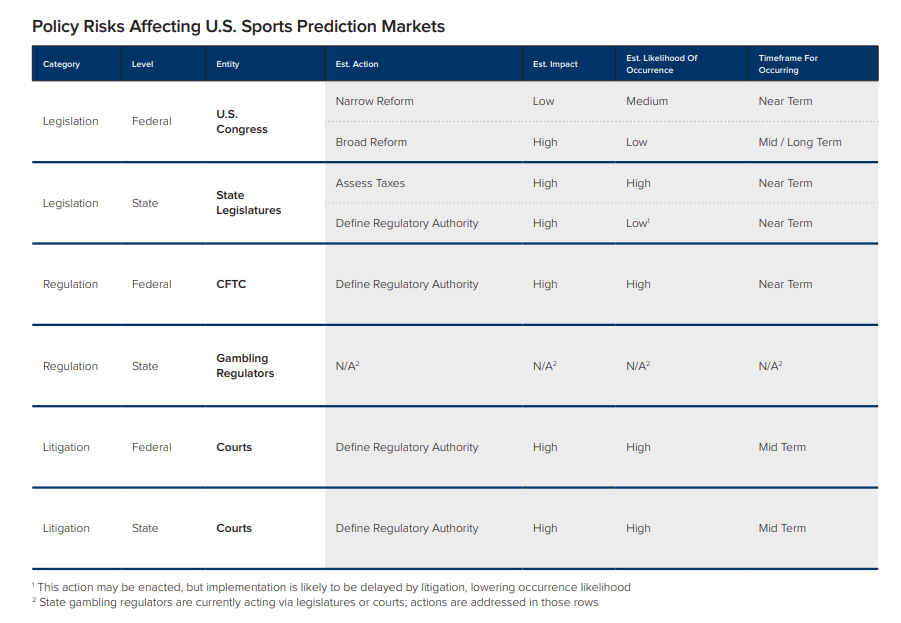
There are the obvious legal and regulatory headwinds to consider:
The court cases pitting Kalshi and other prediction markets against states (which appear destined to go to the Supreme Court).
Federal legislation, with 12 unique bills and counting — Although, this could be a bad news/good news outcome, as a federal law would likely restrict prediction markets in significant ways, but at the same time, codification into law gives prediction markets more cover from state lawsuits.
The non-permanence of CFTC leadership and agency rules.
But EKG brings up another potential roadblock: “State attempts to tax prediction market activity.” Using the recently passed bill in Kentucky as an example, EKG noted that, “Kentucky’s recently enacted H 757 assesses a 14.25% excise tax on PM operator transaction fees. If state taxes withstand (likely) legal challenges, they pose significant economic and compliance burdens.”
Put another way, even if prediction markets are victorious in the current cases, a whole new batch of litigation is likely on the horizon as states try to tax the activity. And, as STTP has noted many times, if prediction markets win, they are likely to hear a knock on the door from the federal government, which is always ready to ‘wet its beak.’
Around the Watercooler
Social media conversations, rumors, and gossip.
NO CONFERNCE FOR YOU! You come back 1 year!

This seems like an extreme overreaction:

Until you take a second to understand why:


Stray Thoughts
“The greatest remedy for anger is delay.” ~ Seneca