

Cause & Effect
The betting scandals involving Terry Rozier and Chauncey Billups are being used to argue both for and against the legalization of sports betting.
The Bulletin Board
THE LEDE: Betting Scandals polarize legal gambling advocates and opponents.
ROUNDUP: Canada ad restriction bill advances; PA skill games case update; Missouri sports betting licenses; NCAA betting rule change; Kalshi sues NY.
NEWS: Crypto.com will stop offering sports contracts in NV.
VIEWS: Mike Selig is the new nominee to head up the CFTC.
AROUND the WATERCOOLER: What the prediction market case actually comes down to.
STRAY THOUGHTS: Ignorance or willful ignorance?

Sponsor’s Message: Increase Operator Margins with EDGE Boost Today!
EDGE Boost is the first dedicated bank account for bettors.
Increase Cash Access: On/Offline with $250k/day debit limits
No Integration or Costs: Compatible today with all operators via VISA debit rails
Incremental Non-Gaming Revenue: Up to 1% operator rebate on transactions
Lower Costs: Increase debit throughput to reduce costs against ACH/Wallets
Eliminate Chargebacks and Disputes
Eliminate Debit Declines
Built-in Responsible Gaming tools
To learn more, contact Matthew Cullen, Chief Strategy Officer, Matthew@edgemarkets.io
The Lede: The Opposing Views on the NBA Betting Scandals
I’ll be posting my Friday Feature column later today (yes, I know it’s only Monday), as I have a lot to say about the dual betting investigations (one sports betting and poker) that are rocking the NBA and the gambling world.
One aspect I don’t cover in the forthcoming article was the two opposing forces that are jumping on the scandals:
Some opponents say that the proliferation of legal sports betting has led to an uptick in incidents, driven by greater awareness and more bettors in the ecosystem.
And there are the supporters who argue that match-fixing and insider information are not new, and increased transparency and cooperation among leagues, operators, regulators, and law enforcement in legal sports betting are helping identify bad actors.

This is true, but like legal marijuana, bringing the sight and the smell to every city block wasn’t part of the plan. For the most part, this used to happen below deck. It’s good that it’s getting some disinfecting sunlight, but there’s a proverb about this: “mizaru, kikazaru, iwazaru,” or “see not, hear not, speak not.”
While the meaning is straightforward enough — avoid seeing, hearing, or speaking evil and unwholesome thoughts — I’ve also heard it explained as an omerta-style warning: I didn’t see anything, I didn’t hear anything, and I’m not telling you anything, which is sort of the way sports leagues could deal with scandals previously.
Basically, legalization often uncovers the mess that was always there, just out of view.
Ultimately, the “see no evil” proverb cuts both ways.
In the past, leagues had plausible deniability and could point to the individuals as bad actors. But once they hitched their wagon to legal sports betting, that luxury is gone.
The bigger problem is, banning or restricting props might make a small dent as some people switch to more traditional wagers. Still, it won't solve the underlying problem: A lot of people want to place these bets, and someone (prediction markets, offshore betting, sweepstakes, DFS) will offer them, and the likelihood that the oversight of these markets will be better is unlikely.
STTP Thoughts: The smarter play is to eliminate easily manipulated markets and restrict bet sizes on player props. If these are “entertainment” bets, that shouldn’t be a problem.
As I wrote in May 2024:
“If the legal industry wants to ease the leagues’ minds, a simple solution is to limit wagers on potentially exploitable outcomes. The issue with Jontay Porter isn’t that props were available on him; it’s that the betting limit wasn’t $20. Someone was able to bet $80,000 (with a $1.1 million payout) on a Porter parlay.
Sure, they can bet offshore, but that’s their problem, and it seems the offshore industry has its own way of dealing with potential manipulation, which shouldn’t be surprising from a decades-old industry.
I usually don’t post statements from offshore sportsbooks, but this one is a perfect fit: “Unfortunately, we aren’t surprised about the Terry Rozier and Damon Jones arrests. With the increased interest in props betting and Same Game Parlays over the last handful of years, it’s opened the door for this type of behavior,” BetOnline Brand Manager Dave Mason told Gambling911. “We’ve been surprised about the high limits some newer books offer on these types of wagers. This is a big reason why we don’t offer super-high limits on player props as it can open the door for people with inside information betting on a particular side.”
So, if you ban player props (or more reasonably, put betting limits on them), are people really going to find greener pastures offshore?
Roundup: Canada Ad Restriction Bill; PA Skill Games Case; Missouri Licenses; NCAA Betting Rules; Kalshi Sues NY
Canadian Senate passes sports betting ad ban bill [Covers]: Bill S-211 was passed by the Canadian Senate last week: “S-211 passed third reading in the Senate on a voice vote, with no one speaking out against its approval. It’s also the second time the appointed Senate has passed this type of legislation, with the previous effort sitting in the House before former prime minister Justin Trudeau’s resignation killed it in January.” The bill will now move to the House of Commons, and if passed, the federal Minister of Canadian Heritage would be tasked with crafting a national framework for gambling advertisements.
Pennsylvania Supreme Court to hear skill games case [Play Pennsylvania]: “The Pennsylvania Supreme Court will begin oral arguments to determine the legality of skill games on November 20.” As STTP previously reported, “in a 7-0 ruling in December 2023, the Commonwealth Court affirmed a Dauphin County Court of Common Pleas ruling that skill games are not gambling.” At the same time, the legislature is considering a bill (SB 626) that would legalize and regulate the machines.
Missouri hands out temporary sports betting licenses [InGame]: The Missouri Gaming Commission awarded eight additional temporary retail/mobile sports betting licenses last week (DraftKings and Circa were awarded untethered licenses in August) as the state prepares for its December 1, 2025, launch. The licensees are: Bet365, BetMGM, Caesars, ESPN Bet, Fanatics, FanDuel, Kambi, and Underdog.
NCAA student-athletes and staff can bet on professional sports [Press Release]: After it was approved by Division III (The change was approved by the Division I Cabinet earlier this month and by the Division II Management Council this week), NCAA student-athletes and athletics department staff members will be able to bet on professional sports, effective November 1.
Kalshi sues NY after receiving a C&D [Event Horizon]: First spotted by Andrew Kim, Kalshi is suing the New York State Gaming Commission to stop enforcement of a cease-and-desist letter issued by New York on October 24. Per Dustin Gouker’s Event Horizon newsletter: “The case relies on themes of federal preemption of state law that we have seen in similar cases around the country. Kalshi argues that its sports event contracts are legal under federal law under the oversight of the Commodity Futures Trading Commission.”

SPONSOR’S MESSAGE - Underdog: the most innovative company in sports gaming.
At Underdog we use our own tech stack to create the industry’s most popular games, designing products specifically for the American sports fan.
Join us as we build the future of sports gaming.
Visit: https://underdogfantasy.com/careers
News: Crypto.com Agrees to Pull Sports Contracts in NV
In the wake of US District Court Judge Andrew Gordon denying Crypto.com’s motion for a preliminary injunction against Nevada, Judge Gordon previously ruled in Kalshi’s favor in a similar case earlier this year. Crypto.com has agreed to stop offering sports contracts in the state, as reported by the Nevada Independent’s Howard Stutz.
The Nevada Gaming Control Board issued a notice last week that reads in part:
“Crypto.com has indicated that it intends to appeal that decision. In the meantime, the Board has confirmed that after November 3, 2025, and until the resolution of its appeal, Crypto.com will not be offering sports event contracts to Nevada residents. That means Crypto.com will no longer hold open positions in sports event contracts for Nevada residents and will not permit new contracts to be opened.”
And as Attorney Andrew Kim noted: “I find it fascinating (and probably right) that no one wants to go to the court of appeals to seek emergency relief. Nevada is probably playing hardball now -- it’s on the verge of swinging the count from 2-2 (NV/Kalshi, NJ for PMs; NV/Crypto, MD) to 1-3.”
The decision is not only another legal loss for prediction markets (as Kim notes in his legal scorecard above), but it also challenges the argument Kalshi has made about the logistical ability to geofence states:


And as Sportico’s Dan Bernstein noted:

Attorney Andrew Kim and I discussed this case, and others, in a recent podcast:

News: Trump Nominates Mike Selig as New CFTC Chair

As STTP has been signaling, pro-crypto policy, not prediction markets, seems to be the pathway to the CFTC chair, which seemingly sank Trump’s first nominee, Brian Quintenz. Of course, pro-crypto is also likely pro-prediction market.
So what are Selig’s thoughts on prediction markets? We don’t have too many official statements, but Selig looks to be a supporter (it’s unclear if that extends to sports contracts), considering the following tweets:


SPONSOR’S MESSAGE - Kambi is the industry’s leading independent provider of premium sports betting technology and services. Trusted by dozens of operators worldwide, each benefitting from the power of Kambi’s global network, Kambi has a proven track record of giving partners the decisive competitive edge required to grow and outperform the market.
As the home of premium sports betting solutions, Kambi offers an expansive product portfolio that caters to the evolving needs of operators and players alike. At its core is Kambi’s flagship Turnkey Sportsbook, renowned for its scalability, flexibility, and unrivaled track record of delivering world-class betting experiences globally. Complementing this are Kambi’s cutting-edge standalone products: Odds Feed+, Managed Trading, Sportsbook Platform, Bet Builder, Esports, and Front End.
Around the Watercooler
Social media conversations, rumors, and gossip.
The following tweet from Paradigm’s CLO Katie Biber drew a skeptical response from Alex Johnson, from FinTech Takes:
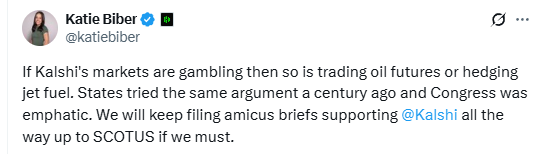

Johnson did a really good job of summarizing the core claims.
As I recently said in a private exchange, the surge in news on prediction markets is diverting attention away from the fact that prediction markets’ entire premise for offering sports contracts hinges on the claim that gaming somehow doesn’t mean gaming in Rule 40.11(a).
Stray Thoughts
“It’s a pretty even mix of doesn’t realize and doesn’t care out there.” ~ Alun Bowden