

Changes At The Top
Is Amy Howe's departure from FanDuel a sign that more changes are on the horizon?
Amy Howe’s tenure as CEO of FanDuel came to an abrupt end this week.
The news was surprising to some, but if you’ve been following the sector for as long as I have, the warning signs were certainly visible. There wasn’t any indication that Howe specifically would be on the chopping block, but the industry writ large has all the signs of wholesale change, and I’d be surprised if we don’t see more companies making changes at the top — with some people leaving and others getting axed.
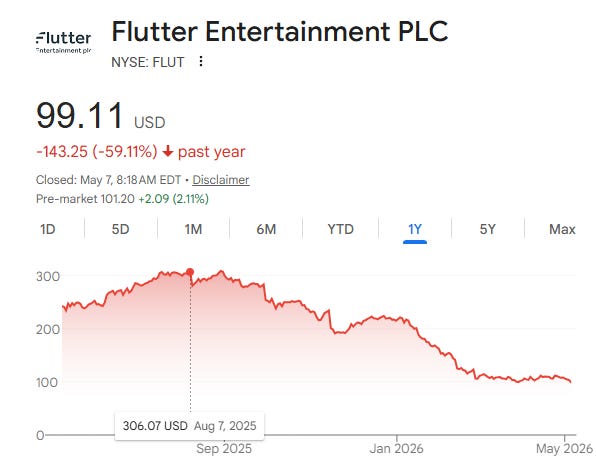
The clearest signal that a change is coming is the sector’s tumbling stock prices since the post-PASPA highs, with Flutter down 60% over the last 12 months.
Even with a recent bump following its earning call, DraftKings stock has also experienced a significant decline from it’s recent high last summer:
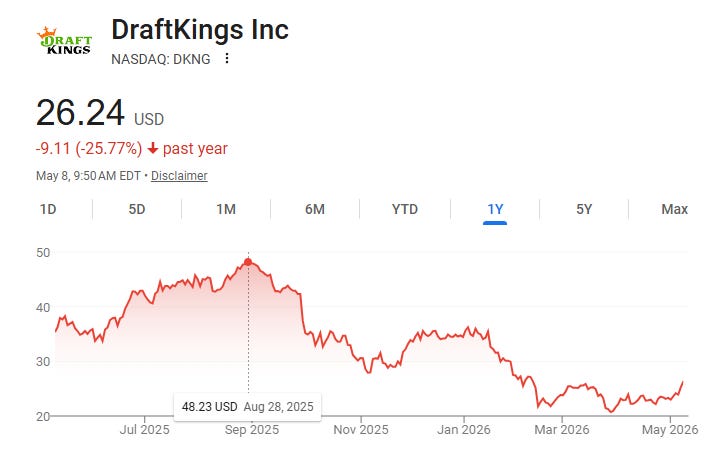
These drops are not limited to FanDuel and DraftKings, but if any companies seemed untouchable two years ago, those were the two. Yet, despite continuing to be the runaway leaders, their stock has taken a beating.
To understand what might be happening, it helps to look back at another gambling boom that followed an eerily similar script: the Poker Boom of the early 2000s.
A Confluence of Events
That explosion wasn’t the product of any single event; it was the proverbial perfect storm of events that occurred over a five-year span:
The advent of online poker (January 1, 1998)
Rounders was released in 1998 and became a cult classic within a few years
The creation of the hole-card camera (1995) and its coming out on party on Late Night Poker in 1999
The launch of the World Poker Tour (May 27, 2002, television debut on March 30, 2003)
James McManus best-selling book Positively Fifth Street (about his own improbable 2000 WSOP Main Event run) is released on April 16, 2003
That was the fuel, and the spark that lit the fire occurred in July 2003, when ESPN decided to radically expand its WSOP coverage, bringing the hole-card camera to a wider audience, and catching lightning in a bottle with the most improbably named champion: Chris Moneymaker, a David who slew multiple Goliaths on his way to the gold bracelet.
Now, think about the confluence of events that occurred within a similar five-year span in the sports betting universe:
Much like online poker sites, FanDuel and DraftKings are pre-seeding a sports betting boom with daily fantasy sports contests.
PASPA is overturned in May 2018
Technology advancements made single-game parlays a viable product (introduced in the US in September 2019)
COVID shutdown the land-based gambling industry in early-2020
In both eras, there were a lot of smart people taking some big, bold chances in the leadup and aftermath of the booms. That said, just like okay poker players discovered during the early stages of the Poker Boom, success was relatively easy. It wasn’t guaranteed, but all the pieces were perfectly in place for sports betting to take offf like a rocket ship.
Something I’ve asked before is: Was it the lobbyists who expanded DFS and sports betting, or could anyone have walked into those statehouses and produced similar outcomes?
“After several years of successfully advocating for the legalization of daily fantasy sports and sports betting, the gambling industry and its lobbyists are suddenly encountering legislative roadblocks as they make their case for online casinos… So, how did the industry go from the 2001-2018 New England Patriots to the 2019-2024 version of the team?
“One reason sports betting was pushed through following the PASPA ruling was the national chatter around the topic. Yes, all politics are local, but there is also the zeitgeist, and in May 2018, the climate was clearly in favor of legalized sports betting.
“This local-national disconnect has exposed deficiencies in the arguments proponents use. They expected to keep playing the Washington Generals and ran into the 95-96 Chicago Bulls.
“The failed 2022 California ballot initiative, as I noted in a previous newsletter, was a turning point, shattering the industry’s aura of invincibility. Since then, it has failed to pass an online casino or sports betting bill in a significant state (and has been shut out in the last two legislative sessions), nearly lost a ballot referendum in Missouri, and has faced tax hikes in multiple jurisdictions.”
And as I said two years ago:
“From 2018 to 2022, the sports betting industry was a runaway freight train blaring DJ Khaled’s All I Do Is Win from the locomotive.
“And then it entered California…
“There were signs that the industry’s warnings were less Cassandra and more Chicken Little… California wasn’t just a resounding loss; it was a turning point. It showed everyone the industry wasn’t an unstoppable force. The industry was Deebo, the biggest kid on the playground that nobody messed with out of fear. California shattered that fear, where the industry unwittingly picked a fight it couldn’t win.”
So why the disparate results between sports and casino, or sports in 2019 and 2026? It’s the same folks, making the same arguments?
Let’s Circle Back to Poker for a Moment
My time in poker taught me a lot of useful lessons. I was there before, during, and after the Poker Boom, and saw how much of a role being at the right place at the right time plays in success. I also saw how people would chalk up their successes to skill and their losses to external forces.
None of this is to call Howe, or any other gaming CEO, incompetent or a failure. Far from it. It is simply hard to imagine that FanDuel or DraftKings would be in a radically different position today if a different hand had been on the tiller.
We tend to anoint people as visionaries and geniuses, but there are periods when it barely matters who is in charge. The market is simply primed for success. Yes, the company still has to execute, but the tailwinds do most of the heavy lifting. The real skill is being competent (not exceptional) and being in the right place at the right time, or, getting lucky.
Consider the following questions:
What happens to DFS if New York doesn’t legalize it at the eleventh hour in 2016?
What happens if the SCOTUS doesn’t take up the PASPA case (remember, New Jersey lost every court decision in the runup)?
What happens to prediction markets if Kamala Harris wins in 2024?
The answers to those questions reveal how much of the last decade’s success was structural luck rather than individual brilliance. A lot of companies have rode those tailwinds, but now that the wind has shifted, people start looking at the results not the hype. And that’s when the visionaries and geniuses start looking more and more like ordinary executives.
Bottom line: More changes at the top are almost certainly coming.