

Consider The Source
Prediction markets claim to harness the wisdom of crowds, but is the crowd really wise if it's an echo-chamber?
The Bulletin Board
THE LEDE: The crowd isn’t always right, especially if everyone thinks the same.
NEWS: States continue to consider casino smoking bans, but results are thin.
NEWS: Kalshi scores another legal victory in New Jersey.
AROUND the WATERCOOLER: Random prediction market tweets.
STRAY THOUGHTS: Know what you don’t know.

Sponsor’s Message: Increase Operator Margins with EDGE Boost Today!
EDGE Boost is the first dedicated bank account for bettors.
Increase Cash Access: On/Offline with $250k/day debit limits
No Integration or Costs: Compatible today with all operators via VISA debit rails
Incremental Non-Gaming Revenue: Up to 1% operator rebate on transactions
Lower Costs: Increase debit throughput to reduce costs against ACH/Wallets
Eliminate Chargebacks and Disputes
Eliminate Debit Declines
Built-in Responsible Gaming tools
To learn more, contact Matthew Cullen, Chief Strategy Officer, Matthew@edgemarkets.io
The Lede: The Wisdom of Your Crowd
Prediction markets and their supporters claim to be better than polling — there is some evidence that they can be nominally better, but the belief is stronger than the evidence at this point. And that belief is that the wisdom of crowds, especially crowds willing to put their money where their mouth is, is superior to random surveys and polls.
However, there is a massive hole in that argument, as there are very few people using prediction markets, and as the operators themselves brag about, that cohort is not representative of society as a whole, as it skews heavily toward young men.
What prediction markets are currently providing us is a glimpse into the minds of gamblers; the people willing to gamble on things (anything) and the professionals, the segment of the population that is willing to prey on them and spend countless hours looking for market inefficiencies.
More simply, the prediction market crowd is small and like-minded, and unlikely to change.
These two polling questions from a recent Morning Consult poll commissioned by Gambling Is Not Investing (GINI) paint a pretty clear picture of what the market penetration ceiling is for prediction markets [highlight mine]:
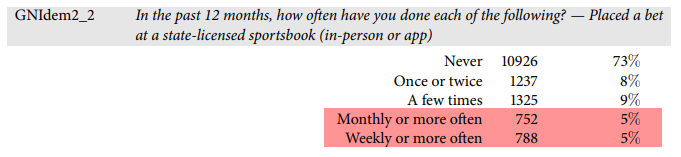
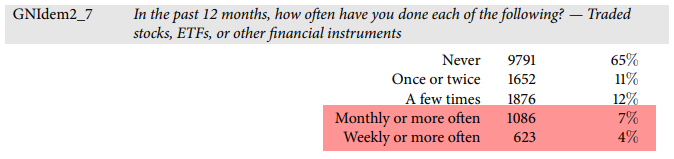
Essentially, about 10% of adults will regularly place sports bets or trade stocks — If I were conducting this poll I would have asked the highlighted respondents what their average trading amount and betting volume is, because my guess is a majority of those customers are dealing in small (relatively speaking) amounts, with only a small percentage of weekly/daily bettors/traders accounting for most of the volume.
Data from a January 2026 analysis of on-chain activity by Messari, a cryptocurrency market intelligence and research company, shows extreme concentration, with the top 0.23% of wallets on Polymarket accounting for 63% of all-time volume, while the bottom 59% of wallets accounts for just 1%.
And even within that already-narrow 10% of regular bettors/traders, prediction markets are far more niche than stocks and sports betting. The same poll found that only 17% of adults have used a prediction market, with only about 5% doing so on a monthly (3%) or weekly (2%) basis.
That isn’t the “wisdom of crowds.” It’s the wisdom of a self-selecting club: young men, early tech adopters, sports bettors, and professional and casual day traders chasing edges.
Prediction markets would fail the first two of James Surowiecki’s four conditions for collective intelligence laid out in The Wisdom of Crowds: diversity of opinion and independence of judgment (they do fine on decentralization and aggregation). Participants are overwhelmingly risk-tolerant young males, so there is little diversity. And traders see everyone else’s bets in real time, which creates herd behavior and kills independence.
Polls, for all their flaws, at least attempt random sampling from the full population. They have biases (I write about those often), but they aren’t structurally limited to people who treat every news event as a chance to make (or lose) a quick buck.
None of this means prediction markets are useless. They’re fantastic at price discovery among motivated, informed participants and can surface information that polls miss. They’re just not a replacement for polling when the question is “what does society actually think?” They’re a window into what risk-tolerant young men think.
The crowd isn’t wise when it’s just the same 10% shouting at each other with money on the line.
And this is a good spot for one of my favorite quotes: “If everyone is thinking alike, then somebody isn't thinking.” ~ Usually attributed to General George S. Patton.
News: States Still Looking at Casino Smoking Bans
Efforts to make casinos smoke-free is a topic that has fallen off my radar (thanks prediction markets) but there are several updates on this front, including New Jersey, which has been considering a smoking ban for several years.
Senate bill, S212, and companion bill in the Assembly, A2354, would fully eliminate the longstanding exemption for casinos and simulcasting facilities under the New Jersey Smoke-Free Air Act. A separate bill, S698, is a compromise with stricter controls in designated smoking areas. While not stating support or opposition, New Jersey Governor Mikie Sherrill recently urged the legislature to act on the bills, telling the Press of Atlantic City, “she will be having talks with legislative leaders on their timetable for considering long-pending legislation that would either ban smoking outright or allow it to continue with additional restrictions.”
Other active legislation dealing with smoking in casinos includes:
Iowa: HF 781, advanced out of a House subcommittee in early February 2026. A companion bill in the Senate stalled.
Pennsylvania: SB 263 passed a committee in 2025 and remains active. The bill would amend the Clean Indoor Air Act to remove casino exemptions and ban smoking, including e-cigarettes, in casinos and other venues.
Kansas: Two bills, SB 176 and HB 2252, did not meet the legislative crossover deadline and are effectively dead for the year.
Missouri: HB 1618, had some early momentum (it was read twice on the House floor in January) but with the Missouri legislature set to adjourn on May 15, the chances of Missouri going smoke-free are dwindling. A second bill, HB 1901, was also introduced.
More from the STTP Talking Shop Podcast on smoking bans in casinos:
News: Kalshi Scores a Win in Third Circuit
Kalshi scored a significant victory in the Third Circuit Court of Appeals on Monday (good writeup from Dustin Gouker here), with the three judge panel ruling 2-1 in Kalshi’s favor, upholding a lower court’s ruling:
“Kalshi has met its burden for preliminary injunctive relief. The parties contest whether the CFTC’s exclusive jurisdiction over DCMs as conferred by the Act preempts New Jersey gambling laws and the state constitution’s prohibition on collegiate sports betting… The Act preempts state laws that directly interfere with swaps traded on DCMs. Kalshi’s sports-related event contracts are swaps traded on a CFTC-licensed DCM, so the CFTC has exclusive jurisdiction.”
In her dissent, Judge Jane Richards Roth wrote:
“These offerings are virtually indistinguishable from the betting products available on online sportsbooks, such as DraftKings and FanDuel. While online sportsbooks are regulated by states such as New Jersey, Kalshi asserts that it is outside the bounds of state regulation because it does not offer gambling products. Instead, Kalshi contends its offered sports-event contracts are swaps, subject to the exclusive jurisdiction of the CFTC. The Majority agrees, holding that Kalshi’s registration as a DCM and branding of its wagers as sports-event contracts are acts of alchemy that transmute its products from sports gambling to futures trading. I see Kalshi’s actions as a performative sleight meant to obscure the reality that Kalshi’s products are sports gambling. Because Kalshi is facilitating gambling, it can be subjected to state regulation… I would also hold that conflict preemption does not apply because Kalshi is not precluded from complying with both New Jersey and federal law, and because New Jersey’s regulations do not undermine the congressional objectives behind the Act.”
As Daniel Wallach noted, the next step for New Jersey is to request an en banc hearing:

But as I said on X, this is not a destination, it’s just another stop on the way to the Supreme Court:

And while I understand that this is a very significant win for Kalshi (a circuit court), states are still doing pretty well, as they sported a 14-2 record before the Third Circuit ruling, and every circuit is different.
Around the Watercooler
Social media conversations, rumors, and gossip.
Some random prediction market tweets that caught my attention, including two on the Third Circuit ruling:


And one on the CFTC’s public comment page that is going to produce some gold:

Stray Thoughts
One of the strangest logical fallacies to me is epistemic trespassing — the belief that expertise or success in one area is transferable to others. It’s usually applied to someone opining about topics completely unrelated to their area of expertise: the business mogul discussing public health policies or the celebrity that throws out hot takes on politics.
But if you want to see this fallacy in all its glory, look no further than the all-time worst offenders, the poker community. That said, the sports betting crowd has been giving them a serious run for their money lately.