

The Bulletin Board
THE LEDE: Why is DraftKings’ stock price plummeting?
NEWS: The latest on 2026 online casino bills.
VIEWS: Are sports leagues cozying up to prediction markets?
AROUND the WATERCOOLER: New CA cardroom rules jeopardize jobs.
STRAY THOUGHTS: Advice from an 18th-Century poet.

Sponsor’s Message: Increase Operator Margins with EDGE Boost Today!
EDGE Boost is the first dedicated bank account for bettors.
Increase Cash Access: On/Offline with $250k/day debit limits
No Integration or Costs: Compatible today with all operators via VISA debit rails
Incremental Non-Gaming Revenue: Up to 1% operator rebate on transactions
Lower Costs: Increase debit throughput to reduce costs against ACH/Wallets
Eliminate Chargebacks and Disputes
Eliminate Debit Declines
Built-in Responsible Gaming tools
To learn more, contact Matthew Cullen, Chief Strategy Officer, Matthew@edgemarkets.io
The Lede: Why Investors Hated DraftKings’ Earnings Call
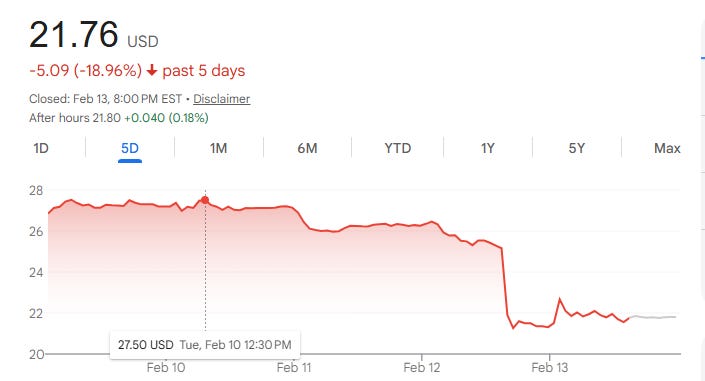
DraftKings stock fell off a cliff after its Q4 earnings and 2026 guidance dropped last week.
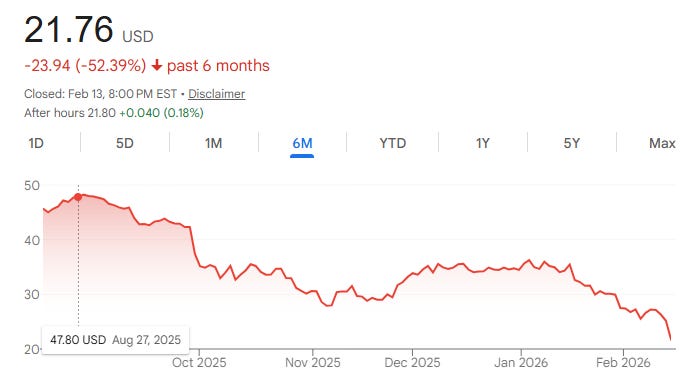
Even more worrisome: Over the last six months, the stock has shed more than 50% of its value:
But as Earnings+More points out, the numbers weren’t all that bad:
“There is a version of DraftKings’ Q4 earnings call that goes well. The company beat EBITDA consensus by 28%, revenue grew 43% YoY and free cash flow hit $516m. By normal reckoning, it was a strong quarter.”
So what the hell happened?
Some have pointed to the ultra-conservative 2026 guidance. Others to the growing threat of prediction markets, and still others to states increasing the financial burdens on operators.
Those are all valid reasons, and are certainly playing a role. Still, STTP believes that investors have reached the put up or shut up point with the US sports betting sector. The market seems to be screaming for proof that the pivot to predictions is a well-thought-out plan, and not a desperate attempt to latch on to the thing that led to initial investor concerns.
As the team at Citizens put it, DraftKings is now a “show-me story,” which may be hard as it goes all-in on prediction markets, requiring another spending spree.
“At some point, DKNG will need to shed costs in view of its slowing revenue outlook… If the CEO is seeing strong underlying fundamentals and prediction markets as a massive opportunity that is not in management’s guidance, FCF (free cash flow) and no debt will be a tool it can leverage to buy back shares… Investors seeing headlines from major prediction market operators places pressure on the stock while DKNG is also having to add costs into its model to get the platform off the ground.”
Further, following the fall of PASPA, DraftKings went from outsider to insider. It became another major player in the highly regulated gambling industry. But I’m not sure it ever fully shed its risk-taking roots.
Think of it this way: One of the wildest UFC finishes of all time was the Justin Gaethje vs. Max Holloway fight, when Holloway pointed to the center of the ring and the two simply threw hands for the final 10 or so seconds with Gaethje getting KOed at 4:59 of Round 5. Holloway was winning the fight, and didn’t need to take that risk. That’s high drama for a UFC fight, but that is not what investors want to see. Investors like stability, not excitement.
There is a sense of desperation in the air from the legacy sports betting industry, with perhaps more uncertainty than at any point since New York’s 11th-hour regulation of daily fantasy sports in 2016.
DraftKings’ exit from the American Gaming Association, full-throated embrace of prediction markets, and threats to bail on states over tax hikes are starting to look a lot more like Holloway’s decision to risk a win with a late-fight slugfest than a meticulously scripted game plan.
Further Reading:


And while we’re on stock prices, here’s an update for a story I reported on last week:

News: Getting Caught Up on 2026’s iCasino Bills
If you’re a supporter of legalizing online casinos, 2026 has been a dream start, with Maine Gov. Janet Mills allowing the online casino bill passed in 2025 to become law, and dare I say, serious efforts emerging in the following states:
Hawaii
SB 1507, sponsored by State Sen. Ron Kouchi (carried over to 2026)
HB 1434, sponsored by Nadine Nakamura (carried over to 2026)
Sports betting is getting most of the attention, but Hawaii also has a pair of bills that would legalize several forms of gambling, including online casinos.
Still, as STTP has said, the existence of a working group (created via legislation in 2025) likely takes expansion (sports betting, casinos, or online gambling) off the table until the group’s recommendations are submitted prior to the 2027 legislative session.
Illinois
HB 4797/SB 3723, sponsored by State Rep. Edgar González, Jr./State Sen. Ram Villivalam (2026)
HB 4802 (poker-only), sponsored by State Rep. Edgar González, Jr. (2026)
Another year means another attempt to legalize online casinos in Illinois, but with the same structural hurdles still in place, don’t expect 2026 to turn out any differently than previous efforts. Online casino legalization will require a change of heart from the VGT industry, which doesn’t seem to be in the cards, as Accel Entertainment leadership told Citizens in January, “there is no shot” of iGaming legalization in the state — the VGT industry is also focused on the recent regulation in Chicago, which was approved in last year’s city budget.
2026’s effort includes an online casino bill that would tether online licenses to land-based casino and racino licensees. There is also a secondary effort to legalize online poker, although the bill has no text, and simply reads, “Amends the Illinois Gambling Act. Adds a Section concerning online poker. Contains a Section heading only.”
Maryland
Maryland has two legalization efforts, and like Illinois, one of them is a poker-only bill. The state is considered one of the better candidates, but rifts within the state’s casino industry, along with concerns from labor unions, have derailed previous efforts, and there is no reason to suspect that will change in 2026.
Massachusetts
HB 4431, sponsored by David Muradian (reporting date extended to March 2026)
Rep. David Muradian, Jr.’s (a guest on Episode 69 of the Straight to the Point Talking Shop podcast) bill from 2025 hasn’t officially been carried over to 2026, but its reporting deadline has been extended to late-March.
The state held two committee hearings on the topic in 2025, but a vote was never taken. A June 23 legislative hearing (on HB 332 and SB 235) was short and sweet.
The Joint Committee on Economic Development and Emerging Technologies held two hearings on the topic last year, the first was a short, informational hearing, the second featured more testimony (for and against), but based on the Committee’s questions and statements, legalization still seems several years off.
Further, as STTP has noted, the upcoming launch of online lottery products, including instant win tickets, will work against online casinos. As Massachusetts Treasurer Deborah Goldberg said in December (the Massachusetts Treasurer oversees the Lottery): “I, right now, am firmly against iGaming. They may not like me for that, but I gotta think about the people of Massachusetts, and that’s my top priority.”
New York
S 2614, sponsored by State Sen. Joseph Addabbo Jr. (rereferred in 2026)
A 6027, sponsored by Assemblywoman Carrie Woerner (rereferred in 2026)
New York’s 2025 online casino bills have been reintroduced in 2026, but the roadblocks that have stalled previous efforts, concerns from the state’s labor unions and land-based cannibalization, have yet to be solved. Further, while the state has awarded the three downstate casino licenses, that means there are three new stakeholders to appease and thousands of new union jobs to consider.
Virginia
After leading the (short-lived) charge in 2025, Simon and Locke have introduced new bills for the 2026 session. Both bills are making progress, with Locke’s bill having moved through committees and sent to the Senate floor and Simon’s passing the Appropriations Committee on February 13, making it eligible to be heard on the House floor.
Locke’s bill was amended to include a reenactment clause that requires the bill to pass the full legislature again in the 2027 session before it can take effect—effectively delaying any potential legalization until at least 2027. Simon’s bill doesn’t contain a reenactment clause.
Here’s where things go a little sideways: On February 11, the Spanberger administration called on the legislature to create a singular gambling regulatory body before it tackles online casinos, skill games, and other expansions. Which likely pushes expansion talks off at least a year.
Secretary of Agriculture and Forestry Katie Frazier said, “Governor Spanberger is deeply concerned about any discussions of gaming expansion in Virginia without first establishing a single entity with clear authority, consistent standards and strong compliance and enforcement capabilities.”

SPONSOR’S MESSAGE: What do you do when you can’t trust your “trust signals”?
Every high-confidence trust decision comes down to three questions:
Who is this user? What device are they using? Where is this activity actually happening?
GeoComply’s digital identity platform captures 750+ high-integrity data points across device, precise location, and behaviour — processing them through AI/ML to deliver clear risk intelligence you can act on with confidence.
When signals are unified instead of siloed, you can stop fraud and fast-track good players — catching synthetic IDs, deepfakes, location spoofing, and device manipulation at the moments that matter most.
Discover what high-resolution trust looks like in action — so you can act with confidence in real time.
Views: Leagues Inching Closer to Prediction Markets
A rundown of where every professional sports league and the NCAA stand on prediction markets.
National Basketball Association (NBA)
Prediction markets were a topic of conversation during the NBA All-Star Technology Summit last week, with the league hosting a 40-minute invite-only panel (that is off-the-record) to discuss what is becoming one of the top issues for sports leagues.
The panel description and lineup, per The Closing Line:
Prediction Markets: The Impact on Sports and Beyond
The surge of interest in prediction markets has disrupted the sports betting landscape, offering new ways to engage with the games we love. While these platforms have the potential to enhance the fan experience, they also present new risks to the integrity of competition. Hear industry leaders talk about the opportunities, the pitfalls, and the yet-unknowns of this quickly evolving space and the impact it could have both within sports and beyond.
Polymarket CEO Shayne Coplan
Kalshi Co-founders Tarek Mansour and Luana Lopes Lara
FanDuel CEO Amy Howe
DraftKings co-founder Paul Liberman
MGM Resorts CEO Bill Hornbuckle
Sportradar CEO Carsten Koerl
It feels like some of the details from the discussion will leak out:

Major League Baseball (MLB)
In a letter from August, obtained by Front Office Sports, MLB and the MLBPA “instructed players against ‘participating in prediction markets to risk money on any outcome related to baseball games or events,’ framing involvement as a violation of its longstanding sports betting policies.”
However, that stance seems to be softening, as reported by Front Office Sports, MLB Commissioner Rob Manfred wants to educate teams on the differences between sports betting and prediction markets, and how partnerships can protect the integrity of games:
“We thought it was important for the owners to be updated on why prediction markets are different than sports betting, why we might want to consider being in business with prediction markets in an effort to protect our integrity, to get the kind of protections we need. The regulatory framework — very different. Obviously, state by state on the sports betting side, federal on the other.”
As ESPN noted, “Striking a deal with prediction markets, the commissioner said, would allow the league similar access to monitor a business so new that Manfred only learned of it in recent months.”
National Football League (NFL)
The NFL has made several comments on prediction markets, and prohibited prediction market commercials during the Super Bowl.
NFL Commissioner Roger Goodell said in early December:
“[The NFL] likes to be first in the market in a lot of things, but in a lot of things, we’re willing to say, ‘We’re going to let things play out. We’re going to decide, is this something we want to do?’”
And in written testimony submitted to the House Committee on Agriculture, for its “stakeholder perspectives” session in December 2025, Jeff Miller, the NFL’s executive vice president for communications, public affairs & policy, player health & safety wrote:
“As Commissioner Goodell recently discussed at a public forum, the league has no plans to participate in prediction markets due to several outstanding legal, regulatory, and commercial concerns on how these markets operate and the possible impact on the integrity of sporting events.
“We are particularly troubled that several sports-related futures contracts have been launched nationwide, including in jurisdictions where sports betting has not been legalized. These contracts fall outside the purview of state regulatory authorities and the safeguards they impose upon the industry, including information-sharing requirements, integrity monitoring, prohibitions on easily manipulated markets, official league data requirements, know-your-customer protocols, and problem gambling resources. For example, just this past weekend, one prediction market exchange was accepting bets on whether or not “concussion protocol,” “late hit,” or “roughing the passer” would be mentioned during the broadcast. Congress and the CFTC should prohibit these and other types of objectionable bets among the many consumer and integrity protective measures needed before sports-related events contracts are legalized.
“The amounts potentially wagered through unregulated gaming contracts markets could significantly exceed those in regulated sports betting markets, creating substantially greater risks to contest integrity… In each of these state-regulated markets, regulators and state legislators closely monitor betting activity and, with input from professional sports leagues, can determine which bets and wager levels are acceptable. Those guardrails do not exist in prediction markets.”
Prior to the Super Bowl, Miller told Front Office Sports, prediction markets are “innovative,” and that “there’s no question we’re going to be spending a lot of time talking about this in the coming months and maybe even years… We’re interested, of course... but we’re also going to be cautious.”
National Hockey League (NHL)
The NHL signed deals with Kalshi and with Polymarket, which Commissioner Gary Bettman later called “protective,” providing the league with some leverage. As Dustin Gouker noted, the league is either okay with player props on Kalshi, or (left unsaid) was ignored if the markets were asked to be taken down.
Additionally, two teams have inked partnerships with prediction markets:
The Chicago Blackhawks announced a direct partnership with Kalshi in December 2025, becoming the first professional sports franchise to partner individually with a prediction market platform.
The New York Rangers partnered with Polymarket in January 2026, naming it the official prediction market partner.
Ultimate Fighting Championship (UFC)
The UFC was the first sports organization to partner with a prediction market. In November 2025, the “UFC’s parent company announced a multiyear partnership with Polymarket on Thursday, increasing the prediction market’s presence in the American sports landscape as it prepares to launch in the US.”
Major League Soccer (MLS)
In January, MLS signed an agreement with Polymarket:
“Soccer United Marketing (SUM), the commercial arm of Major League Soccer (MLS), has announced a new multi-year partnership with Polymarket, the world’s largest prediction market, naming the company an official partner of MLS and an official partner of Leagues Cup in the United States.
“Under the agreement, Polymarket will serve as the official and exclusive prediction market partner of MLS, MLS All-Star Game, MLS Cup presented by Audi, and Leagues Cup.
“The partnership reflects MLS and SUM’s continued focus on innovation and positions MLS among the first global soccer leagues to integrate prediction market insights into the fan experience.”
National College Athletic Association (NCAA)
NCAA President Charlie Baker said in a December interview (which also has many comments about sports betting and prop bets).
“Prediction markets are not regulated at all. And so, ya know, California, which currently doesn’t permit sports betting, the prediction markets could have an absolute ball taking that space over.
“You see DraftKings and FanDuel dropping out of the American Gaming Association… I’d be willing to conclude that a big part of their reasoning is they’re going to get into the prediction market space. They can’t afford to let those folks dominate all that green space they can’t currently access.
“It just says this whole thing is going to get worse unless somebody does something about it. And solving it at the federal level is going to be really challenging because it’s still new and not fully formed. So, I mean, you’re basically talking about no rules, no oversight, no nothing. And that just feels catastrophic to me. Not just for us, but for everybody.”
Around the Watercooler
Social media conversations, rumors, and gossip.
California cardrooms and their host communities are sounding the alarm bells over the new cardroom regulations from California Attorney General Rob Bonta’s office.
As the Press-Telegram reported, cardrooms are preparing to shed as many as 13,000 jobs, as their operations return to their poker-only roots, with Keith Sharp, general counsel at The Gardens Casino, saying it is “bracing for layoffs approaching nearly half of his workforce of 1,300 people who work as dealers, customer service representatives, food workers, and others.”
Further complicating matters (and likely explaining why the state hadn’t pulled the plug on player-banked games previously) is the impact it will have on local budgets, with several cities heavily reliant on cardroom revenue.
“I’m at a loss for words,” said Victor Farfan, councilmember with Hawaiian Gardens. “This decision will be devastating. It shakes at the very foundation of our city. We will not be able to provide essential services for our community.”
Tribes of course, see it differently. James Siva, chairman of the California Nations Indian Gaming Association, said, “The regulations further clarify that games and practices employed by commercial cardrooms are indeed prohibited under California law. Running a business contrary to that law is an illicit business, period. We hope that the [state] Department of Justice will now enforce these regulations so California can ensure a well-regulated gaming industry that is safe for consumers.”
Stray Thoughts
“Fools rush in where angels fear to tread.” ~ Alexander Pope