Eyes On The Prize
A deep dive into an extraordinary week for PrizePicks, from Allwyn acquisition to CFTC approval as a Futures Commission Merchant (FCM).
The Bulletin Board
THE LEDE: What does the future have in store for PrizePicks?
ROUNDUP: Vixio releases NFL estimates; MI bill legalizes social gambling; IL surcharge numbers are in for July.
NEWS: A new CFTC candidate (with strong Kalshi ties) emerges.
VIEWS: NCPG loses 1-800-GAMBLER battle; fires off a scathing press release.
AROUND the WATERCOOLER: Going down to South Park.
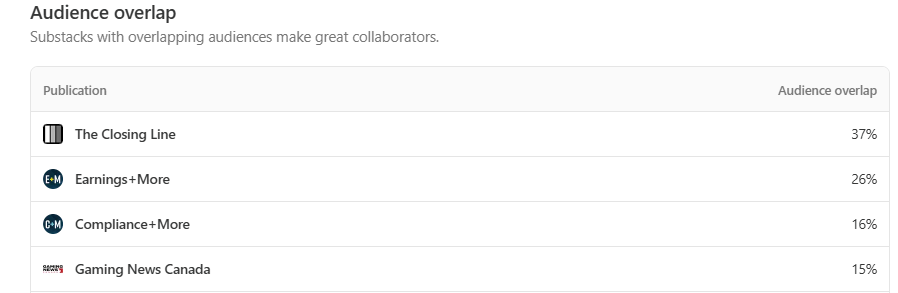
STRAY THOUGHTS: The Venn diagram of gambling Substacks.

Sponsor’s Message: Increase Operator Margins with EDGE Boost Today!
EDGE Boost is the first dedicated bank account for bettors.
Increase Cash Access: On/Offline with $250k/day debit limits
No Integration or Costs: Compatible today with all operators via VISA debit rails
Incremental Non-Gaming Revenue: Up to 1% operator rebate on transactions
Lower Costs: Increase debit throughput to reduce costs against ACH/Wallets
Eliminate Chargebacks and Disputes
Eliminate Debit Declines
Built-in Responsible Gaming tools
To learn more, contact Matthew Cullen, Chief Strategy Officer, Matthew@edgemarkets.io
The Lede: PrizePicks CFTC Approval; Here’s What It Means
I touched on this in yesterday’s newsletter coverage of the Allwyn-PrizePicks deal, but feel like this needs a little more oxygen, following a PrizePicks press release:
“PrizePicks announced today that Performance Predictions II, LLC, a subsidiary of its parent company, SidePrize LLC, has become the first company affiliated with a fantasy sports operator to be registered as a Futures Commission Merchant (FCM) by the National Futures Association (NFA). This designation allows PrizePicks to accept orders from its members to buy and sell futures contracts offered by Designated Contract Markets (DCMs) that are regulated by the Commodity Futures Trading Commission (CFTC).”
The news, in conjunction with the announced acquisition by Allwyn, solidifies PrizePicks as a major player in the evolving and extremely uncertain sports entertainment space in the US. With Allwyn’s backing providing stability and scale, but with a more compliance-first ethos.
Allwyn's global footprint also opens doors for international growth. PrizePicks could adapt its DFS for European markets, where Allwyn already operates lotteries, by introducing localized products such as soccer-focused picks or integrating with lottery apps.
Conversely, as Earnings+More notes, “By adding a substantial US business to its assets, it once again opens up the prospect of a US IPO.” E+M provides more details about a possible US IPO, which Allwyn has attempted in the past.
However, this entry is about PrizePicks' entry into prediction markets, which appears to be the most immediate and transformative opportunity. As an FCM, PrizePicks can now partner with Designated Contract Markets (DCM) like Kalshi or Crypto.com to offer users the ability to trade futures on sports outcomes, elections, or other events.
After being forced to shift to peer-to-peer and even free-play in some states, PrizePicks can return with prediction markets — assuming the status quo remains in place, which it should for the foreseeable future, as Kalshi battles several states in court.
Prediction markets could serve as a bridge product, capitalizing on PrizePicks’ existing user base without directly challenging state gambling laws, and position PrizePicks to cross-sell into sports betting if more states legalize it—using its database from non-legal states as a “strategic bridgehead,” as Citizens put it.
But there are also some risks.
While the FCM nod is a win for compliance, it doesn't eliminate scrutiny—especially as prediction markets blur lines with gambling. States could push back if they see it as skirting betting laws, which could lead to anyone in the space getting blacklisted down the road — recall Arizona, Nevada, and Ohio have warned operators about getting involved with sports prediction markets.
I would also reiterate that we haven’t seen what a competitive prediction market space would look like, or what it will do to the opportunity:
“Is there enough cake for everyone (just ask Milton in Office Space):
“Yes, the opportunity (for an individual operator) is massive if the space is controlled by a handful of players, but if everyone and their brother is offering these contracts, with the same structure, sports contracts will be just another offering within the larger financial market field.
“Think of it this way: If FanDuel, DraftKings, BetMGM, Caesars, bet365, and Underdog can all offer prediction markets on sports, then it’s just another product in a crowded marketplace that is also competing against traditional sportsbooks, DFS, sweepstakes, and everything else. The advantages of being a prediction market evaporate, and it becomes a battle of UX, marketing budgets, and brand recognition.”
Roundup: Vixio NFL Estimates; MI Bill Legalizes Social Gambling; IL Surcharge Numbers
Vixio estimates $35 billion in legal wagers for the NFL season [Press Release]: Vixio (a newsletter sponsor) forecasts that around $35 billion in legal sports bets will be placed on the 2025 season. According to Vixio, “Roughly 63.5% of which Vixio estimates will be attributed to singles bets and 36.5% to parlay bets (though parlays will drive the majority of gross revenue).” More information available in Vixio’s 2025 U.S. Sports Betting Market Outlook.
Michigan bill would authorize social gambling [SBC Americas]: Michigan State Sen. Veronica Klinefelt introduced SB 511 in early September. Per SBC Americas, the bill would “amend the Michigan Penal Code to authorize social wagering contests, like betting pools and sports squares. SB 511 allows for wagering transactions that are ‘incidental to a bona fide social relationship.’”
Illinois collects $5.2 million in surcharge fees [SBC Americas]: Illinois surcharge cost licensed sportsbooks an additional $5.2 million in July, on nearly 21 million wagers placed (SBC Americas has an operator-level breakdown of the payments): “Illinois’ online sportsbooks paid the state more than $5.2 million via the new per-wager tax charge in July, the first month it was in effect, according to the latest revenue report from the Illinois Gaming Board (IGB).”

SPONSOR’S MESSAGE: The NFL season is in full swing—and operators are launching offensive drives to bring new players onto their platforms. If app download is the first down, the next rush is KYC.
But this year, the game is more nuanced than ever before. Sophisticated fraudsters are looking to break through your D-line. Meanwhile, new customers want the breeziest journey to the end zone.
With IDComply, you can play offense and defense at the same time. By leveraging 800+ rich device, location, and user signals right from registration, you get a clearer picture of who is entering your platform. Roll out the red carpet and streamline sign-up (increasing your onboarding rate by 10% to 20%) or add in extra zone coverage with step-up verification, such as IDPV (preventing up to 40% of fraud right from the get-go).
Leading operators are leveraging IDComply to achieve 90% to 95% pass rates, while simultaneously stopping fraud. Get in touch to learn how you can add IDComply to your playbook this NFL season.
News: Who Will Head the CFTC?
The appointment of a new Commodity Futures Trading Commission chair would typically be worth a bullet point entry in a news roundup. However, that hasn’t been the case this time around, as sea changes in crypto and prediction market policies have transformed the usually mundane nomination process into Roman emperor-levels of palace intrigue.
First, there was the Brian Quintenz nomination, which was expected to go smoothly but went sideways quickly.
And now, in the race to replace Brian Quintenz as CFTC chair, we have this:

Readers may recognize Sterling’s name from two recent newsletter entries.
In July, Sterling, representing Kalshi, made waves at the NCLGS Conference:
As reported by Welman, Josh Sterling, a lawyer from Milbank and former Commodity Futures Trading Commission (CFTC) employee, who is representing Kalshi, doesn’t believe the CFTC should be concerned with RG:
“People are adults, and they’re allowed to spend their money however they want, and if they lose their shirt, that’s on them.”
“A nice capstone to NCLGS from MGC Chair Jordan Maynard: “I hear someone on a panel the other day say ‘if someone loses their shirt, who cares?’ We fucking care.” Room broke out into applause.”
And earlier this month, Sterling, representing Sleeper, “wrote a letter to the Office of the Inspector General calling out the Commodity Futures Trading Commission for ‘violating the law’ in dealing with Sleeper’s attempt to enter prediction markets,” Dustin Gouker reported in his Closing Line Substack newsletter. As Gouker notes, “Sleeper is attempting to register as a futures commission merchant, which would allow it to work with a designated contract market like Kalshi or Crypto.com to offer prediction markets, including sports betting.”
As another X user put it:

Views: 1-800-GAMBLER Fight Reaches Breaking Point
STTP has been monitoring a dispute between the Council on Compulsive Gambling of New Jersey (CCGNJ) and the National Council on Problem Gambling (NCPG), which stems from a 2022 contract allowing NCPG to use the helpline number nationwide for a $150,000 annual fee.
According to SBC Americas, the CCGNJ wasn’t pleased with the way the helpline was being operated, with CCGNJ Executive Director Luis Del Orbe telling SBC Americas, “Maintaining its integrity and avoiding the hotline being weaponized is crucial. “The CCGNJ shall not permit that this institution be used to punish or retaliate against anyone, much less the problem gambler.”
The fight spilled into the legal system, and this week, a New Jersey judge ruled against the NCPG and returned control of the 1-800-GAMBLER number to the CCGNJ.
In a press release, the NCPG said:
“The National Council on Problem Gambling (NCPG) is dismayed with today’s court ruling, which orders NCPG to cease management and use of 1-800-GAMBLER as the National Problem Gambling Helpline number after September 29, 2025. This decision will fundamentally hinder nationwide access to timely, confidential, and high-quality care for those in need of problem gambling support by taking critical services offline. Moreover, it will degrade public trust for the 121 million Americans who recognize 1-800-GAMBLER as the National Problem Gambling Helpline.”
“NCPG will aggressively pursue all appellate options concerning today’s decision and is in the process of filing an emergency motion asking the New Jersey Appellate Division to enter a stay to maintain the status quo for helpline operations while the appeal is considered. It cannot be overstated that the loss of access to problem gambling resources via 1-800-GAMBLER, even temporarily, could have life or death consequences for individuals in crisis.”
“NCPG is the only national organization qualified, equipped, and positioned to manage the National Problem Gambling Helpline. With the backing of long-term partners like the National Football League, and a dedication to mitigating gambling-related harm, NCPG is committed to sustaining this vital public health service and ensuring that the National Problem Gambling Helpline remains strong, trusted, and effective nationwide.”
The press release above may shine some light on why CCGNJ has concerns, as it makes some very bold claims about the helpline’s visibility, the NCPG’s unique capability of running it, and the potential life-or-death fallout, given that the NCPG only took over the helpline in 2022. I’ve seen similar rhetoric on social media, and while I understand the frustration, the over-the-top language only serves to strengthen CCGNJ’s case that the hotline number is being weaponized.
As much as I’m for a national helpline, when it comes to mitigating problem gambling, it’s a small piece of the puzzle that some seem overly invested in.
As an aside, I would like to see how NCPG arrived at 121 million people (half the adult population) recognize 1-800-GAMBLER as the National Problem Gambling Helpline. In its 2024 NGAGE 3.0 survey it found 36% of respondents “have heard of 1-800-GAMBLER” and 80% saying they understand its purpose (in a follow-up question). Even if we’re being extremely generous, and use the adult population (the survey only polled adults), that only gives us 96 million who’ve heard of it, and the 121 million number aligns with the entire US population, including minors, which weren’t part of the survey.

SPONSOR’S MESSAGE - Underdog: the most innovative company in sports gaming.
At Underdog we use our own tech stack to create the industry’s most popular games, designing products specifically for the American sports fan.
Join us as we build the future of sports gaming.
Visit: https://underdogfantasy.com/careers
Around the Watercooler
Social media conversations, rumors, and gossip.
The John Wang effect (™ Dustin Gouker).

Stray Thoughts
One of the more surprising statistics I've noticed from Substack is the overlap in my audience. It’s quite remarkable that Dustin Gouker (The Closing Line) and I share just over 1/3 of readers, and Earnings+More just a quarter.