

Last Ditch Effort
In a last ditch effort to stall the new regulations that limit player-banked games, set to go into effect on April 1, California cardrooms have filed lawsuits.
The Bulletin Board
THE LEDE: California cardrooms file lawsuits to stave off new regulations.
VIEWS: Prediction market playbook includes doublespeak and straw manning.
VIEWS: Center for Addiction Science, Policy, and Research grades each state’s gambling policies.
AROUND the WATERCOOLER: Dispatches from the Next.io Summit.
STRAY THOUGHTS: “I look like a banker in this.” ~ Rick “Wild Thing” Vaughan

Sponsor’s Message: Increase Operator Margins with EDGE Boost Today!
EDGE Boost is the first dedicated bank account for bettors.
Increase Cash Access: On/Offline with $250k/day debit limits
No Integration or Costs: Compatible today with all operators via VISA debit rails
Incremental Non-Gaming Revenue: Up to 1% operator rebate on transactions
Lower Costs: Increase debit throughput to reduce costs against ACH/Wallets
Eliminate Chargebacks and Disputes
Eliminate Debit Declines
Built-in Responsible Gaming tools
To learn more, contact Matthew Cullen, Chief Strategy Officer, Matthew@edgemarkets.io
The Lede: California Cardrooms Sue State Over New Rules
Two lawsuits have been filed in San Francisco Superior Court by the California Gaming Association (CGA), California Cardroom Alliance, and Communities for California Cardrooms, in an effort to prevent the recently approved rules limiting player-banked games from going into effect on April 1, with compliance plans required by May 31. The lawsuits are not yet available on the court’s website.
The new rules change:
Player-Dealer Position Restrictions: The regulations require the player-dealer position in cardroom games to be held by a person physically seated at the table. Third-Party Providers of Proposition Player Services (TPPPS) not in this role cannot settle wagers, disrupting the current model where TPPPS employees often act as proposition players to facilitate games.
Blackjack-Style Game Regulations: The new rules would only permit blackjack games without a “bust” feature or a 21-point target, differentiating them from traditional blackjack offered at tribal casinos or elsewhere. Basically, cardrooms would not be allowed to offer blackjack.
“Our industry repeatedly raised legal and economic concerns throughout the rulemaking process, but the attorney general refused to engage with the communities and working families who will be harmed,” CGA President Kyle Kirkland said in a press release. “We are asking the court to stop these unlawful regulations before they wipe out thousands of jobs and put many local economies into fiscal distress across California.”
A spokesperson for the attorney general’s office told FOX40 the department “is prepared to review the lawsuit once it is received and respond as appropriate in court.”
California cardrooms represent a major portion of the tax base in several communities, including the City of Commerce, home to the Commerce Casino, which is responsible for about 40% of all taxes generated.
With the new regulations set to take effect, the city is considering adding 1/4% sales tax question to the June 2026 ballot:
“Unfortunately, the Attorney-General for the State of California has ruled that significant operations at the Commerce Casino are no longer allowed. This determination could reduce Casino Revenues to the City by up to $18,000,000 of the $30,000,000 in total. Such a reduction would have a drastic reduction in City revenues and create significant risks to ongoing operations.
“On February 24, 2026, the Commerce City Council unanimously adopted a resolution declaring a Fiscal Emergency over the impacts of the Attorney-General’s decision. They also took action to adopt a resolution calling an election for June 2, 2026 to hold a vote to add a quarter cent sales tax in the City of Commerce. Voters will be presented with an option to vote on the sales tax (also known as a Transaction and Use Tax or TUT) on the June 2, 2026 ballot.”
Of course, California tribes will tell you the only reason cardrooms have been operating these games is due to regulatory capture, and that story is a doozy.
Views: Prediction Market Sleight of Hand
Speaking at the Next.io Summit in New York, the following comment on the peer-to-peer nature of prediction markets from Novig founder Jacob Fortinsky caught my attention:

Reason being, it’s one of many examples of prediction market supporters mashing words around to make them fit their narrative. Remember, when prediction markets talk about “peer-to-peer” betting, one of those peers is likely to be an institutional market maker, or what a sportsbook might call “a bookmaker.”
As I said on X when the same talking point was lobbed by the Coalition for Prediction Markets’ Sean Patrick Maloney, “This is such an oversimplification, considering the counterparty wins when you lose. It's a weird argument that you will feel better losing to an institutional market maker like Susquehanna or Kalshi Trading than Caesars or Wynn. It's not wrong per se, it just doesn't seem like a solid argument.”
Further, we are starting to see market makers acting an awful lot like a typical bookmaker:

Or consider Kalshi CEO Tarek Mansour’s recent comments about war contracts, reporting from InGame’s Daniel O’Boyle:
“Kalshi CEO Tarek Mansour says that it would be ‘illegal’ for a regulated prediction market to offer contracts on war. But the company’s official position is that contracts on war ‘would not by themselves be illegal.’”
Part of the prediction market/CFTC argument is, as O’Boyle notes [bold mine], that “the Special Rule says that the CFTC ‘may’ ban contracts related to terrorism, gaming, assassination, war, or illegal activities, if they are against the ‘public interest.’”
As O’Boyle highlighted:
“In a legal brief submitted to the U.S. District Court for the District of Maryland in April of last year, Kalshi outlined this position.
“While Section 40.11(a) generally prohibits contracts involving gaming, Section 40.11(c) gives the CFTC discretion to approve such contracts on a case-by-case basis,” it said.
Recall that Kalshi has already performed this rug pull when it was arguing for election contracts in court when it argued, “Elections are not games. They are not remotely analogous to casino games, lotteries, bingo, or even sporting events.”
And when questioned about where the line would be drawn around prohibited “gaming” contracts, Kalshi said: “Sporting events such as the Super Bowl, the Kentucky Derby, and the Masters Golf Tournament were precisely what Congress had in mind as ‘gaming’ contracts.”
[Narrator voice] A few months later it was offering contracts on the Super Bowl.
Basically, if you think Kalshi won’t offer all of the contracts seemingly prohibited by rule 40.11 down the road, I’ll happily be your market maker.
And then there is what I see as the perfect example of the strawman arguments PMs are making:
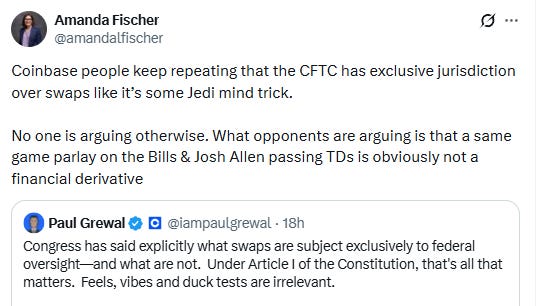
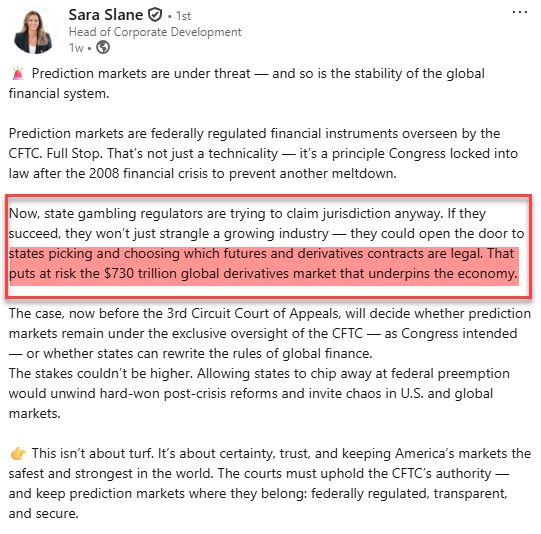
As I said on X, prediction market supporters keep arguing with no one, saying things like states are trying to supplant the CFTC, when the only thing states are fighting against are sports contracts which are barely a year old.
Yet we get strawman arguments like the below, from September 2025:

SPONSOR’S MESSAGE - Underdog: the most innovative company in sports gaming.
At Underdog we use our own tech stack to create the industry’s most popular games, designing products specifically for the American sports fan.
Join us as we build the future of sports gaming.
Visit: https://underdogfantasy.com/careers
Views: State-by-State Gambling Policy Report Cards
Last week, the Center for Addiction Science, Policy, and Research (CASPR) unveiled a 50-state report card, grading each state’s online gambling policies, tax rates, and consumer protections.
Only four grades were given, with states either receiving an A, a D, an F, or an F-, with online gambling being the determining factor for a positive or negative ranking — There were no D- grades, as Thomas Callahan III would say, “It’s not a grade they like to give out, I’ll tell you that right now.”
Based on CASPR’s model, a state receives an A at 90 points, which it can do by not legalizing any form of online gambling, any other policies are more or less moot:
Online sports betting not legal = 30 points
Online casino not legal = 40 points
Online sports betting and iCasino not legal = 25 points
Montana received the best grade (99/100):
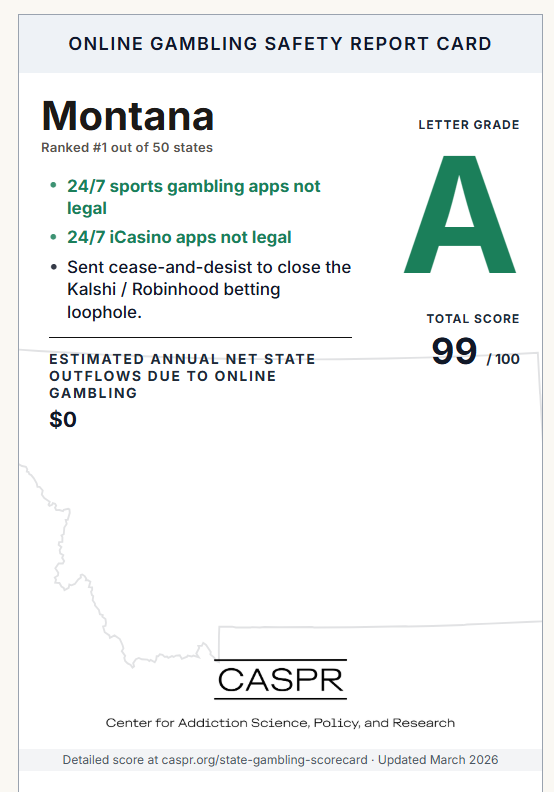
Montana got an extra 4 points for issuing a cease-and-desist letter to Kalshi: “State gambling regulator issued a cease-and-desist order to Kalshi. Joined the 36-state Attorney General coalition to close Kalshi loophole.”
Delaware received the worst (5/100):
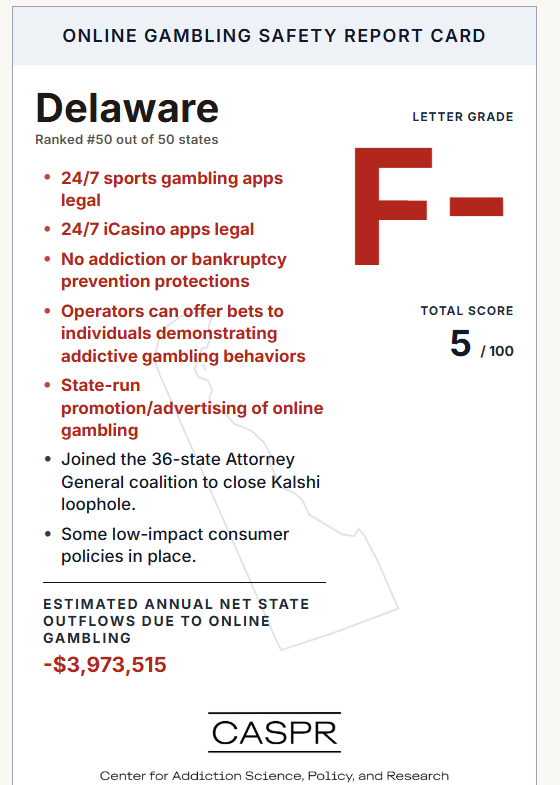
Delaware received 3 points for having a high tax rate and 2 points for having a 21+ age requirement.
So why am I reporting on this? Because CASPR carried out a very interesting piece of analysis, which very few people attempt: Economic outflow, which CASPR calculated as follows:
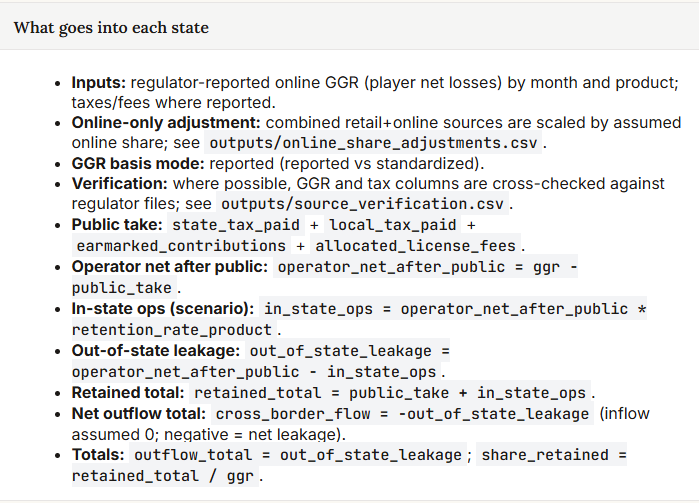
If you support legal, regulated online gambling and disagree with CASPR’s analysis, I highly suggest you produce your own economic impact analysis for each state.
And because this warrants another movie reference:
Around the Watercooler
Social media conversations, rumors, and gossip.
The fracturing of the industry continues, as legacy operators are showing zero signs of coming around to prediction markets, no matter how big they get in the short-term, until it is settled in court:

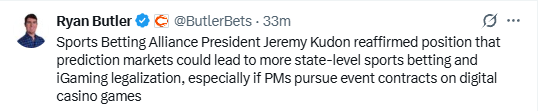
We have to address the elephant in the room, which is the people pushing for state-level legalization (DraftKings, FanDuel, and Fanatics are all SBA members offering prediction market products) of sports betting and online casinos to protect against prediction markets are also offering prediction markets. On some level that starts to feel more like a threat than a rationale.
I actually don’t disagree with this take and think Penn would have been better off long-term sticking with Barstool. Still, I understand how and why the switch to ESPN occurred, and that makes perfect sense.

This is just obvious, and has been for more than a decade, but it also deserves a caveat: these omnichannel customers are not the norm.

I love throwaway lines like these at conferences, as they could be an absolute nothingburger or a signal of behind-the-scenes discussions. Only time will tell:

Stray Thoughts
I posted about this on X yesterday, but it’s worth repeating here: The current dress code standards/norms at gaming conferences could use some attention. I’m not advocating for jacket and tie for all, but can we at least require speakers to wear a shirt with a collar and buttons?