

Move Over Hatfields And McCoys
There has always been a lot of tension between Kalshi and Polymarket, but the social media jabs have grown more intense and pointed of late.
The Bulletin Board
THE LEDE: The Kalshi-Polymarket rivalry is turning into a full-blown feud.
NEWS: MGM gets an $18B offer, days after Caesars acquisition announcement.
VIEWS: Can prediction markets help states pass online casino bills?
BEYOND the HEADLINE: Prediction markets are stalling tax rate hikes.
AROUND the WATERCOOLER: Create the problem and sell the solution.
STRAY THOUGHTS: Upcoming podcast schedule.
Sponsor’s Message: Promoting a sustainable, entertainment-first global gaming industry.
Play’n GO is celebrating its 20th anniversary in 2025. Drawing on that experience from the dawn of the iGaming industry through to today, Play’n GO designs and creates world-class slot games in the online casino space.
Play’n GO wants to see a sustainable industry that puts players first. To realize that vision, Play’n GO:
Creates games designed to be entertaining and fun first
Actively lobbies for increased regulation to keep players safe
Refuses to make games that feature mechanics that we believe to be predatory, such as those that allow players to pay hundreds of times their normal stake to buy into the bonus round directly (‘Bonus Buy’ games)
Now live in over 35 regulated territories around the world, including all US and Canadian iGaming jurisdictions, Play’n GO is the leading provider of entertainment to the online casino industry.
For more info, visit www.playngo.com
The Lede: Kalshi and Polymarket ‘Go to the Mattresses’
I’ve reported on the long-running beef between Kalshi and Polymarket in the past (here and more notably here), but things have really begun to escalate, with the two companies taking it far beyond the previous mud-slinging and behind-the-scenes machinations.
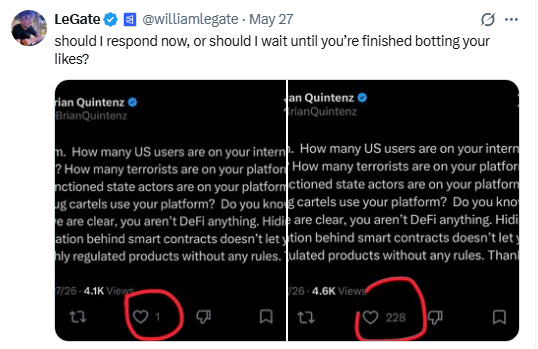
The most recent dust-up started after Polymarket pushed back on a report that it was bolstering its KYC checks:


With the occasional shit-posting mixed in for good measure:
Mike Dudas, a Managing Partner at 6MV, an investment firm focused on crypto and blockchain, called the status quo a one-way ticket to “mutually assured destruction.”

This is something Straight to the Point has been pointing out for quite some time. As I said in a newsletter published on May 12, titled, A House Divided, “Prediction markets are not only fighting battles against state regulators and tribal and commercial gaming, they are also fighting amongst themselves.”
Kalshi has consistently painted Polymarket as the offshore rulebreaker, while Polymarket has called Kalshi a copycat, and now the accusations are escalating, and I can only imagine what is being said behind closed doors, and what dirt is being shoveled on the desk of the powers that be at the CFTC.
As I said in the final thoughts of the May 12th newsletter:
“When the shots are coming from inside the house, one has to wonder what the future holds for prediction markets. We’ve seen this same self-defeating pattern play out repeatedly in sports-betting and online-casino legalization debates, where ‘allies’ push for broader legalization while lobbying for self-serving policies that inevitably fracture coalitions and ultimately derail broader legislation. I suspect the same will happen when the Commodity Futures Trading Commission (CFTC) starts laying out its prediction market rules.”
News: Diller Makes a Play for Remainder of MGM Resorts
Yesterday I detailed Tilman Fertitta’s proposed acquisition of Caesars Entertainment, and today it’s another casino giant that is the subject of acquisition talks: MGM Resorts.
According to reports ( and confirmed by MGM), Barry Diller’s People Inc, a ~26% shareholder in MGM Resorts, formally submitted an offer to acquire the remaining ~74% of the company at a 10% premium ($48.30), valuing MGM Resorts at $18 billion.
The deal is far from done by any stretch of the imagination, and other bidders could emerge, analysts at CBRE rattled off potentially interested parties including Accel Entertainment, Entain, Melco Resorts & Entertainment, and Penn Entertainment last week (per reporting from Earnings+More).
However, as the team at Citizens noted, Diller’s current ownership stake and “given its long history as a shareholder [investing in MGM since 2020]… the proposal carries greater credibility than a typical unsolicited approach.”
Earnings+More also reported that, “Analysts at Texas Capital, writing about the gaming sector post-the news about the Fertitta approach for Caesars last week, said that it was a ‘large showcase of public equity investors currently undervaluing traditional gaming.’” E+M went on to report that Texas Capital believes “that Caesars joins other M&A and take-privates in the casino sector that have occurred at well-below historical valuations over the past few years.”
The team at Citizens concurred, saying, “Even if the transaction ultimately does not close at the proposed price, the offer establishes a meaningful reference point for intrinsic value and should encourage investors to reassess MGM’s long-term earnings potential, asset quality, and strategic attractiveness.”
Views: Can Prediction Markets Help Online Casino Efforts?
The industry has been waiting to catch a wave that has never arrived ever since the first states legalized online casinos in 2013. Over that period of time, every new development, every change the industry undergoes, is supposed to speed the process along. Daily fantasy sports. The legalization of sports betting. The slow trickle of states to legalize: Connecticut, Rhode Island, and Maine. The pandemic. Sweepstakes. And now, prediction markets.
Eric Hession, president of Caesars Digital, told the Nevada Society of Certified Public Accountants that in addition to some new markets — Alberta and Maine, and also iGaming landing in Washington DC’s 2027 budget — prediction markets could be just the nudge states need to consider legalizing online casinos
“As states start to see their revenue move to untaxed prediction markets, there will be pressure to legalize and tax it or allow casinos if they already have legalized sports betting,” Hession said.
Hession isn’t the only person expressing optimism on this front. Rush Street Interactive CEO Richard Schwartz has said on numerous occasions that sweepstakes/prediction markets will nudge states toward iCasino legalization.
In December 2024 (on sweepstakes):
“I think that’s a great reason to jump-start even more efforts on iCasino. We know that when an iCasino is added to legal sports betting states, about three-quarters of the taxes come from iCasino versus sportsbooks. So it’s a very profitable way to raise taxes.”
And in August 2025, Schwartz said that if prediction markets gain hold and start eroding tax dollars from states, there is a “very real possibility” it will accelerate the legalization of iCasino: “I think it could work out well for us ultimately in the sense that our top priority is legalizing more additional iCasino states and opportunities for online casino legalization.”
Beyond the Headline: Tax Increases Have Stalled
As Eilers & Krejcik recently noted in its EKG Line newsletter, one area where prediction markets could be having an impact is stalling tax increase efforts.
Per EKG, “prediction markets are bringing one unlikely benefit for sports betting firms — helping to fight tax hikes.”
“States are a little bit more hesitant to make a change that might inhibit their ability to be competitive against the federal product,” said DraftKings CFO Alan Ellingson at a MoffettNathanson conference.
As Straight to the Point recently noted, the momentum for tax increases has slowed down considerably:
“2025 saw multiple states increase the financial burdens on sports betting operators, but thus far, it’s been a quiet 2026, despite efforts in Arizona, Kansas, Ohio, and West Virginia.”
There are still several active efforts, but 2026 will not be anything near what the industry dealt with in 2025 (you can subscribe to The Forecast Tier for my tax rate tracker):
Maryland (2025): Increased the tax on mobile sports betting from 15% to 20%.
Louisiana (2025): Bumped its tax rate from 15% to 21.5%.
Illinois (2025): Added a $.25 per wager fee on the first 20 million wagers and $.50 thereafter.
New Jersey (2025): Increased its online gambling tax rate from 15% on online casinos and 13% on mobile sports betting to 19.75% (plus 2.5% IAT for iCasino and 1.25% on sports betting).
Illinois (2025): The city of Chicago added a 10.25% tax on sports bets placed in the city.
Colorado (2025): Passed a bill that sunsets promo bet deductions.
Around the Watercooler
Social media conversations, rumors, and gossip.
In a recent tweet, industry veteran Vaughan Lewis perfectly summed up what I refer to as gatekeeping and people protecting their salaries rather than the general public:

Stray Thoughts
I have several interesting podcasts lined up over the next couple of weeks, two of which will discuss prediction markets from completely opposite sides of the spectrum… I was FINALLY able to get a pro-prediction market guest to come on the podcast!