

Numbers Do Lie?
There are no less than three different debates about prediction market data taking place: Parlays, volume coming from non-OSB states, and Kalshi's sports betting mix.
The Bulletin Board
THE LEDE: When it comes to prediction markets, we can’t even agree on numbers.
ROUNDUP: A look at the stories you may have missed.
VIEWS: Gambling firms are pouring money into political races. Is it making a difference?
AROUND the WATERCOOLER: Bloomberg is churning out prediction market banger after banger.
STRAY THOUGHTS: Words of wisdom on difficult decisions.
Sponsor’s Message: Promoting a sustainable, entertainment-first global gaming industry.
Play’n GO is celebrating its 20th anniversary in 2025. Drawing on that experience from the dawn of the iGaming industry through to today, Play’n GO designs and creates world-class slot games in the online casino space.
Play’n GO wants to see a sustainable industry that puts players first. To realize that vision, Play’n GO:
Creates games designed to be entertaining and fun first
Actively lobbies for increased regulation to keep players safe
Refuses to make games that feature mechanics that we believe to be predatory, such as those that allow players to pay hundreds of times their normal stake to buy into the bonus round directly (‘Bonus Buy’ games)
Now live in over 35 regulated territories around the world, including all US and Canadian iGaming jurisdictions, Play’n GO is the leading provider of entertainment to the online casino industry.
For more info, visit www.playngo.com
The Lede: Parlays, Non-OSB States, and Sports Betting Mix
There are several new debates about prediction markets happening, and like everything else in the space, it’s turned into a he-said, she-said kind of argument.
How are parlays impacting total volume?
I’ve written extensively about the difference between sports betting handle and prediction market trading volume in the past:
“For those that don’t know, here’s what trading volume on prediction markets represents: Every contract is counted as $1, so when someone buys 100 contracts of [insert team name] at $.33, someone else (the market makers) are taking the other side. If that person then sells [insert team name] for $.60 at halftime, the volume would increase by another $100, for a total of $200, even though the actual cash changing hands was just $33 on the buy (what the trader paid) and $60 on the sell (what the trader received). If this was a sportsbook it would look like the bettor wagered $33 and took an early cash out to pocket $60.
“Handle is cleaner, as every $1 represents a wager from a customer. Still, it’s far from clean. Reason being, bets get recycled, and with hundreds of millions in promo dollars floating around, it’s hard to know what is deposited and wagered dollars, and what is phantom money.”
And as I’ve been saying quite a bit lately, neither handle nor trading volume is great metrics: “The numbers that would tell us if the ecosystem is 1) sustainable and 2) thriving are net gaming revenue (NGR) and customer deposits.”
Which brings me around to parlays, and the funny coincidence that trading volume has exploded since parlays were added to prediction markets in late September 2025 (which also coincided with the NFL season, and prediction markets still being early in their lifecycle):
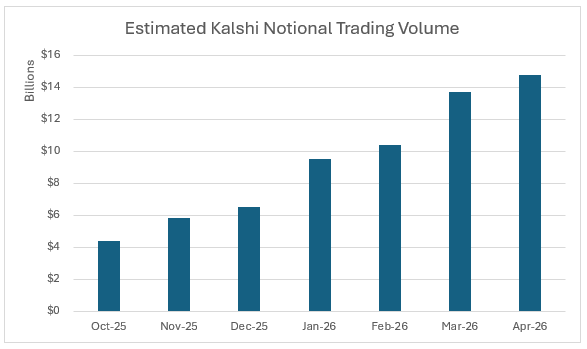
Per recent estimates, Kalshi’s “Combos” (AKA parlays) account for 20-25% of Kalshi’s trading volume, which means they are becoming increasingly popular. Or are they? As Jon Aguiar noted on X, as out of whack as handle-trading volume comparisons are, parlays are the ultimate stat-padding kind of offering:

Bottom line: It’s difficult to assess how popular parlays really are on Kalshi.
What percentage of Kalshi’s volume is from sports betting?
And speaking of parlays, it appears Kalshi is trying to place these outside of the sports category (into something called “exotics”), even though most of these are sports related:


What percentage of prediction markets are coming from states without legal sports betting options?
The final data debate is one Kalshi shouldn’t have touched with a 10-foot pole. But why let an opportunity to commit another unforced error go to waste?

It’s reminiscent of the scene in Full Metal Jacket where Private Joker (played by Matthew Modine) is asked if he believes in the Virgin Mary, to which he says, “no.” This leads to a tense standoff (complete with a backhand) with the drill instructor where he is given a chance to change his answer but doesn’t, saying “he believes any answer he gives will be wrong.” And that’s where Kalshi finds itself with this one: Are you cannibalizing sports betting or is it a different product that can live in harmony with licensed sportsbooks?
Because you have CFTC Chairman Michael Selig routinely saying prediction markets and sports betting are different and “two separate things,” and at the same time you have Kalshi somewhat gleefully refuting reports that the bulk of its sports markets are coming from non-OSB states, which sure makes it seem like it is cannibalizing sports betting revenue.
As the American Gaming Association’s David Forman tweeted in response:

The answer to this might be in what is being measured, with Kalshi including institutional market makers like Susquehanna et al., while Morgan Stanley (and Eilers & Krejcik Gaming) are looking at retail bettors.
Prediction Market Roundup
The newsletter has been overrun with prediction market news, yet somehow there are numerous important stories that I haven’t covered yet. Here they are in bite-sized form.
Kalshi is funding a new federal lobby group [Decrypt]: Safe to say we know where some of the billions the company has raised is going: “Kalshi has unveiled Americans for Fair Markets (AFM), a “well-capitalized” advocacy group designed to lobby Capitol Hill. AFM has tapped Taylor Budowich, a prominent former White House communications staffer and pro-Trump Super PAC leader. The group’s debut comes immediately after House Oversight Committee Chair James Comer (R-KY) launched insider trading investigations.” Also, Kudos to Kalshi for transparently announcing the group and its aims.
NHL signs MOU with the CFTC [Press Release]: The NHL is the second major sports league to enter into a memorandum of understanding (MOU) with the CFTC. Per a CFTC press release issued last week: “Under the terms of the MOU, the CFTC and NHL have solidified the intent to share information and coordinate to protect the integrity of both professional hockey and related event contracts offered on CFTC-regulated exchanges. The CFTC and NHL each designated representatives who will communicate regularly to discuss issues related to integrity, share information confidentially, and ensure open lines of communication. The NHL has also implemented layered protections to monitor these markets, working directly with its partners to ensure integrity.” STTP Note: The NHL is the second major sports league to enter into an MOU with the CFTC, joining MLB, which did the same in March.
Kalshi threatens legal action against anti-prediction market group [Dustin Gouker, X]: Kalshi has sent FairPredicts, a newly created anti-prediction market group, a cease-and-desist letter concerning “the publication, dissemination, and paid promotion of false, misleading, defamatory, and commercially disparaging statements appearing on the website Kalshilies.com [The site is still up at time of writing].” After listing its complaints and demands, the letter states that “Kalshi is presently evaluating all available legal remedies, including litigation seeking damages, expedited discovery into the operators, funders, advertisers, and promoters of the Website and related campaign, and emergency injunctive relief, including a temporary restraining order.”
Bloomberg looks into Polymarket’s dispute resolution system [Bloomberg]: “Nine anonymous cryptocurrency wallets have effectively gained control over who wins and loses on Polymarket’s most contested prediction market bets, giving a tiny group of unappointed people outsized power over billions of dollars of wagers.” Essentially, the article claims that what was designed to be a third-party dispute resolution system has morphed into a small bloc that votes together and always wins, which is creating manipulation fears in a supposedly decentralized system.
Investment firm: CLARITY Act unlikely to pass [The Block]: “The crypto market structure bill, or the Clarity Act, is becoming less likely to pass this year as the political environment around the legislation continues to worsen, according to investment bank TD Cowen. ‘The political environment is getting worse for the Clarity Act,’ Jaret Seiberg, managing director at TD Cowen’s Washington Research Group, said in a note on Tuesday. ‘It is why we remain pessimistic that Clarity will become law this year.’” STTP Thoughts: This meshes with what STTP has been saying about prediction markets becoming a political flashpoint.
Dune puts Kalshi datasets behind paywall after Sportico reporting [Sportico]: “Dune, a company that provides tools to track prediction market betting activity, removed two Kalshi datasets from public view on May 15—less than 48 hours after Sportico used them to analyze how much retail bettors were losing on parlays… Dune said it restored the once-free datasets last week—but only for its highest-paying customers.” The move behind a $40,000 paywall comes on the heels of Sportico’s Dan Bernstein’s reporting on retail bettors’ parlay losses, Dune told Sportico the plan to move the data behind the paywall was already in motion.
DraftKings launch of home-grown prediction market [InGame]: “DraftKings appears set to launch its in-house prediction market exchange, as the exchange has self-certified its first contracts, which could go live Wednesday, while also debuting new branding for its in-house exchange. Six new filings were submitted to the Commodity Futures Trading Commission (CFTC) Friday and published Tuesday. The filings were first reported by DeFi Rate.”
Gemini self-certifies parlays [InGame]: “Gemini is the latest prediction market to self-certify parlays, doing so with a filing similar to the one used by Kalshi when it launched the product. According to a Commodity Futures Trading Commission (CFTC) filing, Gemini — the crypto exchange founded by the Winklevoss twins, which expanded into prediction markets last year — self-certified a contract with the title “Will <outcomes> occur in <events>?” the exact same title used by Kalshi in September.”
Views: Gambling Firms Try to Influence Political Races
Several sports betting companies spent heavily in Alabama state races, and on paper, look to have achieved its goals, with 12 of its 17 candidates winning their races or heading to a runoff. That seems significant considering how close Alabama came to passing a gambling expansion bill in 2024.
But a deeper look into the races throws a little bit of cold water on the results.
As Bloomberg notes, a FanDuel, DraftKings, and Fanatics funded super PAC, the American Conservative Fund, lost its most expensive race: “Rusty Glover, a gambling opponent and former Alabama state legislator, defeated opponent Doug Harwell in Alabama’s Mobile-area Senate District 34. The American Conservative Fund spent more than $2.2 million seeking to boost Harwell.”
In addition to Glover’s win, of the seven Senate candidates backed by the PAC, six were incumbents and only five won, leaving the PAC down one seat. In the House, it broke even, as it supported seven incumbents (five won, two lost) and three challengers (two of whom won or advanced).
The Bloomberg article also notes that the companies (FanDuel, DraftKings, and Fanatics) have put $41 million into the super PAC to spend on state-level candidates across the country (including in Georgia). “The group so far has spent more in Alabama than any other state. Its next-largest financial commitment to date has been in North Carolina, where the American Conservative Fund spent over $3.5 million on Republican primary elections.”
I touched on this earlier this month, noting gambling company spending on political races in three states: Georgia, Alabama, and Pennsylvania. As I noted, “A coalition of nine [Alabama] organizations sent a letter to state officials asking for an investigation into gambling-linked campaign contributions flowing to Alabama candidates for Tuesday’s primary.” And over in Pennsylvania: “Gaming and gambling interests whose industries were eyed for new or higher taxes in 2025 have spent $8.1 million and counting in the lead-up to Pennsylvania’s May primary.”
And as industry veteran Jessica Welman, who now works at Doura-Schawohl Consulting, pointed out on X:

This is not new, nor is it limited to the gambling industry. It’s simply the political world we live in.
As I reported in July 2024: “Gambling dollars are flowing into the coffers of North Carolina political campaigns. In a report from the Carolina Public Press, “Gambling interests donated more than $3 million to top N.C. lawmakers and political committees over the past two years in an effort to legalize forms of gambling in the state.”
And as I reported in December 2024: “Miriam Adelson and Las Vegas Sands have ramped up their already sizable contributions to Texas lawmakers and PACs, ‘Spreading around $13.7 million in political donations in the first 10 months of 2024,’ per Dallas Morning News.
I’d caution that other people donate to these campaigns (sometimes on both sides of the same issue), and political contributions don’t always correspond to actual results. Lawmakers receive numerous contributions, and while it might make them more friendly, it doesn’t always mean the issue will shoot to the top of the priority list. North Carolina and Texas being prime examples. We’ll see if the spending in Alabama pays off.
Around the Watercooler
Social media conversations, rumors, and gossip.
Bloomberg has been crushing its prediction market coverage:
How Accurate Are Prediction Markets, Anyway? — An interesting look into where prediction markets outperform polls, where they don’t, and some of the reasons why.
White House Reviews CFTC Plan to Supervise Prediction Markets
The White House is reviewing a US Commodity Futures Trading Commission proposal that would lay out guidelines for event contracts.
The proposal is under review by the Office of Management and Budget and will be subject to public comment, but details are not yet available.
The plan is expected to build off feedback received after the agency issued a document asking the public to answer questions about regulating the space, including how to handle insider trading and event contracts.
Stray Thoughts
“In any moment of decision, the best thing you can do is the right thing. The next best thing is the wrong thing. And the worst thing you can do is nothing.” ~ Theodore Roosevelt
Or as The Fray put it, “Sometimes the hardest thing and the right thing are the same.”