

Post-Purchase Anxiety
Several states are considering bills that would radically overhaul their current sprots betting laws.
The Bulletin Board
THE LEDE: States (are trying to) overhaul their sports betting laws.
NEWS: Affiliates signal they are ready to take the prediction market plunge.
VIEWS: Federal action may not be imminent, but it feels like an eventuality.
BEYOND the HEADLINE: More unwanted attention from the political class.
STRAY THOUGHTS: From the archives: How we got to this point.

Sponsor’s Message: Increase Operator Margins with EDGE Boost Today!
EDGE Boost is the first dedicated bank account for bettors.
Increase Cash Access: On/Offline with $250k/day debit limits
No Integration or Costs: Compatible today with all operators via VISA debit rails
Incremental Non-Gaming Revenue: Up to 1% operator rebate on transactions
Lower Costs: Increase debit throughput to reduce costs against ACH/Wallets
Eliminate Chargebacks and Disputes
Eliminate Debit Declines
Built-in Responsible Gaming tools
To learn more, contact Matthew Cullen, Chief Strategy Officer, Matthew@edgemarkets.io
The Lede: States Want to Overhaul Sports Betting Laws
While prediction markets get the bulk of the attention, and legalization efforts soak up most of what is left, there is an emerging legislative trend that is flying under the radar, as states are reopening their existing gambling laws to make sweeping, significant changes.
Colorado (passed committee)
Colorado bill SB 26-131 would limit customers to 5 deposits in 24 hours, and prohibits operators from limiting bettors based on performance, push notifications, prop betting, credit card deposits, and sports betting ads from 8 a.m. to 10 p.m. or during a live broadcast of an athletic competition. The bill has advanced out of the Senate Finance Committee and is now in Appropriations.
Kentucky (passed House)
A bill, HB 904, that has passed the Kentucky House would alter the state’s gambling law in several significant ways:
Regulates fantasy contests and fixed-odds horse racing wagering, with a 15% tax
Raises age limits to 21
Requires sports betting operators to accept wagers up to $1,000 (with exceptions) and notify bettors within 24 hours if and why they are limited.
Prevents any racetrack (which holds sports betting licenses) from offering prediction markets or partnering with a company that operates, or is affiliated with, a prediction market platform.
Maryland (passed House)
In Maryland, HB 518 bans college player prop bets, prohibits credit card deposits, and requires mandatory or self-set deposit/time limits.
Massachusetts (passed committee)
Massachusetts State Sen. John Keenan’s S 302, has advanced out of the Economic Development committee and is now in Ways and Means. The bill would completely overhaul the state’s sports betting industry in several significant ways:
Raises the tax on sports wagering from 20% to 51%.
Prohibits in-play and proposition bets.
Bans advertising during televised events.
Prohibits daily wagers over $1,000 and monthly wagers over $10,000 without an affordability assessment (cannot exceed 15% of the person’s bank account balance).
Prohibits operators, employees, affiliates, etc., from receiving compensation based on a percentage of wagers or deposits.
Mandates annual submission of anonymized player data for research on addiction, harm minimization, and high-risk monitoring.
Subjects advertising of bonuses, parlays, odds boosts, reload bonuses, and risk-free wagers to consumer protection laws.
New York (in committee)
New York A7962 limits deposits to 5 per 24 hours and caps wagers to $5,000 per day. It also includes a credit card ban, advertising restrictions (time-based and during events), and promotional offer restrictions.
And these are in addition to single-focus bills addressing credit card deposits, limiting bettors, prop bets, tax hikes, and more. You can track all of these with a Straight to the Point Forecast Tier subscription.
News: Affiliates are Buying What PMs are Selling
One area of prediction markets where Straight to the Point has been waiting for the proverbial shoe to drop is the affiliate sector. Obviously, affiliates have a good thing going with their sportsbook and online casino partners, but the opportunities in the prediction market space might be worth upsetting a few of their current partners.
Pretty much every major affiliate talked about prediction markets on their recent earnings calls — and if you follow Gambling Twitter as closely as I do, you’ve likely noticed a more-friendly tone toward prediction markets coming out of the affiliate space.
Gambling.com Group
Gambling.com Group’s CEO Charles Gillespie said of prediction markets: “There was clear demand for a product that was here to stay, and that GDC would be a “net beneficiary” as prediction markets expand TAM: “With the rapid evolution of prediction markets, the potential customer base for our sports and odds data services is expanding quickly... [this provides] a great opportunity to expand our data and trading solutions business by servicing more exchanges, liquidity providers, financial institutions.”
GDC COO Kevin McCrystle was even more upbeat, saying, prediction markets have unleashed a “Cambrian explosion of entrepreneurial activity... We are supporting all manner of market participants with high-quality data.” Marketing revenue is still small but an “obvious opportunity to scale up.”
Catena Media
At Catena Media, prediction markets were lumped in with “other high-potential verticals,” and cited as an area Catena is “investing actively in.”
This is similar to the companies previous comments on sweepstakes. In August 2024, Catena Media CEO Manuel Stan said, “Sweepstakes are the fastest-growing vertical for us and we expect it to keep growing.” In 2025, Stan said sweepstakes, “positions us well... by allowing us to build brands, databases and operational capability ahead of potential [regulated] market launches.”
Better Collective
Better Collective seems the most ready, willing, and able to take the plunge, with co-founder and CEO Jesper Søgaard calling prediction markets a “natural extension” of the company’s core business during its recent earnings call. And like Gillespie, Søgaard said it would increase Better Collective’s TAM “and is becoming a clear tailwind despite it being early days.”
And then there was the press release issued by Better Collective on about a week ago, outlining its new prediction market strategy:
“Better Collective is launching dedicated prediction market editorial hubs across key brands such as Action Network and VegasInsider. The company will also significantly scale its production of articles, expert analysis and probability-driven insights covering prediction markets across sports, politics, culture and entertainment. In addition, Better Collective will introduce social-first video formats and educational content designed to help audiences understand and navigate prediction markets.”
“Prediction markets increase our total addressable market significantly in the U.S. and represent a natural extension of how people engage with information, probabilities and future events,” said Jesper Søgaard, Co-founder and Co-CEO of Better Collective.
The press release ends with Better Collective noting that it “has already established strategic partnerships with leading prediction market operators…”
Something Must Be Done
It’s no secret that gambling affiliate stocks have taken a beating in recent years:
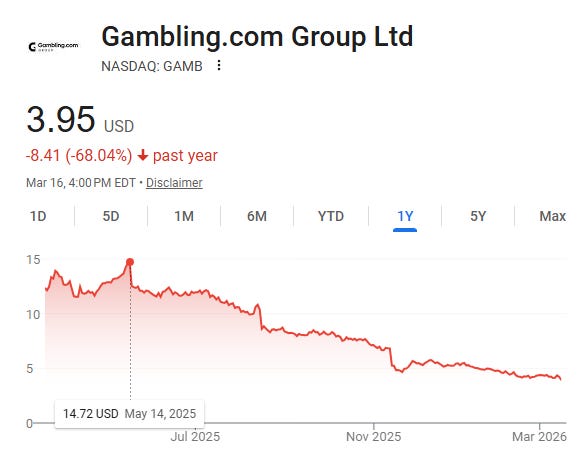
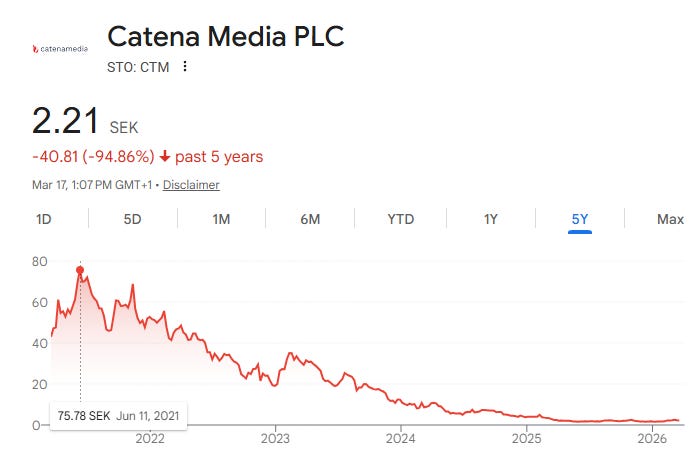
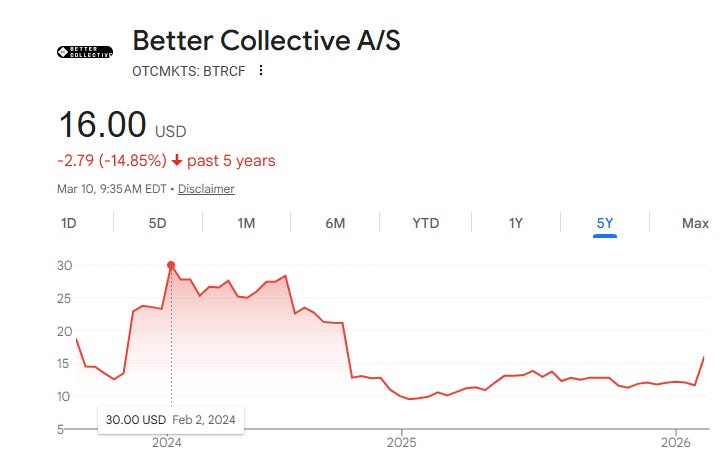
It appears they believe prediction markets are the lifeline they’ve been waiting for, as they await the legalization of sports betting in Texas and California, and online casino to make its long-awaited march across the US.
That said, setting aside the legal and regulatory headwinds, there are interconnected reasons to cast a skeptical eye on predictions market being the savior of plummeting affiliate stock prices.
Lower acquisition fee: At least to date, prediction platforms have largely bypassed affiliates or offer lower payouts than traditional sportsbooks and online casinos. As I said in January, “Prediction markets could offer growth at a time when legalization efforts have ground to a halt, but with low CPAs that initial 50-state burst won’t last very long.” And as Bear Cave Research said in its analysis on Better Collective from October 2025, “Third, prediction markets are increasingly an alternative to online sportsbooks and do not pay the lucrative affiliate fees of the incumbents.”
Cannibalization: Building on the first issue, logic says prediction markets will pull traffic away from traditional sportsbooks. For pure affiliates, the shift to lower-margin prediction market products is net negative.
Number 2 (or 3): And lastly, Kalshi and Polymarket have been signing massive media partnerships (CNN, CNBC, WSJ), and using influencers to a much higher degree than traditional gambling companies, which makes affiliates at best, a secondary source of acquisitions.

SPONSOR’S MESSAGE - Underdog: the most innovative company in sports gaming.
At Underdog we use our own tech stack to create the industry’s most popular games, designing products specifically for the American sports fan.
Join us as we build the future of sports gaming.
Visit: https://underdogfantasy.com/careers
Views: Will the Growing Federal Interest in PMs Lead to Action?
I’ve been sounding the federal alarm for many years, warning that we are inching closer and closer to some form of congressional action. Each time I’ve noted that 1) congressional action is never immediate, often taking several years and 2) it simply needs an issue to coalesce around.
Way back in September 2024, I wrote that “the SAFE Bet Act is a bigger threat to the licensed sports betting industry than many people want to believe.”
“Yes, Congress is a dysfunctional mess that can’t pass a budget and barely avoids shutting down the government every few months. That said, things do get done at the Capitol, and reining in overzealous online sports betting advertisements is precisely the type of measure Congress could find the votes to pass — or sneak into a larger bill at the 11th hour.
All it needs is a spark to turn the pet project of a few lawmakers into a public health crisis — and there are plenty of fire hazards lurking.”
That also holds true for prediction markets (and if Congress does do something, I wouldn’t be surprised if the two issues get lumped together):
As I wrote recently:
“Six months ago I would have told you that sports contracts have a 0.1% chance of being authorized by Congress, and a 0.1% chance of being restricted/prohibited. Now I would put those odds at 0.1% and 5% (given the number of Congressional letters and bills on prediction markets), and the reason is something I’ve written about in the past on a variety of different topics: Hubris.”
So why are we closer than ever? You can thank prediction markets.
The glut of sports betting marketing unlocked the door. The numerous sports integrity scandals gently pushed it open. And along came prediction markets, which kicked the door right off the hinges. If Congress needed a spark, consider the fuse lit.
We now have seven Congressional bills seeking to rein in prediction markets (not all dealing with sports contracts):
S___, the Banning Event Trading on Sensitive Operations and Federal Functions (BETS OFF) Act. Sponsored by Sen. Chris Murphy and Rep. Greg Casar.
S____, the Prediction Markets Security and Integrity Act of 2026. Sponsored by Sen. Richard Blumenthal.
HB 7477, the Fair Markets and Sports Integrity Act. Sponsored by Rep. Dina Titus.
HR 7004, the Public Integrity in Financial Prediction Markets Act of 2026. Sponsored by Rep. Ritchie Torres.
S 4017, the End Prediction Market Corruption Act. Sponsored by Sen. Jeff Merkley and Amy Klobuchar.
HR ___, the Event Contract Enforcement Act. Sponsored by Rep. Blake Moore and Salud Carbajal.
S ___, the Prediction Markets Are Gambling Act. Sponsored by Rep. Adam Schiff and Sen. John Curtis.
There was also an attempted amendment: On March 4, 2026, during the full committee markup on H.R. 7567, Rep. Gabe Vasquez offered an amendment to the Commodity Exchange Act, to reaffirm prediction markets cannot offer event contracts or swaps on sporting events or casino-style games.
The below tweet sums up the situation perfectly, and is something I’ve been saying for quite some time (in regards to the rhetoric coming from both prediction markets and the online gambling industry).
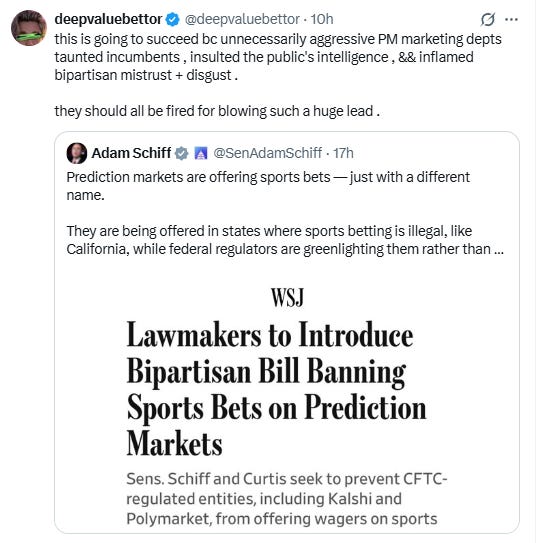
Here are a few of my past warnings about the current rhetoric:
From May 2024: “Even if you have a solid point, Ridicule is not the way to convince people you are correct.”
Also from May 2024: “Lawmakers are also really talented when it comes to playing dumb—I’ve witnessed this firsthand. Lawmakers know what they want to know and don’t always want you to know what they know. In many cases, they are well aware of the tax revenue being left on the table, aren’t blind to the existence of the black market, and grasp the cannibalization discourse. The hard-to-pin-down reasons and references to unresolved debates are, in many cases, a smokescreen.”
From February 2025: “In another scene [in the movie Tommy Boy], after giving his spiel, Richard is told by another potential customer that the problem is, “I don’t like you, and probably never will. You’re a smug, unhappy little man, and you treat people like they were idiots.” It’s not that Richard was wrong; it’s a message and messenger problem. The gambling industry’s messengers have the same issue—smug, technical, and off-putting.”
From March 2026: “And while the adage ‘you can’t please all the people all of the time,’ is certainly true, your goal shouldn’t be to piss off all of the people all of the time. Because that’s when you’ll get a reaction from people who can make your life a living hell.”
And now, here we are, with numerous entities asking Congress to step in on prediction markets, which is becoming more likely as prediction markets keep drawing unwanted attention to themselves.
Beyond the Headline/Watercooler: Unwanted Attention
A little combo entry today, as this Beyond the Headline would be the Around the Watercooler entry in any other newsletter, but fits perfectly with the above entry on federal action.
I’ve been noting for quite some time that prediction markets are increasingly becoming a hot political topic, and the list of people weighing in just continues to grow.
Starting with Florida Gov. Ron DeSantis:

And here are his comments from a CNBC Squawk Box interview:
“This is something (that) really within the last year has really become a big deal,” DeSantis said. “In Florida, we kind of have a unique relationship with the Seminole Tribe of Florida. There was things done long before I was Governor to give them exclusive rights over gaming. They also have the exclusive rights over sports betting. And so the question is: Is something like Kalshi, is that clashing with the laws of the state of Florida? Or is it separate? It’s more of a prediction (market). So we’re kind of trying to get our mind around that.”
And then there is this two-fer from David Axelrod and Rahm Emanuel:

And a double-dose from AOC:


Connecticut Sen. Chris Murphy:

Stray Thoughts
As I was searching for a past entry I stumbled upon this entry from June 2025, which bears repeating:
“Further, when you muddy the waters to the point that DFS isn’t betting (it’s a contest) and then start patting yourself on the back, you get the current situation full of skill games, HHR machines, sweepstakes, prediction markets, and membership poker rooms.
“Slap a new label on it, hire a legal team to argue that it’s something new and innovative, and voilà, you’ve got a new product that falls outside current laws. Sometimes it works; sometimes it doesn’t. But the waters keep getting murkier.
“Everyone is perfectly fine with that when it works in their favor. When someone deploys the same tactic and cuts into their business, it’s a travesty.”