

Kalshi has been taking steps to crack down on insider trading and identify non-permissible users, with the company recently announcing it caught (after the fact) three political candidates who placed bets on themselves, with one being incredibly egregious and crossing the threshold of insider trading, while the other two instances are more along the lines of violating Kalshi’s Terms & Conditions.
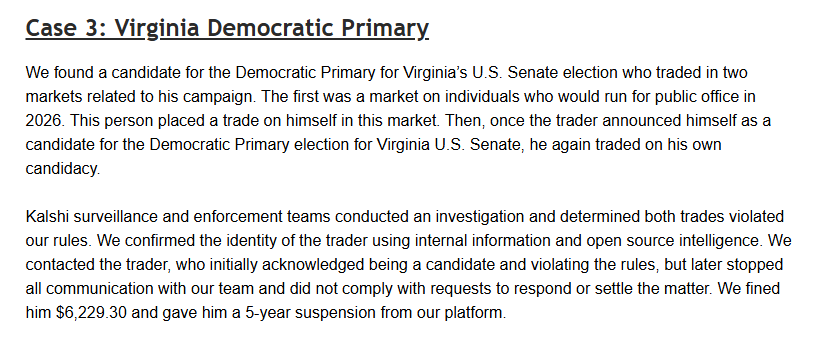
One of the other cases involved Mark Moran, an independent Senate candidate in Virginia, who claims he intentionally bet $100 on himself as a stunt to attack Kalshi and push a 25% vice tax.
First, credit where credit is due. Good on Kalshi for improving its internal oversight (and as I previously applauded, improving its responsible gambling policies).
Still, something isn’t sitting right with me when it comes to prediction market regulation; and it should alarm everyone.
First, this isn’t the only instance of potential insider trading/T&C violations, and we’ve barely heard a whisper from prediction markets on these contracts: the Pope, the Nobel Prize, a Google insider, Coinbase CEO mention markets, and Chris Hayes. Great, you caught a few blatant cases, but let’s not pretend the tip of the iceberg is the only point of danger.
More importantly, state gambling regulators hold the industry accountable, while the Commodity Futures Trading Commission lets the industry hold itself accountable. As Kalshi noted, “When a trader violates our exchange rules, they will be subject to exchange discipline. For more serious matters, we refer cases to the CFTC or DOJ for further investigation and prosecution, which didn’t happen here.”
Let’s look at how each would handle the same scenario.
An athlete betting on their own games through at a licensed sportsbook would trigger the operator to self-report the incident to state gaming regulators (or it might get caught when a third-party audit is performed), have to explain what happened, lay out a clear plan to prevent it happening in the future, and get hit with a fine or penalty that would increase with each incident or based on how negligent the operator was and how egregious the violation was.
A prediction market also self-reports incidents, but rather than getting hauled before the CFTC, it fines the customer and gets patted on the back for uncovering the error after the fact. The CFTC has enforcement capabilities and can pursue action against both the offender and the licensee if it so chooses.
It’s the difference between operators needing to be proactive and reactive, and that’s a massive difference.
As I noted when reporting on the CFTC’s recent guidance on prediction markets:
“The guidance affirms that the CFTC has sole authority over these contracts under the Commodity Exchange Act (CEA). However, the advisory emphasizes that prediction markets need to abide by existing CFTC rules including Core Principle 3, which prohibits listing contracts readily susceptible to manipulation.
“That said, the guidance, and subsequent comments by Chairman Selig, stress that exchanges serve as the ‘first line of defense’ against manipulation and insider trading. ‘I think it’s more of a free-market approach than the Biden administration but we’re certainly going to have our exchanges as the first line of defense as our statute requires,’ Selig told CNBC.”
It’s worrisome enough that prediction markets can self-certify contracts, but when you add self-regulation and prediction markets deciding the terms of resolution (a market on Ayatollah Khamenei being “out as Supreme Leader?” is a great example), things can go sideways real fast.
As I previously wrote on market resolution:
“On the market settlement front: We have several examples from the recent Super Bowl to point at, including Jason Kelce and Mark Wahlberg, but most notably, Cardi B’s, ‘did she or didn’t she perform during the halftime show’ (full story here).
“The market turned into a fiasco that highlights how even seemingly straightforward event contracts can devolve into chaos when market settlement rules aren’t clearly defined.
“Again, everything with prediction markets boils down to definitions— what counts as “performing”? Singing? Dancing? Mouthing lyrics? And you better be paying close attention to the resolution rules.”
Kalshi eventually resolved the market at $0.26 for Yes holders and $0.74 for No holders. Polymarket paid out “yes” bettors at $1 and “no” bettors at $0.
When you turn the operator into the regulator you get the proverbial fox guarding the henhouse, only the fox also built the henhouse.
Or, as Joe Brennan Jr. said about self-certification on the Prime Suspects podcast, “If I got to grade my own papers, I would’ve gone to Harvard.”