

Rocks And Hard Places
A group of Pennsylvania lawmakers have introduced legislation that would regulate prediction markets.
The Bulletin Board
THE LEDE: Pennsylvania bill seeks to regulate prediction markets.
ROUNDUP: A look at the stories you may have missed.
NEWS: Gambling.com rebrands to Grandstand.
AROUND the WATERCOOLER: Dodd-Frank namesake on prediction markets.
STRAY THOUGHTS: Martial arts and overcoming plateaus.

Sponsor’s Message: Play’n GO is launching into land-based casinos.
After more than 20 years at the forefront of iGaming, Play’n GO is bringing its world-famous games to land-based spaces, too.
Play’n GO’s unrivalled portfolio of some of the world’s most played online casino games is now available for physical casinos, giving operators the opportunity to harness the power and growth of online casino to bring a new demographic of players into their brick and mortar spaces for the very first time.
With cabinets already placed with one of the biggest casino chains in the world, Play’n GO’s CEO Johan Tornqvist said “We are bringing the best of online casino content and features to casino floors worldwide.”
For more info, visit www.playngo.com
The Lede: PA Bill Would Regulate Prediction Markets
There is a new trend emerging.
As previously reported, a bill signed into law in North Carolina (SB 257), explicitly allows CFTC-registered prediction market operators to operate lawfully in the state without any additional state licensing, registration, or regulatory requirements, provided they comply with the federal Commodity Exchange Act. It also imposes a 6% tax on prediction markets “net trading fee.”
That said, if prediction markets abide by these laws they would undercut their legal argument that the Commodity Futures Trading Commission (CFTC) is the sole regulator of prediction markets.
Pennsylvania lawmakers are considering following suit. HB 2711 amends Title 4 (Amusements) of the Pennsylvania Consolidated Statutes to create a regulatory framework for prediction market platforms. The bill does not tax prediction markets or ban sports event contracts. It focuses on consumer protections, integrity measures against insider trading/manipulation, and restrictions on sensitive markets, including:
Bars providers from allowing anyone under 21 to open an account.
Requires providers to exclude self-excluded individuals, as well as anyone with material nonpublic information, and other categories as determined necessary.
Prohibits providers from offering markets that include liquidity providers or market makers who knowingly engage in gaming activities.
Bars positions on sporting events involving minors or high school teams, an individual’s health status, or “death markets.”
Requires providers to implement commercially reasonable and technically feasible measures to detect and prevent fraud, market manipulation, or use of material nonpublic information, and to report detected issues to the Attorney General and (if appropriate) law enforcement.
Holds providers liable for knowingly violating the chapter or failing to implement required safeguards. Imposes penalties up to $10,000 per violation (or $50,000 for persistent conduct). Higher amounts apply for certain violations.
Grants the Attorney General authority to promulgate rules to administer and enforce the chapter.
All that said, prediction markets are stuck between a rock and a hard place. If they abide by these laws, no matter how friendly they are, they would undercut their legal argument that the Commodity Futures Trading Commission (CFTC) is the sole regulator of prediction markets.
Roundup: So Much News; So Little Newsletter Space
Two new operators launch in Alberta [Covers]: There are two new online gambling operators in Alberta, following the launches of PartyCasino and Sports Interaction. “According to the Alberta iGaming Corp., the “conduct and manage” entity for the province, PartyCasino and Sports Interaction are now among the “approved” operators for the regulated iGaming market.” As STTP previously reported, 22 sites were part of the province’s launch on July 13, 2026.
Resorts World New York keeps getting bigger and bigger [New York Post]: “New renderings show a planned $5 billion expansion of the Big Apple’s first full-fledged casino that will transform it into the largest integrated gaming resort in the country… complete with a second 400-room hotel tower and a 7,000-person concert arena. This groundbreaking comes a day after Resorts World unveiled its first-floor expansion, putting an additional 1,400 slot machines online and open to the public.”
NCLGS issues resolution opposing prediction markets [Press Release]: The National Council of Legislators from Gaming States (NCLGS) has issued a formal statement opposing prediction markets. “The resolution, unanimously approved by the NCLGS Executive Committee at its July meeting in San Diego, notes that prediction markets ‘have rapidly expanded in the United States, allowing participants to wager on the outcomes of political elections, economic indicators, sporting events, and other real-world occurrences’ and that ‘these platforms choose largely to operate outside the established regulatory frameworks governing licensed sports betting, casino gaming, and other forms of legalized gambling.’” The Sports Betting Alliance is taking a “no position” position on prediction markets.
Fanatics buys registered DCM and DCO [InGame]: “Fanatics… announced Monday it entered into an agreement to buy Water Street Labs and CX Clearinghouse from BGC Group Inc. Water Street Labs is a designated contract market (DCM), and CX Clearinghouse is a derivatives clearing organization (DCO) — and both are registered with the Commodity Futures Trading Commission (CFTC). With this purchase, Fanatics will now be offering its own federally regulated prediction market.”
NFL letter says proposed CFTC rules fall significantly short [Dustin Gouker, The Closing Line]:

News: Gambling.com Group Rebrands to Grandstand
A story that slipped through the cracks last week was Gambling.com Group’s rebrand to Grandstand: “Today, Gambling.com Group becomes Grandstand, the intelligence layer of sports, gaming and entertainment. Our vision: to power informed decisions for consumers and partners across the industry. Grandstand captures our twenty-year evolution, including building the brands, data and technology products that make consumers sharper and partners stronger. Since our 2021 IPO, we’ve materially diversified beyond performance marketing.”
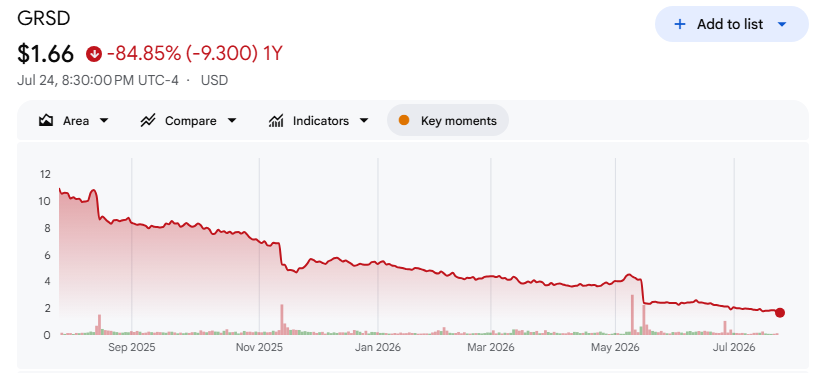
The company changed its listing on Nasdaq from GAMB to GRSD on July 23.
The announcement went on to list the various properties and assets under the Grandstand banner, including affiliate marketing sites Gambling.com, Casinos.com, WhichBingo, Sports Data providers OpticOdds and RotoWire and Spotlight.Vegas, which offers ticketing and experiences for Las Vegas venues, casinos and hotels.
As Grandstand CEO Kevin McCrystle said on LinkedIn:
“We are very excited to announce our new corporate name - Grandstand. Tomorrow we will switch trading from $GAMB to $GRSD. The new name reflects who we are today after an already significant evolution of our business. Grandstand better describes our position as the intelligence layer powering informed decisions for consumers and partners across sports, gaming and entertainment. There have never been more interesting opportunities in front of us, and we are excited for what’s ahead.”
Gambling.com, like many gambling affiliate companies, has seen its stock plummet over the last 12 months. In July/August 2025, the stock was trading near $11. It has dipped under $2.
Around the Watercooler
Social media conversations, rumors, and gossip.
This point of view should carry some weight, considering the name of the bill:


But as former CFTC General Counsel Rob Schwartz noted:


And my borrowed words of wisdom:

More from Dustin Gouker on Dodd’s comment to the CFTC here:

Stray Thoughts
Another excellent post from The Lost Creonte (podcast Episode #87) this time exploring the skill plateau many Brazilian Jiu Jitsu practitioners experience after receiving their blue belt:
“When you’re awarded your blue belt, you pass a ‘learning threshold’. I first heard about this concept in an essay called ‘Superlinear Returns’ by Paul Graham - a computer scientist, venture capitalist, and one of my favourite essayists.
“In the essay, Graham talks about how progress works in non-linear domains. He talks about how learning thresholds explain why, when you learn certain skills, you go through periods of plateau - where it feels like nothing changes - to periods where it feels like you’re making huge leaps with every practice.”
You can read the whole post here:

This reminds me of something else I’ve heard (I don’t remember who said it) about BJJ, which is, ‘everything you learn up to blue belt is to beat an untrained person on the street. And everything you learn after that is to beat another BJJ practitioner.
It’s also very apt to anyone who partakes in skill-based games like poker.
As I was finishing the post, I was just thinking this "it’s also very apt to anyone who partakes in skill-based games like poker" before I then read the sentence you wrote.
Going to think about this a bit more, I think a two-level learning model for poker could be interesting to explore and write about....
Keep up the great coverage!
Joe