

Stop The Madness
The developments in the prediction market space are coming at a furious pace, with 10 congressional bills and Kalshi involved in more than a dozen lawsuits with states.
The Bulletin Board
THE LEDE: Congress is paying a lot of attention to prediction markets.
ROUNDUP: A look at the stories you may have missed.
QUICK HITTER: Kalshi bests FanDuel and DraftKings in NCAA pricing.
BLASK DATA SPOTLIGHT: The Massachusetts Story.
AROUND the WATERCOOLER: A few PM tweets from last week.
STRAY THOUGHTS: People are starting to wake up to youth sports.

Sponsor’s Message: Increase Operator Margins with EDGE Boost Today!
EDGE Boost is the first dedicated bank account for bettors.
Increase Cash Access: On/Offline with $250k/day debit limits
No Integration or Costs: Compatible today with all operators via VISA debit rails
Incremental Non-Gaming Revenue: Up to 1% operator rebate on transactions
Lower Costs: Increase debit throughput to reduce costs against ACH/Wallets
Eliminate Chargebacks and Disputes
Eliminate Debit Declines
Built-in Responsible Gaming tools
To learn more, contact Matthew Cullen, Chief Strategy Officer, Matthew@edgemarkets.io
The Lede:
There are now 10 active bills in Congress trying to rein in prediction markets (13 if you include companion legislation).
Four of the bills explicitly prohibit sports contracts, as did a failed amendment to the Farm, Food, and National Security Act of 2026:
H___/S___, (STOP Corrupt Bets Act)
Sponsored by Rep. Jamie Raskin and Sen. Jeff Merkley, March 26, 2026
The STOP Corrupt Bets Act prohibits prediction markets from offering event contracts on U.S. elections, sports outcomes, wars, military actions, or government decisions in order to prevent insider corruption and restore the original non-gambling purpose of such markets.
S___ (Prediction Markets Are Gambling Act)
Sponsored by Rep. Adam Schiff and Sen. John Curtis, March 23, 2026
The Prediction Markets Are Gambling Act prohibits CFTC-registered entities from listing any event contracts that closely resemble sports bets or casino-style games, clarifying that such wagering falls outside federal commodities law and belongs under state gambling regulation.
HR 7840 (Event Contract Enforcement Act)
Sponsored by Reps. Blake Moore and Salud Carbajal, March 5, 2026
The Event Contract Enforcement Act requires the CFTC to prohibit event contracts based on terrorism, assassination, war, gaming/sports betting, illegal activity, election outcomes, or any level of government action (while allowing states to opt out of the gaming prohibition).
HR 7477, (Fair Markets and Sports Integrity Act)
Sponsored by Rep. Dina Titus, February 10, 2026
HB 7477 prohibits CFTC-regulated prediction markets from offering contracts on sporting events or casino-style games, ensuring that sports wagering remains exclusively under state-regulated gaming laws.
Amendment to the Farm, Food, and National Security Act of 2026
A proposed amendment to the Farm, Food, and National Security Act of 2026 by Rep. Gabe Vasquez that would have reaffirmed existing law and regulations confirming that derivative exchanges registered pursuant to the federal Commodity Exchange Act cannot offer event contracts or swaps on sporting events or casino-style games.
The other federal legislation focuses on insider trading and prohibiting markets on war, terrorism, assassinations, and the like:
H ___ (PREDICT Act)
Sponsored by Reps. Nikki Budzinski and Adrian Smith, March 25, 2026
The PREDICT Act prohibits Members of Congress, the President, Vice President, their immediate families, and senior federal officials from trading on prediction-market contracts tied to political events, policy outcomes, or government actions to eliminate insider-trading risks.
S___/HR 7955, (BETS OFF Act)
Sponsored by Sen. Chris Murphy and Rep. Greg Casar, March 17, 2026
The BETS OFF Act prohibits prediction markets from offering bets on military operations, sensitive government actions, terrorism, war, assassination, or any event where a participant knows or controls the outcome to curb insider trading and national-security risks.
S 4060 (Prediction Markets Security and Integrity Act)
Sponsored by Sen. Richard Blumenthal, March 11, 2026
The Prediction Markets Security and Integrity Act prohibits wagers on war or death-related events, bans insider trading and market manipulation in prediction markets, imposes consumer protections and age restrictions, and returns primary regulatory authority over gaming-style contracts to the states.
S 4035/HR 7942 (DEATH BETS Act)
Sponsored by Sen. Adam Schiff and Rep. Mike Levin March 10 and 17, 2026
The DEATH BETS Act prohibits CFTC-registered entities from listing any contracts involving, relating to, or referencing terrorism, assassination, war, or an individual’s death.
S 4017 (The End Prediction Market Corruption Act)
Sponsored by Sen. Jeff Merkley, March 5, 2026
The End Prediction Market Corruption Act prohibits the President, Vice President, Members of Congress, and other high-level federal elected officials from participating in or profiting from any prediction-market event contracts to prevent the appearance or reality of insider trading and corruption.
HR 7004 (Public Integrity in Financial Prediction Markets Act of 2026)
Sponsored by Rep. Ritchie Torres, January 9, 2026
The Public Integrity in Financial Prediction Markets Act of 2026 prohibits federal elected officials, political appointees, Executive Branch employees, and congressional staff from buying or selling prediction-market contracts on government policy, actions, or political outcomes when they possess or can access material nonpublic information gained through their official duties.
Roundup: So Much News; So Little Newsletter Space
Kalshi approved for margin trading [Bloomberg]: “Kalshi Inc. has secured a license allowing it to offer margin trading to users, a feature that would make the prediction market platform more appealing to sophisticated institutional investors. The company has been approved to operate a futures commission merchant through an affiliate called Kinetic Markets LLC, according to a March 24 filing with the National Futures Association.” Margin trading is the financial version of credit betting, “allowing users to open positions without putting up the full amount of capital.”
World Series of Poker returns to ESPN for the first time since 2021 [ESPN]: “ESPN and the World Series of Poker announced a multiyear agreement to bring the competition back to the media outlet’s platforms this summer. The new deal is highlighted by more than 100 hours of coverage of the main event beginning on July 2, culminating in a three-night linear finale for the final table from Aug. 3 to 5. Early-round coverage of the main event will include three simultaneous featured tables, allowing viewers to see more hands from the top players as they make their way through the tournament.”
BetMGM slapped with $100k fine in Pennsylvania [Press Release]: The Pennsylvania Gaming Control Board issued a $100,000 fine to BetMGM, for failure “to have sufficient procedures to prevent fraudulent behavior on its BetMGM and Borgata wagering platforms. This includes insufficient Know-Your-Customer (“KYC”) protocols that allows for the creation, access and use of multiple accounts by individuals using personal identifying information of other individuals and the funding of those accounts using stolen or fraudulently obtained payment devices.” According to the press release, “The consent agreement identified four individual fraud rings” that were active at varying times from June 2021 to November 2024 with over 2,000 accounts identified and over $2 million in wagers placed.
Gambling.com shakes up leadership roles [Press Release]: “Gambling.com Group Limited… announced that Chairman, Chief Executive Officer and Co-Founder Charles Gillespie will be appointed Executive Chairman of the Board and that current Chief Operating Officer and Co-Founder Kevin McCrystle will succeed Mr. Gillespie as Chief Executive Officer of the Company. Mr. McCrystle also currently serves on the Board of Directors and he is based at the Company’s U.S. headquarters in Charlotte, North Carolina. The appointments will be effective at the conclusion of the Company’s Annual General Meeting which is expected to take place in mid-May 2026.”
Outlier continues to grow with SportsCapital acquisition [Press Release]: “Outlier has acquired intellectual property of SportsCapital, Inc., strengthening Outlier’s existing data infrastructure and enabling a first-of-its-kind real time injury and incident feed for Outlier’s live betting product, React Live. SportsCapital’s event detection system captures live game incidents across the NFL, NBA, NHL, MLB, NCAAB, and NCAAF, documenting moments that fall outside traditional sports data feeds, including acute injuries, diagnoses, recoveries, and other player status updates from over a thousand sources across all major U.S. sports leagues.”
Ole Miss Launches Center on Collegiate Gambling [ABC News]: Last week, the University of Mississippi announced the upcoming launch of its new Center on Collegiate Gambling. Per ABC, “The center was approved by the Institutions of Higher Learning Board of Trustees in February and will cost about $700,000 a year. It was conceived to study the ‘heightened risks’ for college students and student athletes caused by the rapid growth of legalized sports betting and online gambling, its founders said. Researchers said the center will now begin hiring staff.”

SPONSOR’S MESSAGE - Underdog: the most innovative company in sports gaming.
At Underdog we use our own tech stack to create the industry’s most popular games, designing products specifically for the American sports fan.
Join us as we build the future of sports gaming.
Visit: https://underdogfantasy.com/careers
Quick Hitter: VigWatch: Citizens Compares NCAA Pricing
After trailing the major sports betting operators for most of the NFL season, Kalshi has been offering much better pricing during the NCAA tournament, per recent notes from Citizens:
Kalshi: First Round 3.77% → Second Round 4.33% → Tournament 4.04%
DraftKings (sportsbook): First Round 4.23% → Second Round 4.38% → Tournament 4.28%
FanDuel (sportsbook): First Round 4.25% → Second Round 4.63% → Tournament 4.40%
Interestingly, Kalshi ranked last after the first eight games of the tournament:
DraftKings: 4.57% (vs. NFL season average of 4.48% for its sportsbook)
FanDuel: 4.64% (vs. NFL season average of 4.42%)
Kalshi: 4.89% (vs. NFL season average of 4.84% for its exchange)
Blask Data Spotlight: The Massachusetts Story
Massachusetts’ efforts to legalize online casinos (H 4431) has been put on ice for 2026, with just a slim possibility the issue gets resurrected during budget discussions.
Here’s what Blask data shows is happening right now, with no regulation in place.
Total Massachusetts iGaming market, 2025:
Blask Index*: 2,163,497 (total consumer demand signal across all brands)
~$2.17B in estimated operator revenue (CEB — Competitive Earnings Baseline**)
295 active operators tracked by Blask in Massachusetts
Of the top 25 by demand: 19 offer an online casino product — all of them offshore. The 6 operators with no casino vertical are the licensed sports betting brands (DraftKings, FanDuel, BetMGM, TheScore, Fanatics, Caesars).
Every dollar of online casino revenue in Massachusetts flows to offshore, unregulated operators. Not most of it — all of it. Massachusetts has legal sports betting, but no iGaming license framework, which means any player in the state who wants to play slots or table games online has exactly one option: go offshore.
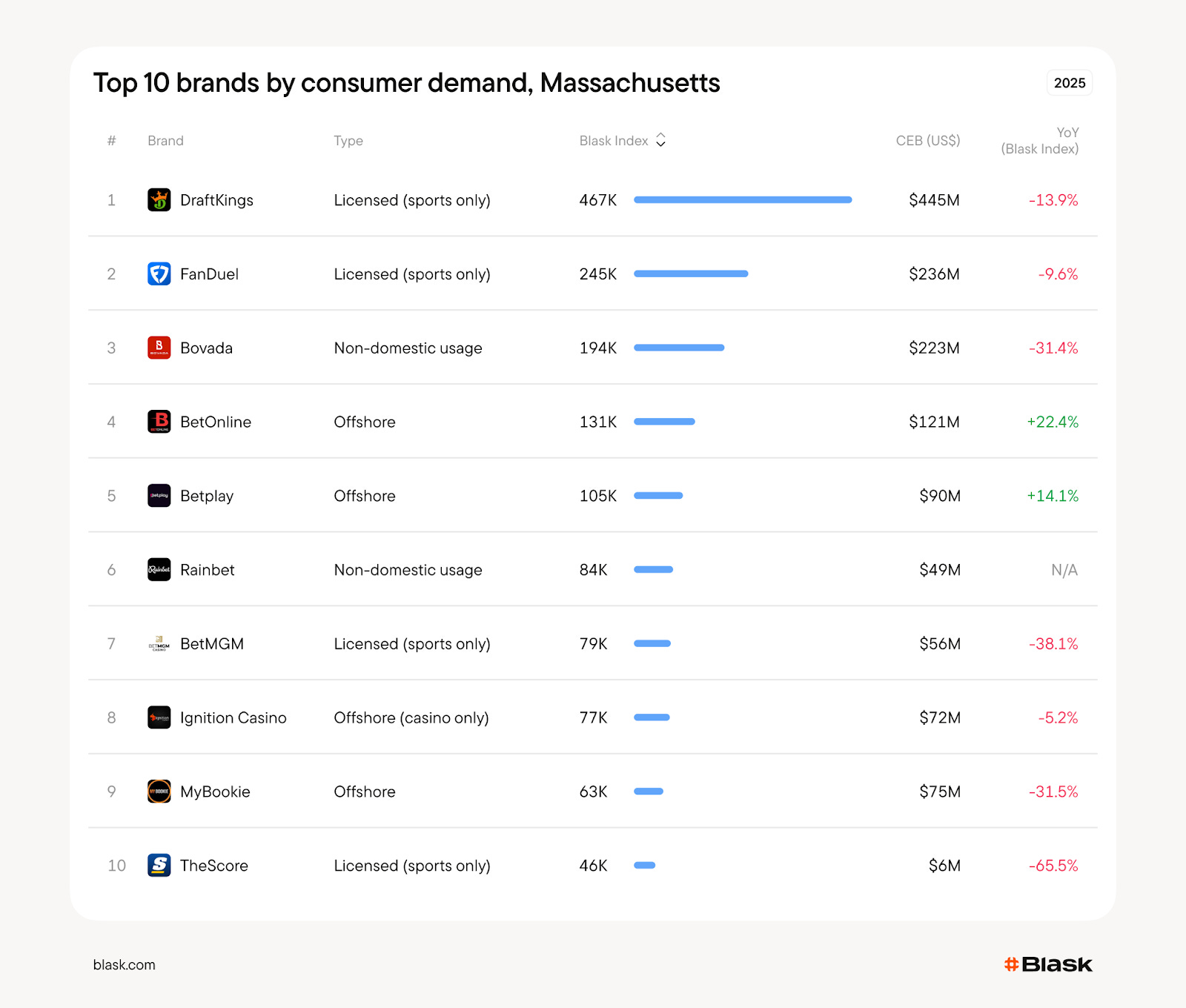
The split: Licensed operators (DraftKings, FanDuel, BetMGM, Fanatics, Caesars) hold a combined Blask Index* of 867,000 — roughly 40% of the state’s total demand. All of it is sports betting. The remaining 60% of consumer demand flows to offshore operators, with 100% of the online casino segment untaxed and unregulated.
Non-domestic usage: Bovada and Rainbet are flagged by Blask as “non-domestic” in Massachusetts — meaning these operators do not appear to actively accept users from the state (no geo-targeted marketing, no local payment processing). However, Massachusetts consumers are demonstrably searching for these brands, generating a measurable demand signal. Blask counts their Blask Index and CEB in the market totals to reflect the full scope of unregulated demand — including operators that benefit from Massachusetts player interest without formally serving it. The non-domestic flag makes the offshore problem larger, not smaller: some of this demand flows to operators that don’t even acknowledge the market they’re capturing
The Structural Problem This Data Reveals
Massachusetts has legal, regulated sports betting. It works. DraftKings leads the state with a Blask Index of 467,103. Yet that same DraftKings is down -14% YoY — while offshore operators serving the casino demand it legally cannot touch are growing.
BetOnline, a fully offshore platform with no Massachusetts license, grew +22% in 2025 in the state. Ignition Casino, which offers only online casino games and holds no US license, commands nearly the same consumer demand signal as BetMGM (76,860 vs 79,060 Blask Index).
The pattern matches exactly what Blask data showed at the national level: without a licensed casino product, offshore fills the gap by default. In Massachusetts, there is no licensed casino product. The gap is the entire casino market.
*Blask Index measures consumer demand for each brand in a given geography — how actively players are searching for that operator, from that location.
**Competitive Earnings Baseline (CEB) is a derived revenue estimate expressed in USD. It is not sourced from operator financial disclosures or self-reported data. Blask’s model combines four inputs:
Blask Index — brand visibility and search trend signals, which feed directly into
BAP (Brand Accumulated Power) — the brand’s percentage share of total market demand, derived from its Blask Index;
APS (Acquisition Power Score) — an estimate of the brand’s capacity to attract new customers, modeled from BAP and historical demand trends; and
Competitive benchmarks modelled from observed market competition signals + public financial reports and regulatory commission data if available.
Around the Watercooler
Social media conversations, rumors, and gossip.


Stray Thoughts
More thoughts on Youth Sports, Part 1:
Good coaches know how and when to motivate. When to yell, when to hug, when to ignore, and when to praise.

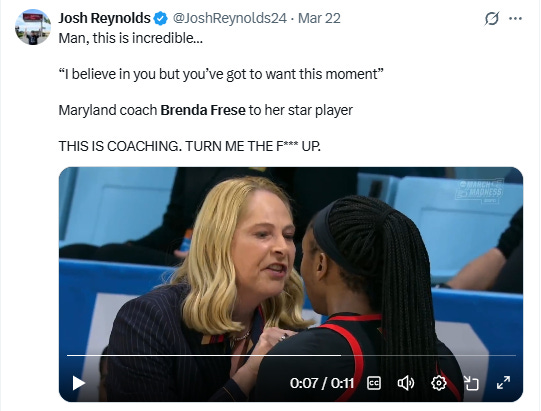
STTP’s previous thoughts on youth sports, which I’ve touched on three other times in the newsletter, from private equity’s involvement to parents’ wild beliefs to the time demands placed on elementary school children.
“Through my martial arts school, I see the demands these sports make on young children (and their parents) all the time. Seven- and eight-year-olds are being asked to commit to playing baseball or flag football four-plus days a week and travel to games. I get this for elite middle school leagues and high school, but elementary kids playing a sport for the first time?!?!?!!
“One introductory flag football league in our area requires an eight-year-old playing the sport for the very first time to practice four days a week in the summer from 5:30 to 8 PM.”