

The headline from Gallup’s latest poll on gambling is that fewer Americans are gambling, which flies in the face of reality. But is the headline true?
The Bulletin Board
THE LEDE: What Gallup’s new gambling poll can, and can’t, tell us.
BEYOND the HEADLINE: Where gambling polling has been consistent.
ROUNDUP: A look at the stories you may have missed.
VIEWS: The prediction market trap. Or, what happens when liquidity dries up.
AROUND the WATERCOOLER: Florida AG sues Stake and VGW.
STRAY THOUGHTS: Baseball’s Bible.

Sponsor’s Message: Play’n GO is launching into land-based casinos.
After more than 20 years at the forefront of iGaming, Play’n GO is bringing its world-famous games to land-based spaces, too.
Play’n GO’s unrivalled portfolio of some of the world’s most played online casino games is now available for physical casinos, giving operators the opportunity to harness the power and growth of online casino to bring a new demographic of players into their brick and mortar spaces for the very first time.
With cabinets already placed with one of the biggest casino chains in the world, Play’n GO’s CEO Johan Tornqvist said “We are bringing the best of online casino content and features to casino floors worldwide.”
For more info, visit www.playngo.com
The Lede: About That Gallup Poll on Gambling…
The headline takeaway from a new Gallup poll is that Americans are gambling far less in 2026 than they were in 2016: “Americans are significantly less likely than they were 10 years ago to say they participate in a variety of gambling activities,” Gallup said. And the poll results, however counterintuitive they seem, bear that out.
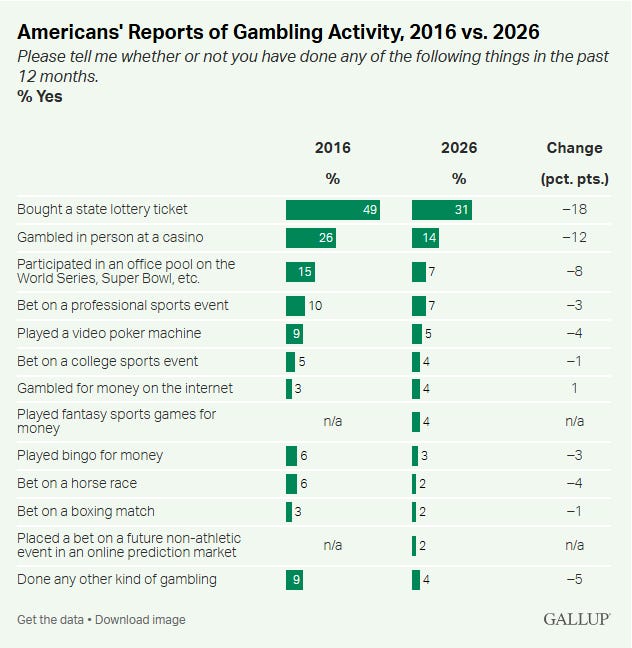
But once you get past the headline, the numbers actually start to align with other polling.
Buried further down the article on the Gallup site is this:
“The historical and current Gallup data are based on telephone interviews conducted by live interviewers. However, Gallup conducted a parallel web survey in June that asked the same gambling questions using the Gallup Panel, an online probability sample.
“In that web survey, the percentages of U.S. adults who indicate they participate in each of the 13 different forms of gambling are slightly higher. As a result, the estimate of those who gambled in any form last year — 53% — is also higher than in the telephone survey.”
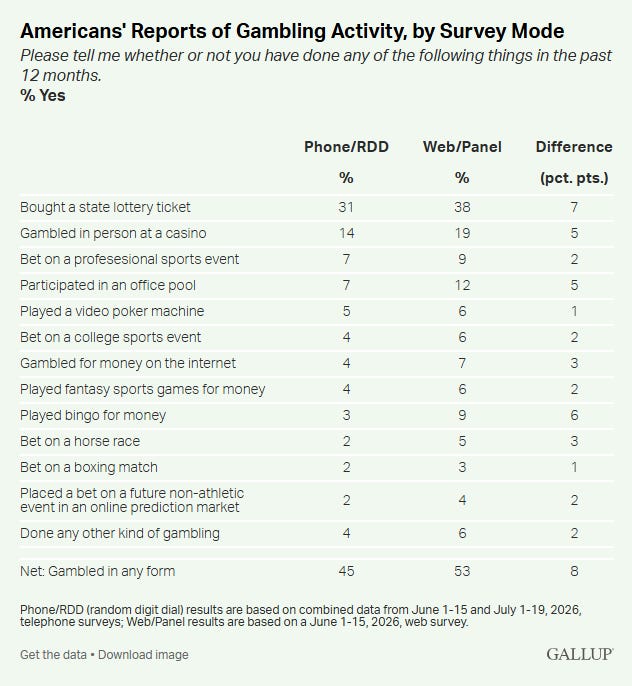
The online polling numbers are far closer to what we expect to see, with nearly 10% of respondents placing a sports bet, 7% gambling online, and 4% using prediction markets. Keep in mind that there are several sports betting categories in the Gallup poll: Sports bets, college sports, office pools, boxing, and fantasy sports.
I often criticize how questions are phrased in polls. Just as important is who gets surveyed. What the Gallup numbers really show is that people who answer phone surveys are less likely to gamble than people who take online surveys. And my educated guess is that people who don’t take surveys are even more likely to be gambling.
Still, let’s not write off this poll as a nothingburger.
We are often told that we need to protect people from the scourge of gambling, but here’s the thing, humans also adjust, and after getting beaten over the head with gambling expansions for the better part of 30 years, people might be getting sick of it. At least among certain cohorts.
As I said in a soon-to-be-released podcast with investigative journalist Brian Joseph (Brian just published an impressive five-part series on compliance failures), pre-Internet, people aged into gambling, and what we might be seeing here is people aging out of gambling, considering the people who grew up during the Poker Boom are now in their 40s and 50s.
Also, we need to stop pretending everyone is a gambler or a gambler-in-waiting, who is one advertisement away from downloading a sports betting app and going ham. Outside of the Super Bowl and March Madness, sports betting isn’t exactly a popular activity. Yes, when asked if they’ve bet in the last year, a lot of hands will go up, but as I’ve said in the past, betting on the Super Bowl, or placing a $20 bet every week or two, doesn’t make you a sports bettor.
Beyond the Headline: Gambling’s Perception Problem
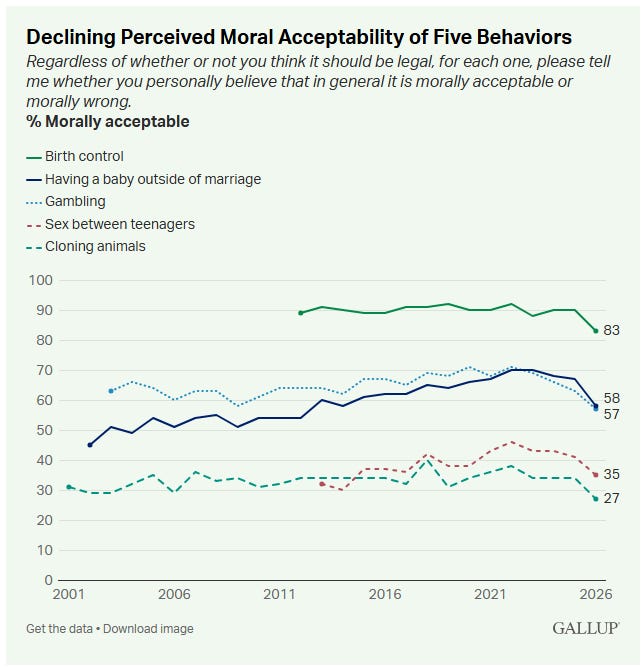
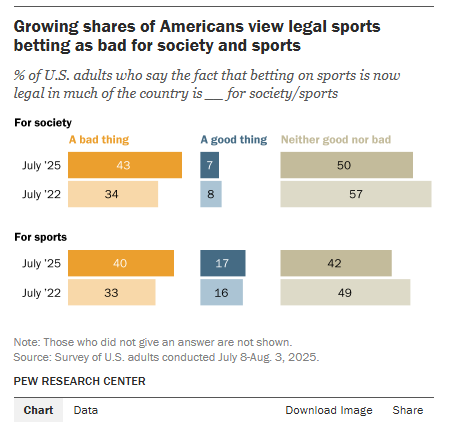
In June, Gallup surveyed Americans on the moral acceptability of different activities, and as has been the case with numerous other polls, including polling from Pew (screenshot below), Gallup found the perception of gambling is waning:
Roundup: So Much News; So Little Newsletter Space
FanDuel and GeoComply renew agreement for ID, fraud, and geolocation services [Press Release]: “FanDuel Group and GeoComply announced a multi-year renewal that will see “FanDuel will continue to leverage GeoComply’s industry-leading identity verification and fraud prevention technology to help protect customers and maintain the integrity of its platform… GeoComply will also commit dedicated forward-deployed engineers directly to FanDuel’s product and operations teams, deepening the use of location & device intelligence, behavioral signals and real-time fraud detection.”
NCLGS Winter Meeting is coming to Savannah, GA [Release]: “Registration is open for the Winter Meeting of the National Council of Legislators from Gaming States, which will be held December 9-12, 2026, at the JW Marriott Savannah Plant Riverside District.” Why go to NCLGS? From the release: “Legislators, regulators and gaming industry leaders will gather for four days of timely gaming insights, critical policy discussions, legislator panels, networking and the unique NCLGS experience. NCLGS meetings are the only conferences where state lawmakers from across the country regularly come together to discuss issues shaping the gaming industry.”
New study looks at long-term impacts of New Orleans smoking ban [Study]: “A new study examining the long-term impacts of New Orleans’s landmark smokefree law has confirmed that eliminating indoor smoking from the city — including in bars and casinos — has led to a dramatic decline in smoking-related deaths and lung cancer rates.” Cynthia Hallett, president and CEO of Americans for Nonsmokers’ Rights (and a former Straight to the Point podcast guest): “LSU’s study confirms what we have seen on the ground for over a decade. When cities take action to eliminate indoor smoking, public health dramatically improves, and businesses continue to prosper. New Orleans’s success as a smokefree city over the past 11 years refutes the tired industry scare tactics about what happens when casinos go smokefree.”
Evoke shareholders approve Bally’s Intralot takeover [Next.io]: “The £243m [$329m] deal for Bally’s Intralot to take over Evoke has moved closer to completion after the target’s shareholders voted convincingly in favor… Robeson Reeves, CEO of Bally’s Intralot, has maintained that he has no intention of immediately selling off any Evoke assets following the deal’s completion, which has been expected to complete in Q4 2026 or Q1 2027.”
Another legal threat for prediction markets [Bloomberg Law]: In addition to battling in state and federal court with states, “Consumers have filed more than a dozen class action lawsuits against Polymarket and Kalshi — the two biggest players in prediction markets — as well as Robinhood and DraftKings, claiming that they violate state consumer protection laws by offering a form of sports betting disguised to skirt safety regulations and licensing regimes. The lawsuits against Kalshi and Robinhood have been consolidated in the Southern District of New York and Northern District of California, respectively.”
Massachusetts regulators reapprove table tennis markets [Sports Betting Dime]: “The Massachusetts Gaming Commission (MGC) unanimously approved a DraftKings event petition to allow sports betting on TT Elite Series table tennis events, which had been removed from the regulated Massachusetts sports betting catalogue earlier this year. The Sports Wagering Division of the Massachusetts Gaming Commission conducted a review of TT Elite Series and determined the organization strengthened its integrity controls and showed improved integrity performance for its markets.” STTP Thoughts: I just don’t see the need for Americans to bet on international ping pong matches.
Underdog adds pitch-by-pitch Crash Games [Underdog]: Underdog (a newsletter sponsor) has launched a new offering, Crash. “Crash is a live, pitch-by-pitch fantasy sports contest available during MLB games. You're projecting how many pitches a batter's plate appearance will last against the opposing team's pitcher — and deciding when to cash out before the at-bat ends.”
After ceasing gambling operations, Bodog is now a media brand [Next.io]: “Bodog has relaunched as an independent media platform, marking a sharp departure from the gambling operations that built its name. The company stopped operating as a casino and sportsbook this past February. Its new website instead focuses on editorial content, research and commentary across several consumer sectors. Bodog will continue to focus on the gambling sector but also plans coverage spanning sports culture, technology, travel and wellness. It is also positioning responsible gambling education and research within its editorial operation.”
EGR parent company acquires H2 Gambling Capital [Press Release]: “Burghclere, a family office that invests in Data and Analytics businesses, has acquired H2 Gambling Capital… the betting and gaming sector’s most trusted market intelligence provider with market sizing and forecasting models spanning over 150 national and state gambling markets and more than 100 listed operators and suppliers… Burghclere also owns EGR Global, the leading B2B news and events business for the gaming sector, and the transaction will bring the two businesses into one portfolio to create the leading data intelligence platform to serve the gambling industry.”
Tweet of the Week:


STTP Thoughts: I’ve been ignoring this story because, well, I wrote extensively about it last year:
Arbitrary Lines

Every year, the cream-of-the-crop youth baseball players from around the world converge on Williamsport, Pennsylvania, for the Little League World Series (LLWS), capturing the attention of sports fans everywhere.
Quote of the Week: “Unsurprisingly, FanDuel is using the broken ‘responsible gaming model’ to shield themselves from any possible wrongdoing and place the blame entirely on the consumer. FanDuel and other sportsbooks have proven themselves to be incapable and unwilling to protect their customers from this dangerous, addictive product.” ~ Rep. Paul Tonko on FanDuel’s response to questions about its VIP practices (covered here).
Views: What Happens When Liquidity Dries Up?
This is something I’ve written about several times in the newsletter:

As I said in December 2025:
“The problem P2P gambling has always had is that the sharks don’t care about the ecosystem’s health; that’s the operator’s problem. They’re not into sustainable fishing. They’ll fish until there’s nothing left, leaving the pond empty and the operator scrambling to restock it (at massive costs).”
And in May 2026 I said, “that’s where everything falls apart, because skill-level is relative and churn is real”:
“Unfortunately, in the real world you don’t get a slow bleeding of your customers, you get a shrinking ecosystem where a very small percentage of your customers are feeding on your other customers… Once all the losers are chewed up and spit out, they become the prey.
“That isn’t a problem when the industry is in a period of rapid growth (prediction markets are in their Poker Boom phase), but when that growth slows, and losing customers grow frustrated and move on to the next thing, it becomes a very serious problem, very fast.”
And as I wrote in an article on limit vs. no limit poker:
“The bottom line is this: Prediction markets are still in their Poker Boom phase, with plenty of new fish being added. The concern is: What happens when the fresh supply of fish stops? History tells us that once the low-hanging fruit is picked, things start going sideways, which is why the next 12 months will be good times for all, but after that we’ll find out if these platforms can actually build a sustainable business.”
Or, if you want to hear a perspective other than mine, Jason Robins talked about during DraftKings’ Q1 earnings call:
“When you have a peer-to-peer setup, you’re going to have people on one side that are experts, and you’ve got to make sure you protect the ecosystem as best as you can, within the rules and regulations.
“Doing things to make sure that you’re building a healthy ecosystem was critical to us building out a sustainable daily fantasy sports product. Right now, I don’t see that necessarily happening with some of our predictions competitors.”
Around the Watercooler
Social media conversations, rumors, and gossip.
Florida Attorney General James Uthmeier is suing sweepstakes operators Stake and VGW — Full press release here:
“Attorney General James Uthmeier announced the filing of two lawsuits against the operators of major online “sweepstakes” casinos—including Stake and VGW’s Chumba Casino, LuckyLand, and Global Poker—and the payment processors that enable them. The complaints, filed in Hillsborough County Circuit Court today, allege the defendants are operating illegal online gambling enterprises that violate Florida’s gambling laws and the Florida Deceptive and Unfair Trade Practices Act.”

An interesting aspect of the lawsuits is, as attorney Daniel Wallach noted, the targeting of payment processors:


To say VGW is reeling is an understatement. The company was a sweepstakes juggernaut just a couple of years ago, but oh how the mighty have fallen. Setting aside the numerous US state crackdowns and class action lawsuits:
Earlier this year, VGW founder Laurence Escalante stepped down as chief executive (and formally resigned in July) after being charged with family violence and drug offences over an alleged assault.
VGW announced LuckyLand Slots is exiting the US in September.
Stray Thoughts
Today’s headline was said by my father, and it’s one I’ve heard second-hand several times.
Many years ago, in the days before the Internet, he was arguing with the local sports reporter for the town (remember when newspapers had those) about some random baseball statistic.
The argument went on for about 30 minutes, got heated, and the reporter, Richie, left, drove home, and returned with The Baseball Encyclopedia, known as “The Bible.” He showed my father the statistic in question, which led to my father's infamous and oft-quoted (at least in our family) emphatic response of: “The book is wrong!” which he believed settled the debate.
"Still, let’s not write off this poll as a nothingburger."
With all the cognitive biases associated with gambling, I think polling (whether by phone or online) often misleads to the point of misdirecting policy and responsible gaming initiatives. At the same time real data based on actual player behavior is underutilized in sizing problems and identifying corrective measures.
I once ran a telephone betting business. As you might expect, we did a lot of market research, including quick surveys of our customers after they made an inbound call to bet (our average response time in answering calls was faster than 9-11 - VIPs didn't always hear a ringtone).
If you asked them when the last time was that they had placed a bet with us, whether by phone or in a shop, they could recall details with precision. Whether they said today/yesterday/last week/ last month, you could model their data, compare it to what they had actually done and get a pretty accurate profile of betting frequency.
If you asked them to estimate whether they were betting more, less or the same WITH US over the past year, the data was utterly meaningless. They were as likely to overestimate as they were to underestimate their betting activity. There was no meaningful correlation between their sense of how much they were wagering and their actual behavior.
Politicians, journalists and academics will often use the results of such polling to influence public policy, despite the fact that there is a much more accurate dataset of trends available in regulated markets, and regulators are in a unique position to track the activity of individuals across multiple gambling sites.
Regulators already get operators to pool data on central customer exclusion lists. They could request data from operators to compile - and publish - annual results on how many active customers shut their accounts due to gambling problems each year. They could also publish data on how much these customers lost compared to an average online player in their jurisdiction, and to make it truly meaningful they could break that down by age group.
That data would show, for instance, that young men under 25 are much more likely to be at risk for problem gambling. It would also almost certainly show that young men lack the disposable income to pop up on radar screens for financial loss alone. Two decades ago, men 25 and under accounted for 30% of active sports customers but only 10% of operator gambling revenues. It would be fascinating to see where the trends lie today. That alone could do a lot to dispel myths and align academic and industry initiatives to curb problem gambling.