

The International Desk
The US isn't the only country that is trying to figure out how to deal with the new online gambling reality.
The Bulletin Board
THE LEDE: VGW exits Canada as anti-sweepstakes pressure continues to mount.
ROUNDUP: Golden Nugget in Ontario; BBB’s illegal gambling complaints; CA sweeps hearing Friday; Betr launches skill games.
NEWS: What else is going on around the Globe: India and Brazil.
VIEWS: Oh boy, another report on cannibalization.
AROUND the WATERCOOLER: The NFL’s position on prediction markets.
STRAY THOUGHTS: Gimme a break!

Sponsor’s Message: Increase Operator Margins with EDGE Boost Today!
EDGE Boost is the first dedicated bank account for bettors.
Increase Cash Access: On/Offline with $250k/day debit limits
No Integration or Costs: Compatible today with all operators via VISA debit rails
Incremental Non-Gaming Revenue: Up to 1% operator rebate on transactions
Lower Costs: Increase debit throughput to reduce costs against ACH/Wallets
Eliminate Chargebacks and Disputes
Eliminate Debit Declines
Built-in Responsible Gaming tools
To learn more, contact Matthew Cullen, Chief Strategy Officer, Matthew@edgemarkets.io
The Lede: VGW Pulls the Plug in Canada
In a move that underscores the mounting pressures on sweepstakes operators in the US, VGW Holdings has announced the shutdown of Chumba Casino and Global Poker across Canada, with a full withdrawal scheduled for October 23, 2025.
The exit will be phased, beginning with the end of Gold Coin purchases on August 28. A month later, on September 25, gameplay will be halted, but players can still redeem Sweeps Coins until October 23.
VGW cites the need to redirect resources toward the US market, saying it was not driven by immediate regulatory threats in Canada, with a VGW spokesperson telling Canadian Gaming Business:
“Ultimately, this is a difficult but strategic, isolated decision. Our Canadian business is relatively small, as the vast majority of our players reside in the larger U.S. market, where we will concentrate our management focus, resources and investment going forward.”
The pivot makes sense given the size of the US market.
As Sweepsy reported:
“A recent study conducted by Eilers & Krejcik Gaming at the request of the Social Gaming Leadership Alliance (which VGW is a part of) found that 98% of worldwide online sweepstakes gaming revenue is generated in the U.S. So logic dictates whatever resources VGW was dedicating to Canada weren’t producing returns strong enough to justify the continued investment — again, especially as VGW and other sweeps operators face headwinds to maintain their presence in the U.S.”
However, VGW's Canadian retreat to focus on the US ironically comes as US options shrink. For instance, New Jersey's impending statewide ban prompted Chumba and over a dozen platforms to exit preemptively in July 2025, and similar crackdowns in Connecticut, Maryland, Nevada, and Delaware have also led to widespread withdrawals by sweepstakes operators.
The sweepstakes crackdown (why it has been so swift and is there a better option than prohibitions) is something GeoComply cofounder David Briggs and I discussed on a forthcoming podcast episode.
Roundup: Golden Nugget in Ontario; BBB’s Gambling Complaints; CA Sweeps Hearing; Betr’s Skill Games
Golden Nugget online casino launches in Ontario [Covers.com]: The #2-ranked online casino app in the US (according to Eilers & Krejcik Gaming’s proprietary testing) is now available in Ontario: “Golden Nugget's Ontario offering has more than 2,000 online slot titles, classic table games, and exclusive DraftKings-developed content.”
BBB has received 10,000 complaints about online gambling [WIFR.com]: According to research from Better Business Bureau (BBB), “It has received almost 200 scam reports and more than 10,000 business complaints related to online gambling and gaming since 2022. Some scam reports involved theft, while complaints showed a pattern of unclear terms and consumer misunderstandings. In some cases, consumers lost tens of thousands of dollars.”
Fate of California sweepstakes bill could be decided Friday [CA Senate Appropriations Committee]: A bill, AB 831, banning sweepstakes in California was placed on the suspense calendar, which allows the committee to expeditiously advance or kill bills. As reported by local press, “While the Suspense File is intended as a way to provide more efficiency to the process of approving bills, it's also criticized for its lack of transparency.” The Suspense Hearing will be held on Friday, August 29, with the California legislature set to adjourn on October 15.
Betr launches skill-based arcade games [Casino Reports]: Skill games are an under-discussed part of the gambling/gaming ecosystem, but if there is any domain that still has the potential to be a massive disruptor, it’s skill games, and now there is a new entrant. “Betr has launched a real-money, peer-to-peer, skill-based game called Betr Arcade inside its Betr Picks daily fantasy sports app,” per Casino Reports. The initial four games are available in 29 states, with plans to launch more titles in the coming weeks.
Another tribe joins opposition to California sweepstakes bill [Press Release]: From the Social and Promotional Games Association (SPGA): “Big Lagoon Rancheria, a federally recognized Indian Tribe in the State of California, has formally announced its opposition to CA Assembly Bill 831.” An SPGA spokesperson said: “The SPGA agrees with Big Lagoon Rancheria Chairperson Moorehead that AB 831 is rushed and flawed legislation. It’s irresponsible for California lawmakers to jam through this broken bill over a growing chorus of complaints from tribes, consumers, and California companies.” Last week, I noted that the Kletsel Dehe Wintun Nation of the Cortina Rancheria tribe not only opposed the bill but also inked a deal with VGW — keep in mind there are over 100 tribes in California, so finding a few willing to break off isn’t all that difficult. As I’ve written in the past, you need to have the right support.

SPONSOR’S MESSAGE: They’ve stopped treating every new player the same.
Instead of a single, rigid KYC process, they use IDComply to intelligently assess risk from the very first interaction. Here’s how it works:
Instant Risk Snapshot: The moment a user registers, 800+ signals (device, location, identity) are analyzed to understand their true risk profile.
Tailored Onboarding: Based on that data, you can dynamically choose the right path. Roll out a fast, frictionless journey for trusted users, or automatically add layers of security for suspicious ones.
The result is a system that pleases your good players and frustrates the bad ones. You get the best of both worlds: industry-leading pass rates and robust fraud defense.
Want to know what that math looks like for your platform? Get in touch with your GeoComply rep today.
News: Big Goings On In India… and Brazil
This is a massive development that has been on my radar for a couple of weeks, but the story recently went from 0-60, as India has passed a blanket ban on online real-money gambling, dubbed the Promotion and Regulation of Online Gaming Act 2025.
As Regulus Partners wrote in a note:
“India’s Parliament is not famous for speed. Yet on 20 August, the Lok Sabha (lower house) introduced the Promotion and Regulation of Online Gaming Bill, 2025, and by 21 August, the Rajya Sabha (upper house) had passed it - no debate, no consultation, no amendments. A seismic industry law went from zero to final vote in under 48 hours, catching many operators completely by surprise… India’s President signed the ban into law on 22 August, and many large local operators have already either exited or reduced their offer to free-to-play over the weekend.”
The ban covers virtually every form of online gambling, regardless of whether games are based on skill or chance. The bill also prohibits advertisements and financial transactions related to the gambling platforms.
The ramifications were immediate. As reported by Pokerfuse, India is experiencing its own Black Friday. Even though the bill has yet to officially become law, “Virtually every major Indian online poker room has pulled the plug on real-money games. PokerBaazi, PokerStars India, Junglee Poker, Adda52, Natural8, Spartan Poker, and MPL Poker — all have been among the first to go dark.”
The law is likely to be challenged in court.
“The Bill is extremely problematic, prima facie unconstitutional and not sustainable in law,” Technology and gaming lawyer Jay Sayta told Poker Industry PRO. “‘Betting and gambling’ as well as ‘amusements and entertainments’ are squarely state subjects. Parliament has no legislative competence to enact laws on these matters, except under Article 252 of the Constitution, where two or more state legislatures expressly pass a resolution allowing it.”
In addition to India (some readers may not be aware that online gambling occurs outside the US), Brazil is considering increasing the financial burdens on its recently launched online gambling industry, having passed a provisional measure to increase its tax rate from 12% to 18%, pending final congressional approval (by October 8, 2025) and with a planned effective date in October or November 2025.
Views: Spectrum Analysis Finds Cannibalization Exists
New analysis from Spectrum Gaming, comparing the GGR growth rate of six igaming states (CT, DE, MI, NJ, PA, WV) to the GGR growth rate of eight states with established retail casinos but no igaming (CO, IN, IA, LA, ME, MS, MO, OH), is going to pour more fuel on the cannibalization fire.
Per Spectrum, “if the igaming states’ retail casino revenue had grown at the pace of casino GGR in the non-igaming states, the retail casinos would have generated an additional $1.75 billion in GGR.”
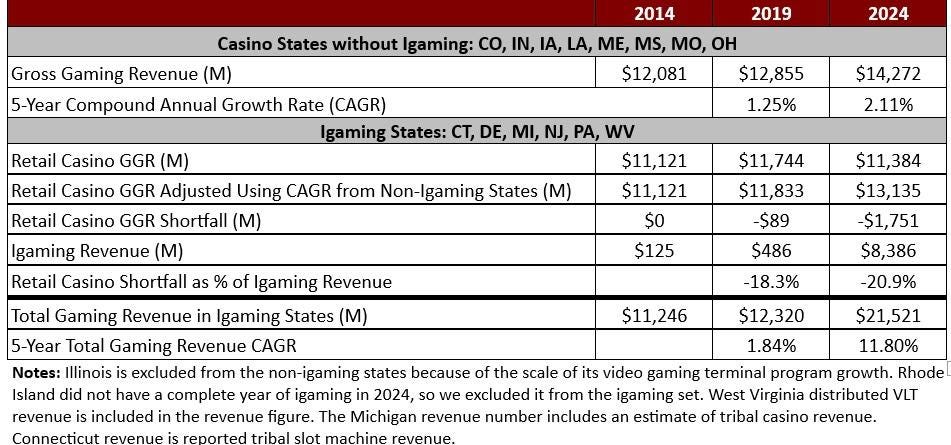
As Spectrum notes, it’s becoming increasingly difficult to argue that online casino legalization isn’t negatively impacting existing land-based casinos. However, it’s hard to ignore the demand and overall growth that online casino legalization accounts for: “Total gaming revenue in igaming states grew 75% from 2019 to 2024 – all in igaming.”
The Spectrum findings align with a February 2025 report from The Innovation Group, which stated: “iGaming steals revenue from existing gaming operations. Analysis of current iGaming states shows that brick-and-mortar casino revenue underperforms by 16.5% following iGaming introduction.”
David Isaacson, Senior VP at Spectrum Gaming Capital, advised brick-and-mortar casino clients to lobby for tethering iCasino licenses to retail casinos at the recent Saratoga Racing and Gaming Conference, noting that they’re engaged in a damned if you do, damned if you don’t situation, as online gambling is already readily available in every state. “If mobile casino becomes even more lucrative in terms of gross gaming revenue than brick-and-mortar casinos, as has occurred in several recent months in New Jersey, the traditional casino operators would still benefit to an extent from the spending shift… [casino operators] need to know the value they bring to the table.”
FanDuel executive James Hartmann emphasized the prevalence of unregulated offshore iGaming, saying: “The question shouldn’t be, ‘Should there or shouldn't there be iGaming?’ There already is iGaming, and Americans are betting hundreds of billions of dollars per year on it, except that in 43 states, they are getting zero tax revenue. The gambling is done with offshore companies that don’t care about responsible gaming practices. So do you want the tax revenue, and do you want your citizens to be protected? That’s the real question.”
Without completely rehashing the debate, there are numerous points of contention:
The two sides are looking at online casinos through different lenses (macro vs. micro).
A dollar of land-based revenue is different than a dollar of online revenue.
There is a jobs and local economy argument to be had.
There is little reliable data on problem gambling concerns.

SPONSOR’S MESSAGE -Light & Wonder, Inc. is the leading cross-platform global games company. Through our three unique, yet highly complementary businesses, we deliver unforgettable experiences by combining the exceptional talents of our 6,000+ member team, with a deep understanding of our customers and players. We create immersive content that forges lasting connections with players, wherever they choose to engage.
At Light & Wonder, it’s all about the games. The Company is committed to the highest standards of integrity, from promoting player responsibility to implementing sustainable practices.
Around the Watercooler
Social media conversations, rumors, and gossip.
I was supposed to discuss the segment on The Whole Story with Anderson Cooper: "Sports Betting: America's Big Gamble.” That will have to wait another day or two, as there is simply too much news, like yesterday’s NFL media briefing, where the NFL talked about everything from its sports betting policies:

To micro-bets [bold mine]:
“Something… we’ve been very focused on since the initiation of our work in this area has been proactively prohibiting certain types of wagers that we think provide the minimum expanded engagement and could also present higher risk to the betting markets,” David Highhill, the NFL’s Vice President of Sports Betting said. “Those include prohibiting any type of officiating-related wagers, things that are inherently objectionable, like player injuries, and single-player bets that are 100 percent controllable by a single player on a single play. So things like ‘Will this kicker miss a field goal?’ are things that we’ve worked collaboratively across the board with operators to make sure those types of wagers are not offered.”
Although prediction markets weren’t a focus of the call, the topic is what everyone was interested in.
Here are the highlights.
“What's important about the sports betting markets right now that are legal is that they have robust protections that include information sharing between sportsbooks and the leagues,” Highhill said. “There's integrity monitoring requirements, there's prohibitions on certain types of wagers or markets that are more subject to influence. There's the requirements sometimes to use consistent and reliable official league data, and there's also mandatory responsible betting requirements and resources.”
“I think for us, the key distinction is that, for now, prediction markets lack certain regulatory requirements that we know regulated sportsbooks are subject to — information sharing, responsible betting tools, objectionable bet prohibitions. For us, we're concerned that if these markets aren't properly regulated, they could be susceptible to manipulation or price distortion.”
Sabrina Perel, the NFL’s Chief Compliance Officer, on prediction markets being off-limits for NFL personnel:
“Our view is that these platforms mimic sports betting, and that they are covered as prohibited conduct under our policy… And now we're educating on this point, specifically stating that engaging in these platforms would be prohibited under the policy.”
Covers.com reached out to the NFL for clarification and was told that “NFL players could participate in prediction markets in sports other than the NFL and as long as they aren’t doing it at work or on a work trip," said Alex Riethmiller, vice president of communications for the NFL, in an email. "In that way, it mirrors the policy for regular sports betting.”
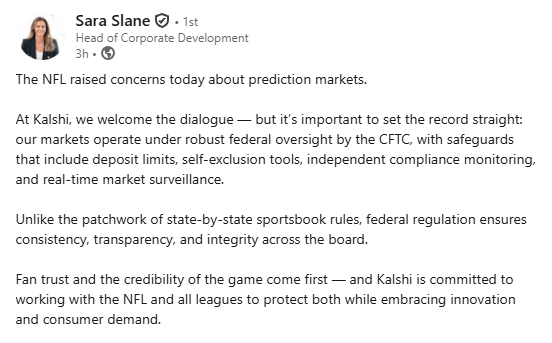
Kalshi’s Sara Slane weighed in, rebuking the idea that prediction markets do not have robust protections in place:
The best take I saw was from Chris Grove, who astutely noted that it’s important to read between the lines (what I often refer to as speaking politician):

Those conditions are:
Integrity monitoring
Information-sharing with the leagues
Prohibitions on certain markets
Consumer protections
Use of official league data
As Grove went on to say, there is a world where leagues like the NFL have a better relationship with prediction markets than traditional sportsbooks. But as Dr. Strange would say, that’s just one of many possible futures.
Stray Thoughts
There’s not much newsletter left (and several decently big stories I still haven’t gotten to this week), which has me wondering: Will the news ever slow down?