

The More You Know
Three things stood out in the public comments submitted to the CFTC, two of which will be extremely important in the upcoming rulemaking progress.
The Bulletin Board
THE LEDE: Three things we learned from the CFTC public comments.
ROUNDUP: A look at the stories you may have missed.
PREDICTION MARKET CATCHUP: All the important bits of PM news.
NEWS: Caesars Digital is the latest operator to prohibit credit cards.
AROUND the WATERCOOLER: Match-fixing is not a new phenomenon.
STRAY THOUGHTS: Stop making up words.

SPONSOR’S MESSAGE - Underdog: the most innovative company in sports gaming.
At Underdog we use our own tech stack to create the industry’s most popular games, designing products specifically for the American sports fan.
Join us as we build the future of sports gaming.
Visit: https://underdogfantasy.com/careers
The Lede: 3 Takeaways from the CFTC’s Public Comments
The Commodity Futures Trading Commission (CFTC) is one step closer to writing new rules for prediction markets, as the public comment period officially closed last week.
You can probably figure out what most of the comments say by who submitted it, but there were a few interesting takeaways:
Takeaway #1: Kalshi’s CTA worked… sort of
More than 1,500 comments were submitted, but most can be combined into a single entry, as Kalshi was apparently urging users and supports to submit comments via a template it created.

Some of the submissions were downright comical:


What impact these comments will have on the rulemaking process is anyone’s guess: My guess is none.
Takeaway #2: Kalshi is willing to draw the line at casino games
While Kalshi was busy rallying users to submit template comments in support of broad prediction market access, its own formal submission to the CFTC draws a very clear boundary. In a letter to the CFTC, Kalshi co-founder and COO Luana Lopes Lara said:
“The Commission should build on this strong foundation by providing clear guidance that supports a broad range of event contracts on regulated exchanges, drawing firm lines where appropriate—around terrorism, assassination, war, and casino-style gaming—while ensuring that the universe of event contracts can continue to be listed, traded, and overseen by the Commission.”
The prediction markets’ main lobbying arm, The Coalition for Prediction Markets, which represents Kalshi, Robinhood, Coinbase, Crypto.com, and Underdog, also filed comments with the CFTC drawing a line around casino games:
“Casino games have no place on prediction markets based on the rules… There is no price discovery function to casino-style games. Event contracts on DCMs are tied to real-world events associated with a potential financial, economic, or commercial consequence. Wagers on casino games have no economic significance apart from the wager itself.”
By explicitly saying they do not support listing contracts on traditional casino games, and want the CFTC to formally define “gaming” to cover those games, Kalshi and other prediction markets are taking a proactive step to head off casino lobby attacks.
Takeaway #3: Leagues want restrictions, not prohibitions
Four professional leagues, the NFL, MLB, PGA, and the ATP submitted comments, as did Elevate Government Affairs, which submitted comments on behalf of the NFLPA, MLBPA, NBPA, NHLPA, and MLSPA.
The leagues were careful to not take a side in the legal fight, but did make several recommendations.
One of the big asks was age restrictions, with leagues asking for prediction markets to be restricted to 21+. Dan Spillane, Executive Vice President and Assistant General Counsel, League Governance & Policy, went furthest on this request:
“We note that sports event contract trading is currently available to individuals of 18 years of age or older. By contrast, legal sports betting is, in most states, limited to individuals over the age of 21. Like sports betting, trading in sports prediction contracts carries material risks (e.g., of financial loss) that may be particularly acute for younger individuals. The Commission should take formal note of this reality and should categorically prohibit trading of sports prediction contracts by individuals under 21. Short of that, the Commission should take action to restrict DCMs’ ability to directly market their sports products specifically to individuals in the 18-20 age range.”
Andy Levinson, SVP, Tournament Administration for the PGA concurred, urging that the CFTC, “Increases the age requirement of those who can participate in sports event contracts to 21.”
Other asks include:
Limits on easily manipulable markets: Spillane asked the CFTC “to impose meaningful limits on the types of permitted markets - particularly with respect to markets that are more susceptible to manipulation and/or misuse of confidential information,” and Quest Meeks, Senior Vice President & Head Counsel, Policy, Integrity & Compliance for the NBA asking that “DCMs should not list contracts that a league has identified — through a public notice or other mechanism — as readily susceptible to manipulation or unfair trading practices.”
Responsible gaming tools: All four leagues urged the CFTC to mandate responsible “trading” policies: “We urge the Commission to adopt a robust set of responsible trading requirements. Specifically, DCMs should be required to provide (directly and/or by requiring their contracted FCMs to provide) responsible trading tools to their customers, such as deposit limits, trading breaks, and educational resources to understand risks,” Spillane wrote. The NBA, PGA, and ATP letters made the same recommendation.
Official League Data: “In order to avoid confusion and maintain fan and consumer confidence in sports prediction markets, DCMs should be required to, wherever possible, use only officially-verified data to settle sports-related contracts,” Spillane said. The ATP also expressly mentioned official league data.
Anyone interested in a deeper dive into the comments can check out Dustin Gouker’s reporting at The Closing Line:

In its recently published Prediction Market Tracker, Eilers & Krejcik Gaming anticipated an accelerated timeline (something CFTC Chairman Michael Selig has argued in favor of), with the proposed rules posted sometime in mid-2026, and final rules ready before the end of the year.
Roundup: So Much News; So Little Newsletter Space
Commerce Subcommittee announces sports betting/prediction market hearing [Press Release]: “U.S. Senator Marsha Blackburn (R-Tenn), Chairman of the Senate Commerce Subcommittee on Consumer Protection, Technology, and Data Privacy, will convene a subcommittee hearing regarding sports betting and gaming integrity on Wednesday, May 20, 2026, at 10:00 a.m. ET. This hearing will examine the rapid expansion of sports betting in the United States and its growing impact on the integrity of games. Since the recent advent of prediction markets and the Supreme Court’s 2018 decision to strike down the Professional and Amateur Sports Protection Act, what was once a tightly restricted sports gambling industry has evolved into a $165 billion market allowed in 39 states and the District of Columbia.”
Another New Hampshire casino is on the way [CDC Gaming Reports]: As STTP has been reporting, New Hampshire’s charity casinos are becoming a very big business: “Granite State Gaming & Hospitality (GSGH) has closed a real-estate purchase in Littleton, New Hampshire, planning to build a casino on the site. The announcement was made pre-dawn on April 30.” The size and scope of the project have not been released. As CDC reports, “GSGH already operates two charitable casinos in New Hampshire, the Beach Club Casino in Hampton Beach and Rochester’s Lilac Club Casino.”
Kambi secures Canadian lottery contracts [Complete iGaming]: “Following a joint request for proposal led by Atlantic Lottery Corporation, Kambi will provide online gambling and sports betting in Saskatchewan and Manitoba for British Columbia Lottery Corporation, as well as in Nova Scotia, New Brunswick, Prince Edward Island, and Newfoundland and Labrador for Atlantic Lottery Corporation.”
FanDuel adds Erin Andrews as RG Ambassador [Press Release]: FanDuel has added sports broadcaster/personality Erin Andrews as a Responsible Gaming Ambassador. “Andrews’ partnership brings a new dynamic to FanDuel’s Responsible Gaming Ambassador program, strengthening its ability to connect with a broader audience of sports fans. With deep roots in the sports world and a strong connection to fans, she will help amplify responsible gaming messaging as FanDuel continues its mission to encourage customers to set limits and play with a plan.” STTP Thoughts: I’m shocked that in 2026, we are still leaning into these celebrity sponsorships (more on this in an upcoming newsletter).
Prediction Market Catchup: PM News You Need to Know
Kalshi hit with class action lawsuit in MA [WCVB]: “A self-described gambling addict from Raynham recently filed a class action lawsuit accusing Kalshi of offering illegal betting to Massachusetts residents, according to a complaint filed in Suffolk Superior Court. The legal action is the latest escalation in a fight over the prediction market industry’s operations in the Bay State. The lawsuit, filed in Suffolk Superior Court on April 22, 2026, alleges that Kalshi and related companies allowed users to place sports wagers without a Massachusetts license, violating state gambling laws and causing financial losses to consumers.”
Senate resolution prohibits Senators from using prediction markets [AP]: “The Senate has approved a bipartisan resolution to prevent its own members from using prediction markets, banning senators who are often privy to sensitive information from making bets on upcoming events. The measure that passed unanimously by voice vote Thursday was written as a change to the Senate’s rules, so it will go into effect immediately. It comes a week after a U.S. special forces soldier was charged with using classified information to bet on the January capture of Venezuela’s then-president, Nicolas Maduro, and as lawmakers increasingly voice concerns about who might be making public wagers on the war with Iran.” And it sounds like the House will follow suit, per Semafor.
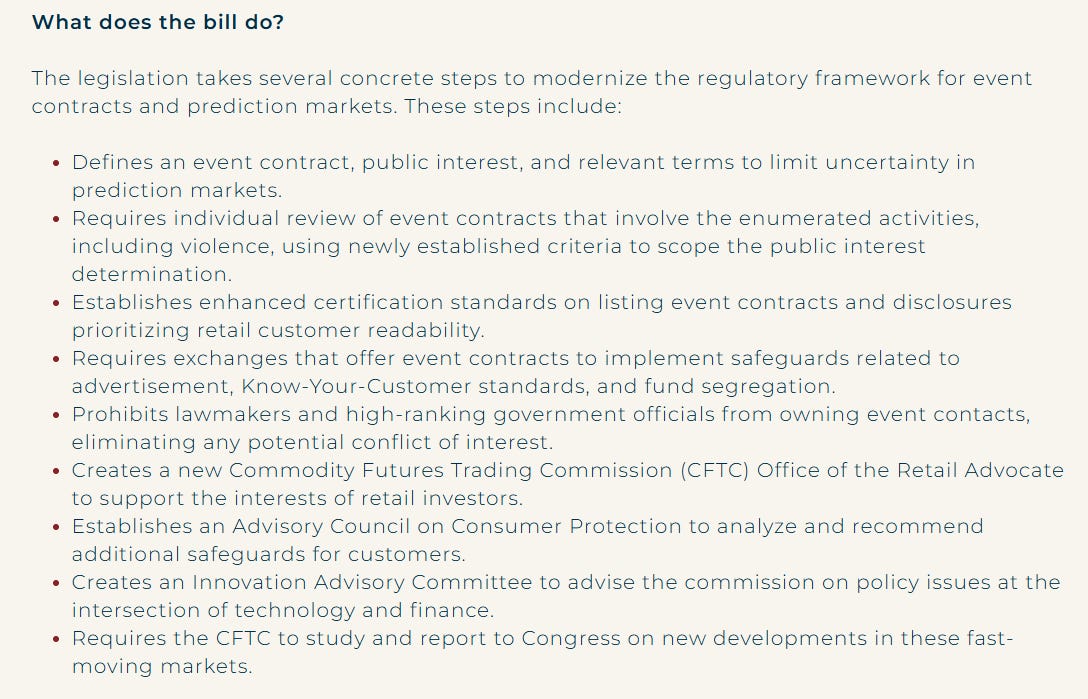
Prediction market bill has the PM industry’s support [Press Release]: Senators Dave McCormick and Kirsten Gillibrand introduced the Prediction Market Act of 2026 last week. The legislation has the support of the Coalition for Prediction Markets, making it one to watch. Here’s what the bill does, per Sen. McCormick’s press release:
News: Caesars Digital Prohibits Credit Cards
I saw hints at this on X, but SBC Americas was able to get the confirmation: “Caesars stopped accepting credit card account funding on its online gambling platforms in the United States on April 14, the company confirmed to SBC Americas on Thursday. The change applies to all Caesars Digital sites and apps.”
Caesars is the latest online betting company to cease accepting credit cards, joining BetMGM, FanDuel, and DraftKings.
As I noted when DraftKings prohibited credit cards in August 2025, “companies aren’t seeing much upside from credit cards, which are becoming a less popular deposit option, carry heavy transaction fees, and a customer-annoyance component — in most cases, customers are charged the cash-advance rate when they deposit via credit card.”
Some other potential reasons companies are prohibiting credit cards that I have pointed to are:
Chargeback fees pose a significant financial risk to online operators, as they often incur additional costs of $20 to $100 per incident, along with other potential penalties, such as higher processing fees. By prohibiting credit card deposits entirely, DraftKings mitigates these costs and risks, shifting users to lower-dispute methods like debit cards or e-wallets.
Navigating the mishmash regulatory environment, with eight states prohibiting credit card deposits (Iowa, Tennessee, Massachusetts, Rhode Island, New Hampshire, Oregon, Vermont, and Illinois), and the disparate regulations led to a massive $450,000 fine for DraftKings in Massachusetts when customers deposited in other states and then placed bets in Massachusetts.
Credit card prohibitions are picking up steam, and DraftKings is getting out in front of them. As Shawn Fluharty said on my podcast, a credit card ban is almost required for an online gambling bill to pass in the current environment: “I don’t care how many studies you bring me after the fact. You need votes to get legislation passed, and including the credit card ban is going to help you get votes to get legislation passed… It’s just one of those things; good policy isn’t always good politics.”
Around the Watercooler
Social media conversations, rumors, and gossip.
Worth 10 minutes of your time, and I’d highly recommend Franzese’s channels (the video below is on Franzese Wines, and he also posts on his main channel, Michael Franzese) if you’re interested in mafia lore.
Stray Thoughts
I will be a very happy person when the gambling industry (and the world writ large) stops using manufactured buzzwords.
A masterclass in sanewashing.