

The Bulletin Board
THE LEDE: How did prediction markets do compared to traditional sportsbooks.
VIEWS: Kalshi runs into its first Super Bowl traffic jam.
QUICK HITTER: Kalshi’s Super Bowl pricing bests sportsbooks.
AROUND the WATERCOOLER: Kalshi CEO gets grilled on CNBC.
STRAY THOUGHTS: A lot of Kalshi news today, hopefully less tomorrow.

Sponsor’s Message: Increase Operator Margins with EDGE Boost Today!
EDGE Boost is the first dedicated bank account for bettors.
Increase Cash Access: On/Offline with $250k/day debit limits
No Integration or Costs: Compatible today with all operators via VISA debit rails
Incremental Non-Gaming Revenue: Up to 1% operator rebate on transactions
Lower Costs: Increase debit throughput to reduce costs against ACH/Wallets
Eliminate Chargebacks and Disputes
Eliminate Debit Declines
Built-in Responsible Gaming tools
To learn more, contact Matthew Cullen, Chief Strategy Officer, Matthew@edgemarkets.io
The Lede: Prediction Markets vs. Sportsbooks vs. Nevada
Prediction markets had a very strong showing, with Kalshi posting somewhere around $1 billion in trades (not to be confused with handle). Trading volume on Sunday was a new daily record for Kalshi.
How did the traditional sportsbooks fare?

According to the Eilers & Krejcik EKG Line, handle came in “light” but hold was “north of 20%” for most of the major operators thanks to the under hitting and higher likelihood prop bets not coming in. As EKG noted, “DraftKings had 12 promoted parlays on its site pre-game and none of them hit, as the two most popular touchdown scorer bets—Jaxson Smith-Njigba and Kenneth Walker — failed to find the end zone. Remember that holding call late in the game when Walker was walking in for a touchdown, or the slightly overthrown bomb to Smith-Njigba? That’s how fine a line a good night and a bad night for sportsbooks can be.
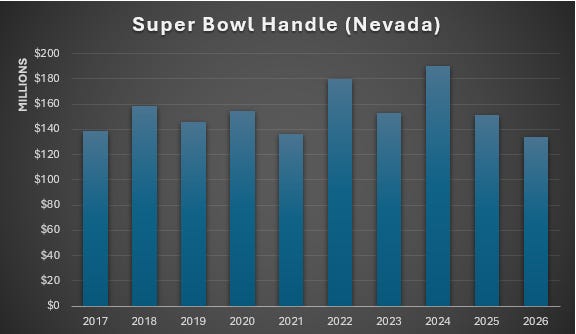
There isn’t a ton of state-level data yet, but we do have the numbers out of Nevada, which are not great, with handle at its lowest point in a decade ($133 million).
Here’s a look at the Super Bowl handle out of Nevada over the last 10 years (Super Bowl LX is the lowest in that time), but on par with Super Bowl LV, Tampa Bay vs. Kansas City.
There are several potential reasons for the decline:
Less travel to Las Vegas (an ongoing story that Straight to the Point has been monitoring).
Nevada’s archaic in-person registration requirement to open a mobile sports betting account.
The widespread availability of online sports betting (including prediction markets) across the country.
The game was an absolute snooze fest.
Views: Growing Pains: Outages and Market Resolution
Kalshi learns what every sportsbook already knows: You’re going to have what amounts to a DDoS attack on Super Bowl Sunday.

Anyone who has been around long enough knows that pretty much every sportsbook experiences this (you can see how I voted below), and most take measures ahead of the game to prevent it.

And then there was the “did Cardi B (who was clearly on the screen during the halftime show) perform in the Super Bowl halftime show?”
As Dustin Gouker noted in his Event Horizon newsletter:

Kalshi eventually resolved the market (in a manner that will certainly upset many users, see below), but the fiasco makes one thing very clear: The ambiguous market resolution language is something prediction markets need to clean up.
Here’s what Kalshi posted on its website:
“Important information: Due to ambiguity over whether or not Cardi B’s attendance at the 2026 Super Bowl halftime show constituted a qualifying ‘performance’, Kalshi is invoking Rule 6.3(c) to settle this market to the last traded price before trading was paused. Those prices are $0.26 for Yes holders and $0.74 for No holders. Conversely, per Kalshi’s full rules, celebrities that danced in the background during the halftime show but did not visibly sing or play an instrument did not “perform” for purposes of the contract.”
FWIW, Polymarket paid out “yes” bettors at $1 and “no” bettors at $0.
There are also debates over the resolution of other attendance markets: Jason Kelce and Mark Wahlberg.

SPONSOR’S MESSAGE - Underdog: the most innovative company in sports gaming.
At Underdog we use our own tech stack to create the industry’s most popular games, designing products specifically for the American sports fan.
Join us as we build the future of sports gaming.
Visit: https://underdogfantasy.com/careers
Quick Hitter: Kalshi’s Super Bowl Pricing
As it’s done throughout the NFL season, the team at Citizens tracked the odds and the implied vig (operator pricing) for the Super Bowl for FanDuel, DraftKings, and Kalshi, and the Super Bowl was the first time (to my knowledge) that Kalshi’s pricing was notably better.
“Overall, Kalshi’s pre-game odds for game outcome and over/under were better for the vast majority of the week, with an average vig of 4.35% when adding in the transaction fee, on average, 3% better than DraftKings and FanDuel, on average… The implied vig for Kalshi was 23.7%, 4% better than pricing for DraftKings and FanDuel, without the transaction fee.”
Around the Watercooler
Social media conversations, rumors, and gossip.
What started as a nice, fluffy interview on CNBC turned into an interrogation when Kalshi CEO Tarek Mansour started touting the amount of trading on Bad Bunny’s Super Bowl appearance.
This led to CNBC’s Andrew Ross Sorkin and Becky Quick questioning Mansour about potential insider trading concerns, and let’s just say his answers didn’t put many minds at ease.


Essentially, Mansour tried to draw a line between insider information (data within a company) and material non-public information, which are usually used interchangeably, with the only difference being the origin of the information.
Mansour seems to be saying (Kalshi can correct me if I’m wrong) that the origin matters, and MNPI, as put forth in the hypothetical Bad Bunny dancer question, isn’t insider trading, which it technically isn’t. The issue is, all insider trading is MNPI, but not all MNPI is insider trading.
MNPI is prohibited by the CFTC, under its anti-fraud and anti-manipulation rules, which prohibits trading on MNPI in breach of a pre-existing duty, such as a confidentiality agreement, employment contract, or nondisclosure obligation owed to the production team, artist, or event organizers.
What Mansour is claiming — that someone with non-public information isn’t technically insider trading — is correct, but they are violating the rules that insider trading falls under.
Further, the Commodity Futures Trading Commission (CFTC) has rules that effectively prohibit the listing of markets that are readily susceptible to manipulation.
As I said on X:

Stray Thoughts
Heavy on Kalshi news today, I’ll try to keep it to a minimum tomorrow… fingers crossed.