

Uncrossable Lines
Kalshi jumped headfirst into sports contracts, but it's not taking the same "full steam ahead" approach to horseracing, casino games, or even crops.
The Bulletin Board
THE LEDE: 3 areas where Kalshi has decided the juice isn’t worth the squeeze.
BEYOND the HEADLINE: How the CFTC can best help prediction markets.
QUICK HITTER: Missouri bill would raise taxes on all forms of gambling.
VIEWS: Celebrity endorsers and authenticity in advertising.
AROUND the WATERCOOLER: WSJ article becomes the hot topic on X.

Sponsor’s Message: Promoting a sustainable, entertainment-first global gaming industry.
Play’n GO is celebrating its 20th anniversary in 2025. Drawing on that experience from the dawn of the iGaming industry through to today, Play’n GO designs and creates world-class slot games in the online casino space.
Play’n GO wants to see a sustainable industry that puts players first. To realize that vision, Play’n GO:
Creates games designed to be entertaining and fun first
Actively lobbies for increased regulation to keep players safe
Refuses to make games that feature mechanics that we believe to be predatory, such as those that allow players to pay hundreds of times their normal stake to buy into the bonus round directly (‘Bonus Buy’ games)
Now live in over 35 regulated territories around the world, including all US and Canadian iGaming jurisdictions, Play’n GO is the leading provider of entertainment to the online casino industry.
For more info, visit www.playngo.com
The Lede: 3 Lines Kalshi Is (Currently) Unwilling to Cross
There were three interesting developments on the prediction market front last week.
First, Kalshi decided not to offer Kentucky Derby contracts, after very overt warnings from Churchill Downs. Kalshi has never offered a Kentucky Derby market (as far as I can tell) and Polymarket briefly opened a market and then pulled it after a direct request from the track.
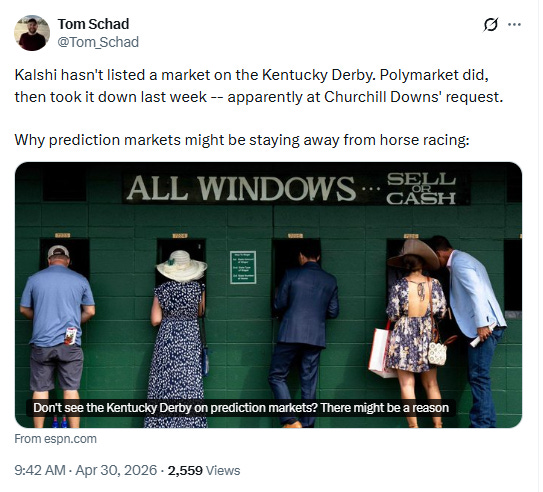
As Schad reported for ESPN, “‘We reached out to Polymarket and asked for the wagers to be removed,’ Churchill Downs spokesperson Breck Thomas-Ross told ESPN. ‘And Polymarket complied.’”
“Right now, the law’s fairly clear on what [prediction markets] are allowed to do without consent by our sport,” Tom Rooney, the president and chief executive officer of the National Thoroughbred Racing Association, said in an interview with ESPN. “There is a door that could be opened if a race track or state gaming commission or horseman’s group or something like that would give consent. We don’t have that yet.”
What Rooney means by legal clarity is that horse racing operates under its own federal rulebook. The Interstate Horseracing Act (1978) gives tracks like Churchill Downs strong control over wagering on their races, basically treating the Derby as their intellectual property. This is a line that even prediction markets seem unwilling to cross, and raises bigger questions about where other lines get drawn, as well as providing opponents with some easy ammunition.

Second, Kalshi agreed to halt off-hours trading on its crop contracts after pushback from the agriculture industry and traditional derivatives exchanges.

Kalshi launched 24/7 commodities markets in mid-April, but quickly walked it back on crops to match traditional exchange hours after the Commodity Markets Council and others raised concerns about round-the-clock pressure on farmers and margin calls.
And finally, as noted yesterday, the prediction markets’ main lobbying arm, The Coalition for Prediction Markets, which represents Kalshi, Robinhood, Coinbase, Crypto.com, and Underdog, filed comments with the CFTC drawing another line:
“Casino games have no place on prediction markets based on the rules… There is no price discovery function to casino-style games. Event contracts on DCMs are tied to real-world events associated with a potential financial, economic, or commercial consequence. Wagers on casino games have no economic significance apart from the wager itself.”
By explicitly saying they do not support listing contracts on traditional casino games, and want the CFTC to formally define “gaming” to cover those games, is a proactive step to head off casino lobby attacks.
Beyond the Headline: How the CFTC Can Best Help PMs
The courts are not the only obstacle standing in the way of prediction markets. Their future could be shaped by three other forces:
An act of Congress, particularly the recently introduced bill that the Coalition for Prediction Markets applauded.
The CFTC rulemaking process (which can shift with each administration), where everything from age restrictions to prop bet/parlay restrictions to a casino gaming firewall (see the Coalition for Prediction Markets CFTC comments above) could be considered.
A second legal battle over state taxes, like the recently passed bill in Kentucky — this is something I will discuss in an upcoming newsletter.
The Commodity Futures Trading Commission (CFTC) has aggressively entered the legal fray on the side of prediction markets. It is currently suing or filing amicus briefs against multiple states claiming exclusive jurisdiction over prediction markets.
But the CFTC’s biggest long-term assist may come from its ongoing rulemaking process. After withdrawing earlier restrictive proposals, the agency issued an Advance Notice of Proposed Rulemaking (ANPRM) in March 2026. the public comment period came to a close on April 30, and as I wrote yesterday, there are several intriguing comments from professional sports leagues and prediction markets that might point to where the lines get drawn — CFTC Chairman Michael Selig also left the door open to limiting prop bets.
As I said previously, there is room for a grand bargain:
“The best way to deal with that would be to concede some ground… The larger questions are, how much ground will it concede, and could that possibly be enough to appease commercial sportsbooks, tribes, and states to drop the lawsuits?”
“And as I’ve been saying all along, the end result might be limited sports contracts at prediction markets (tentpole events or even contracts on individual games in major sports).”
I’m not the only one thinking this way. CNIGA Chairman James Siva recently told Front Office Sports: “In fact, I think that’s actually the play here from this administration, which wants cryptocurrency to be regulated, but not by the [U.S. Securities and Exchange Commission]. They want it regulated under the CFTC. They want their crypto bill. I don’t think the administration actually cares about sports event contracts.”
The rulemaking process opens the door for targeted guardrails on the most controversial markets: war/terrorism/assassination contracts, multi-leg parlays and prop bets with little economic utility, and the longer-term risk of casino-style products — the latter two being the primary concerns of commercial sportsbooks, states, and tribes.
While the Supreme Court (assuming a preemption case reaches it) will focus on the strict legal question of CFTC authority versus state gambling laws, but it’s hard to imagine the justices won’t be influenced by the CFTC’s approach to these markets, be it the current hands-off, anything goes attitude or specific rules with clear guardrails and bright lines.
In the same vein, the Supreme Court will likely give significant deference to any prediction-market-specific bill Congress ultimately passes, which would provide a clear statutory signal on how these instruments should be classified and regulated.
Bottom line: Prediction markets have powerful federal allies right now, but that could turn on a dime in a couple of years. The current rulemaking (and potential legislation) could be a significant factor at SCOTUS, which makes the next 6–12 months of CFTC rules and Congressional actions all the more important, and intriguing.
Quick Hitter: Missouri Bill Would Increase Gambling Taxes
A new bill in Missouri, HB 3533, would raise taxes on all forms of gambling. The bill seeks to increase the tax burdens on casinos and online sportsbooks in three significant ways, in an effort to offset potential income tax cuts.
The bill would:
Nearly triple the admission fee from a flat rate of $2 to $5.50 for every two hours they are on the casino floor — the fee is adjusted annually for inflation.
A new 1.5% tax on online gambling (as a stand-in for an admission fee).
An across the board tax increase on all forms of casino gambling (land-based and online, if it is ever approved) which would increase the current casino tax rate of 21% to 34%, and a 24% increase on the current 10% sports betting tax rate, once again increasing the rate to 34% — the proposed 13% and 24% increases are layered on top of existing rates.
Views: Authenticity in Gambling Advertising
An interesting article from Hilary McAfee on celebrity partnerships/endorsers in the gambling industry, and the need for something Straight to the Point is constantly screaming from the rooftops: Authenticity.
“Remember when Nicki Minaj became the global ambassador of MaximBet? I do. Nicki Minaj has one of the most devoted audiences in music, which was never the question. The question nobody asked was whether that audience had any interest in sports betting. And it turned out the answer was largely no.”
Somebody has asked these questions, as this is something I discussed with Rivalry CEO Stephen Salz on the podcast (Episode #2!) more than two years ago, in March 2024.
I also wrote about it in January 2024:
“Definitely outside of my area of expertise, but I often wonder how effective these celebrity endorser campaigns are. A big name certainly brings people to theatres and sports events, but that doesn’t feel like an apples-to-apples comparison as people are there to see them do what they do best, not pitch a product they have little connection to - this isn’t Michael Jordan with sneakers.
“If the ad is good, does it matter who delivers the message? If the names are huge (like they are here), does the star power overshadow the message: ‘Did you see the new Brady ad,’ rather than, ‘Did you see the new BetMGM ad?’”
And the topic came up again in November 2024:
“I’ve been saying what Craig Carton said on X for a while: The use of celebrity endorsements is often out of touch with how people view and indirectly engage with celebrities.”
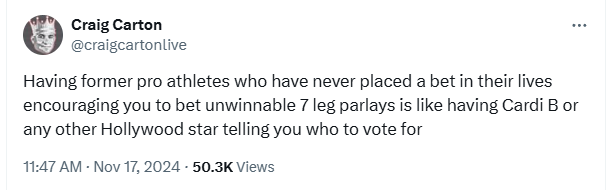
I’ll let McAfee have the final word in this entry: “The difference between a partnership that works and one that doesn’t has nothing to do with how famous the person is. It has everything to do with whether the audience they bring already has a reason to care.”
Around the Watercooler
Social media conversations, rumors, and gossip.
A Wall Street Journal article became, as Chrissie Hynde would say, the talk of the town, on Monday — you can read the article here (paywall).
I’ll be discussing this at length in an upcoming newsletter, but the gist of the debate can be summed up in a single tweet:

What followed was a Spider-Man gif battle about what’s worse for you drugs, cigarettes, or alcohol sports betting or sports betting at prediction markets:


Again, more to come on this.