

The Bulletin Board
THE LEDE: AIBM Survey on familiarity, usage, and attitudes toward PMs.
BEYOND the HEADLINE: Pro-prediction market survey has similar results.
QUICK HITTER: Wisconsin passes tribal online sports betting bill.
NEWS: Arizona files criminal (yes, criminal) charges against Kalshi.
NEWS: AGA releases March Madness estimates and takes shots at PMs.
AROUND the WATERCOOLER: Will prediction markets be a flashpoint?
STRAY THOUGHTS: Nobody likes my neighbor Nursultan Tulyiagby.

Sponsor’s Message: Increase Operator Margins with EDGE Boost Today!
EDGE Boost is the first dedicated bank account for bettors.
Increase Cash Access: On/Offline with $250k/day debit limits
No Integration or Costs: Compatible today with all operators via VISA debit rails
Incremental Non-Gaming Revenue: Up to 1% operator rebate on transactions
Lower Costs: Increase debit throughput to reduce costs against ACH/Wallets
Eliminate Chargebacks and Disputes
Eliminate Debit Declines
Built-in Responsible Gaming tools
To learn more, contact Matthew Cullen, Chief Strategy Officer, Matthew@edgemarkets.io
The Lede: AIBM Commissions Poll on Prediction Markets
The American Institute for Boys and Men (AIBM), released the results of a survey conducted by Ipsos using KnowledgePanel® on prediction markets this morning.
The Prediction Markets Survey asked about familiarity, usage of, and attitudes toward the stock market, crypto, sports betting, daily fantasy sports, and prediction markets.
Unsurprisingly, most Americans are not actively betting on sports or using a prediction market, with the exception of young men: “In the past six months, 26% of young men report using at least one sports betting, daily fantasy sports, prediction market, or other gambling platform, compared to 14% of the general public.”
One of the key findings from the survey was that prediction markets are still relatively unknown:
“Only 21% of Americans say they are very or somewhat familiar with prediction markets, compared with 35% who say the same about online sports betting. Even among men ages 18–24, familiarity with prediction markets is still below one-third (29%), though notably higher than the general public.”

Another interesting result is the perception of prediction markets:
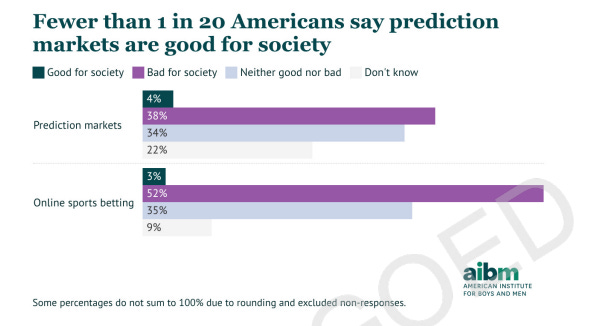
“Americans view purchasing event contracts on prediction markets as closer to gambling than investing (61% to 8%),” by an extremely wide margin. Further, “most Americans (91%) and young men (88%) view purchasing event contracts on prediction markets as financially risky, on par with investing in cryptocurrency and placing a sports bet.”
And, despite the narrative prediction market supporters are trying to construct, the public sees these products as risky, with far more downside than upside. The good news (if you’re a prediction market operator) is your product has better PR than sports betting.
Which brings us to the million-dollar question: Who should have oversight of prediction markets: States or the federal government?
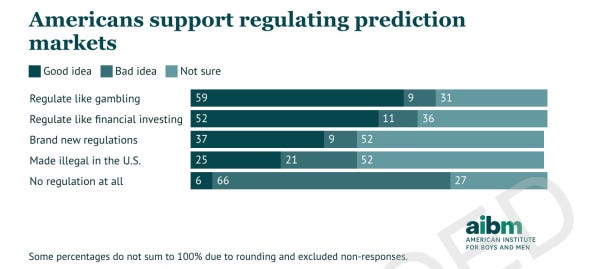
When asked about regulation, respondents were pretty split on whether they should fall into the gambling (21+ and state-level regulation) or financial investment (18+ and federal regulation) bucket.
Beyond the Headline: Different Survey; Same Results
It's rare that polls from opposite sides of the debate match up, but several findings in a recent survey by Echelon Insights on behalf of Paradigm “to study voter views on prediction markets,” closely resembled AIBM’s findings. The survey was conducted from February 13-18, 2026 among a sample of 1,008 registered voters in the Likely Electorate (LE) nationwide.
STTP Note: Paradigm is an investor in and supporter of prediction markets; Paradigm has publicly disclosed its investment in Kalshi multiple times. As such, if the results are skewed in any direction, it would be toward prediction markets.
Here are a few of the findings that caught my attention.
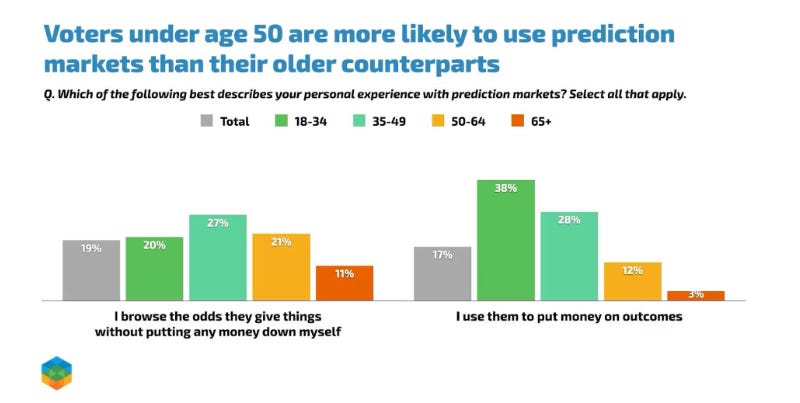
This finding from the poll could help explain why some people are so interested in prediction markets, and where those $20 billion valuations come from:
2) Usage of prediction markets differs by age. While 38% of those 18-34 and 28% of those 35-49 have put money down via prediction markets, just 3% of those 65 or older have. This represents an age chas[m] even larger than crypto and dwarfs all other demographic divisions.
STTP Note: Paradigm’s findings line up perfectly with AIBM’s 29% of 18-24 year-olds are somewhat or very familiar with prediction markets.
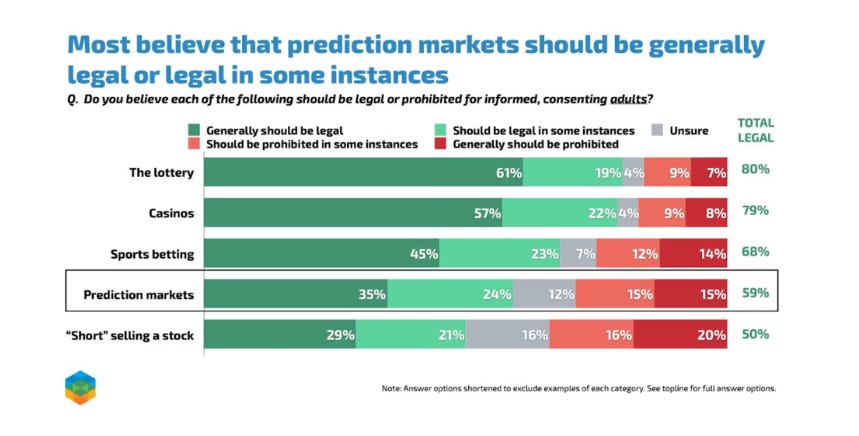
The below is a very interesting framing of these poll results (but as I noted above, Paradigm is pro-prediction market), as it could just as easily be framed as more than half of respondents want prediction markets restricted or outright prohibited, considering legal in some instances and restricted in some instances is the same response.
Again, these results align with AIBM’s findings that 59% would like prediction markets regulated like gambling, with 25% firmly against making them illegal.
And one more finding of note: “The idea that Americans are consistently being bombarded with information about prediction markets is an elite phenomenon. In the last 12 months, only 39% of respondents say they have heard, seen, or read something about prediction markets, while 51% said they have not.” Recall that 36% of respondents in the AIBM survey said they have heard of prediction markets, while 42% said they had not heard of prediction markets.
There is also a third polling set on prediction markets, conducted by progressive think tank Data for Progress (full coverage over at Dustin Gouker’s Event Horizon newsletter):
A majority of voters (59%) agree that wagers on potential government actions…should not be permitted.
Voters also show strong support for barring the president, vice president, and members of Congress from using prediction markets. Two in three voters (67%) support such a ban.
Voters are also concerned about markets that let users bet on whether a candidate will win or lose an election (70% concerned) and markets covering events where a person has complete control of the outcome (69% concerned).
Quick Hitter: Wisconsin Passes Tribal Sports Betting Bill
It’s not often a state legalizes sports betting (the bill still needs the signature of Gov. Tony Evers) and the sports betting industry looks at it like a loss, but that is precisely what happened in Wisconsin yesterday, when the Senate passed a mobile sports betting bill that creates a hub-and-spoke model (similar to Florida) that runs through the state’s tribes.
AB 601, makes mobile sports betting licenses exclusive to Wisconsin’s 11 federally recognized Indian tribes, using a hub-and-spoke model where bets are processed via servers on tribal lands allowing statewide mobile access. Any licensing fees and taxation rates would be set during compact renegotiations.
The point of contention for national operators like FanDuel and DraftKings is that because it falls under the Indian Gaming Regulatory Act (IGRA), at least 60% of all revenue in any revenue-sharing deal between a tribe and a sports betting platform must go to the tribe.
“It’s a bit odd because I’ve been listening to the sponsors and I think we agree on many of the goals, we just don’t think this vehicle gets us there,” the Sports Betting Alliance’s Damon Stewart said. “Online sports betting is a low-margin and capital-intensive business. It is simply not economically feasible for a commercial operator to hand over 60% just for the right to operate in the state.”

SPONSOR’S MESSAGE - Underdog: the most innovative company in sports gaming.
At Underdog we use our own tech stack to create the industry’s most popular games, designing products specifically for the American sports fan.
Join us as we build the future of sports gaming.
Visit: https://underdogfantasy.com/careers
News: Arizona Files Criminal Charges Against Kalshi
Prediction market lawsuits are a dime a dozen at the moment, but the latest filing in Arizona stands out as it is the first instance of a state filing criminal (not civil) complaint against Kalshi.
The lawsuit, filed by Arizona Attorney General Kris Mayes on Tuesday, comes on the heels of Kalshi filing a federal lawsuit against Arizona to prevent enforcement of the state’s sports betting laws against Kalshi — Arizona sent a cease-and-desist letter to Kalshi last year.
In a press release, the Arizona AG wrote, “Kalshi may brand itself as a 'prediction market,' but what it's actually doing is running an illegal gambling operation and taking bets on Arizona elections, both of which violate Arizona law,” said Attorney General Mayes. “No company gets to decide for itself which laws to follow.”
The press release goes on to say:
“The 20-count criminal information alleges that Kalshi accepted bets from Arizona residents on a wide range of events in violation of Arizona law. These events included professional and college sporting contests, proposition bets on individual player performance, and whether the SAVE Act would become law. Among the charges are four counts of election wagering, including bets on the 2028 presidential race, the 2026 Arizona gubernatorial race, the 2026 Arizona Republican gubernatorial primary, and the 2026 Arizona Secretary of State race.”
In a statement to Dustin Gouker’s Event Horizon newsletter, A Kalshi spokesperson said:
“Sadly, a state can file criminal charges on paper thin arguments. States like Arizona want to individually regulate a nationwide financial exchange, and are trying every trick in the book to do it. As other courts have recognized and the CFTC affirms, Kalshi is subject to federal jurisdiction. It’s different from what sportsbooks and casinos offer their customers, and it should not be overseen by a patchwork of inconsistent state laws.”
On X, Kalshi called the charges “meritless”:

Even the CFTC Chair weighed in:

That dismissive response belies the seriousness of what Arizona has done. According to attorney Daniel Wallach, the criminal charges “raises the stakes considerably on both Kalshi’s motion for preliminary injunction filed in AZ federal court yesterday and on the upcoming CA9 oral argument.”

Also, Victor Rocha (recent podcast guest) knows things, as this was posted on Monday:

News: AGA March Madness Estimates and More PM Shade
The American Gaming Association (AGA) released its annual March Madness betting estimates, which come in at $3.3 billion for the upcoming 2026 tournament — H2 Gambling Capital is estimating March Madness sportsbook handle this year to reach $4.0 billion, per a press release.
But even bigger than the legal wagering estimate is the AGA’s ongoing attempt to draw attention to prediction markets, as the same press release on March Madness contains a few arrows pointed in the direction of prediction markets and the differences between the two industries.
Per the release, while betting volumes are climbing, the number of advertisements from commercial and tribal operators is declining: “A Nielsen study commissioned by the AGA shows that despite increased betting activity, overall sportsbook advertising volume has continued its multi-year decline.”
On the other side of the ledger:
“Sensor Tower data compiled by the AGA shows that prediction market platforms have rapidly increased their presence in sports betting advertising. While digital ad impressions for online sportsbooks declined nearly 14 percent in 2025, impressions tied to prediction market advertising surged dramatically.”
“With the expansion of prediction market advertising, nearly one in five (15%) digital sports betting ads seen by consumers last year did not comply with state-mandated responsible gaming messages. Kalshi alone became the third largest sports betting advertiser by digital impressions in 2025.”

“Confidence in your wager - and in the integrity of the games - starts with a fair and compliant betting market,” said Miller. “That’s why it’s so important that everyone offering sports bets in the U.S. comply with state and tribal regulations, ensuring that consumers are protected.”
Around the Watercooler
Social media conversations, rumors, and gossip.

I have also been saying that prediction markets could be a factor in the midterm elections, and something of a flashpoint if Democrats take control of Congress.
As I previously wrote, prediction markets “will likely be an issue in the midterms and creep into the 2028 presidential election, given the stench of corruption emanating from it (summed up nicely in this recent Wired column):
“Selig is a Trump Administration appointee, and there is ample evidence to suggest that President Trump and his inner circle want to ensure prediction markets are treated with a light touch, not the least being that he and his family plan to soon launch their own called Truth Predict. The president’s son Donald Trump Jr. is an adviser to both Kalshi and Polymarket, and his firm 1789 Capital is an investor in the latter. The Trump Media and Technology Group also has a strategic partnership with Crypto.com.”
Stray Thoughts
I wrote at length about McKay Coppins’ Atlantic article earlier this week, and since then I’ve noticed something on social media: The attacks on Coppins from the sports betting world have caused people to circle around Coppins and rally to his defense, effectively turning the pushback into the strongest possible validation of his critiques and amplifying the piece’s impact (The Atlantic has been heavily promoting it and Coppins has been making the media rounds to discuss it: Bloomberg, NPR, Radio Atlantic, MS Now, and his own podcast on Deseret Voices (with guest Craig Carton).

As I said Monday, the article really struck a nerve.