

Change My Mind
I don't put much stock in polling about gambling, but even when it's "push polling," there are things we can learn from the results.
The Bulletin Board
THE LEDE: What do polls really tell us about people’s attitudes toward gambling.
ROUNDUP: A look at the stories you may have missed.
VIEWS: Does online gambling cannibalize lottery sales?
AROUND the WATERCOOLER: We caught one!
STRAY THOUGHTS: Coming around to my point of view.

Sponsor’s Message: Increase Operator Margins with EDGE Boost Today!
EDGE Boost is the first dedicated bank account for bettors.
Increase Cash Access: On/Offline with $250k/day debit limits
No Integration or Costs: Compatible today with all operators via VISA debit rails
Incremental Non-Gaming Revenue: Up to 1% operator rebate on transactions
Lower Costs: Increase debit throughput to reduce costs against ACH/Wallets
Eliminate Chargebacks and Disputes
Eliminate Debit Declines
Built-in Responsible Gaming tools
To learn more, contact Matthew Cullen, Chief Strategy Officer, Matthew@edgemarkets.io
The Lede: What Recent Polling Really Tells Us
We have dueling polls about legalizing online casinos. One was commissioned by the pro-legalization Sports Betting Alliance (SBA) and the other by the anti-online gambling group, the National Association Against iGaming (NAAiG).
According to the survey from Beacon Research, 76% of Massachusetts voters believe legalized iGaming under state oversight is a better way to prevent children from gambling and provide safeguards for bettors than the current offshore market. STTP Thoughts: I’m surprised support is only at 76% given the question phrasing.
And then there is the polling commissioned by the NAAiG and conducted in Colorado and most recently Virginia (NAAiG has also commissioned polls in Mississippi, Indiana, and Maryland), that found the exact opposite.
In Colorado:
“58% initially opposed, rising to 80% when informed - As voters learned about the economic and mental health harms associated with online casino gambling, opposition intensity increased significantly.”
In Virginia:
“Virginia voters solidly oppose legalizing iGaming, also known as online casino gambling, with resistance growing as voters learned more about it, according to a new statewide poll conducted by Lake Research Partners on behalf of the National Association Against iGaming (NAAiG)… As voters learn about addiction, youth access and economic harm, opposition reaches 76%, with nearly two-thirds (65%) strongly opposed.”
STTP Thoughts: Again, phrasing matters.
I’m not here to debate which of these polls is more meaningful, or if they are push polls. The most useful bit of information that can be gleaned from the two polls is how malleable the public is on this issue: Meaning, this is not a topic the public cares very much about.
And in another, unrelated poll in Utah, more than half of respondents believe athletes help gamblers rig games:
“Nearly a third of Americans say they’ve bet money on a sporting event through a sportsbook, online platform or mobile app, and the number is even higher among younger people.
“At the same time, half of those surveyed in a new national Deseret News/Hinckley Institute of Politics poll believe current professional athletes often or sometimes alter the way they play to help sports gamblers win bets.”
This poll is important as it demonstrates something STTP has been screaming for quite some time: The industry has lost the narrative.
Roundup: So Much News; So Little Newsletter Space
FanDuel Sports Network lays off staff and closes offices [Awful Announcing]: FanDuel Sports Network is laying off dozens of employees and closing offices in Atlanta and Cleveland, per Awful Announcing. “Earlier this month, Main Street Sports Group filed WARN notices in Minnesota, Missouri, and Connecticut, notifying the states that it’s closing its local offices and laying off employees. The move comes weeks after nine Major League Baseball teams terminated their agreements with the company, saying they had not received scheduled rights payments.” Previous STTP Coverage: FanDuel snagged the naming rights to the regional sports network in 2024, after the company went through bankruptcy.
DraftKings announces “reorganization,” AKA, job cuts [Boston Globe]: DraftKings is cutting jobs, as the sports betting giant tightens its belt amid growing competition from lightly regulated prediction markets. “DraftKings has decided to reorganize some teams to better align their people with the most important priorities and areas of investment for the company,” the company said in an emailed statement on Tuesday. “Unfortunately, these changes will impact some roles across the organization.” How many jobs will be cut was not disclosed, but Citizens Jordan Bender (podcast episode #75) said it could affect up to 5% of jobs, which would save the company about $30 million annually.
Penn expands Board of Directors [Front Office Sports]: “Penn Entertainment will add three directors to its board to end a long-standing dispute with activist investor HG Vora Capital Management, an agreement that comes less than four months after Penn’s sports betting deal with ESPN went kaput. As part of the “cooperation agreement” announced Monday, HG Vora also withdrew a lawsuit it filed against Penn in May in Pennsylvania federal court.” Previous STTP Coverage: Penn-HG Vora fight from both sides (Penn and HG Vora), Penn’s previous concession (two of three proposed board members) and a subsequent lawsuit filed by HG Vora.
MGC to discuss limiting bettor rules in hearing today [Massachusetts Gaming Commission]: One of the items on the MGC’s agenda today is the previously proposed rule around limiting bettors: “Procedures to provide timely notice to a patron that their wagering activity has been limited, including a specific explanation for the attachment of the limit(s) and identification as to which market(s) are so limited.”
A very good responsible gambling policy proposal in NY [Next.io]: A new bill in New York, AB 10329, introduced by Assemblymember Anna Kassay would impose a responsible gambling policy that Straight to the Point has always supported: “If enacted… the measure would require disclosures to flow directly to bettors themselves… Every licensed mobile operator would have to issue an electronic monthly account statement to each authorized sports bettor, itemizing activity within the account over the preceding month.”
Kambi continues to rack up tribal partnerships [Press Release]: “Kambi… has signed a multi-year sportsbook partnership with the Mandan, Hidatsa and Arikara (MHA) Nation to provide on-property sports betting solutions at the tribe’s flagship gaming destination, 4 Bears Casino and Lodge in New Town, North Dakota… The partnership also includes future scope for on-premise mobile sports betting, as well as state-wide mobile betting pending regulatory conditions.” As STTP noted in the past, Kambi is perhaps the most trusted sports betting platform by tribes.
Pro League Network launches dedicated channel [Press Release]: Pro League Network (PLN) has debuted its free 24/7 streaming channel. “The channel will become PLN’s always-on home for its eye-catching, creator-driven sports. Available initially on Prime Video in the US and LG in select international markets, the Pro League Network streaming channel will be the home of all of PLN’s live events and contain the best of PLN’s library of entertaining sports leagues, including crowd-favorites such as Putt Tour, SlapFIGHT Championship and Ultimate Tire Wrestling.” And STTP’s favorite, CarJitsu.
Five-minute crypto markets at Polymarket [Earnings+More]: “Earlier this month, Polymarket went live with 5-minute Bitcoin up/down markets that allow users to bet on whether the price of Bitcoin will be higher or lower at the end of a five-minute window, settled automatically via Chainlink oracle feeds.It had previously introduced 15-minute crypto markets but the compression to five minutes – with one-minute markets and a POLY token reportedly in the pipeline – represents a significant acceleration.”
Quote of the Week: “We do many things that involve regulation of third parties,” he said. “We are acting as a regulator. We are a regulated party to be sure, but for the purposes of removal — we are the regulator.” ~ Polymarket’s lawyer Tom Dupree in Nevada hearing. STTP Thoughts: This may be a great legal argument, but this is not going to instill confidence from the public or lawmakers — tee up the Captain Phillips memes with “I’m the regulator now.”

Sponsor’s Message: Promoting a sustainable, entertainment-first global gaming industry.
Play’n GO is celebrating its 20th anniversary in 2025. Drawing on that experience from the dawn of the iGaming industry through to today, Play’n GO designs and creates world-class slot games in the online casino space.
Play’n GO wants to see a sustainable industry that puts players first. To realize that vision, Play’n GO:
Creates games designed to be entertaining and fun first
Actively lobbies for increased regulation to keep players safe
Refuses to make games that feature mechanics that we believe to be predatory, such as those that allow players to pay hundreds of times their normal stake to buy into the bonus round directly (‘Bonus Buy’ games)
Now live in over 35 regulated territories around the world, including all US and Canadian iGaming jurisdictions, Play’n GO is the leading provider of entertainment to the online casino industry.
For more info, visit www.playngo.com
Views: Should We Talk About Lottery Cannibalization?
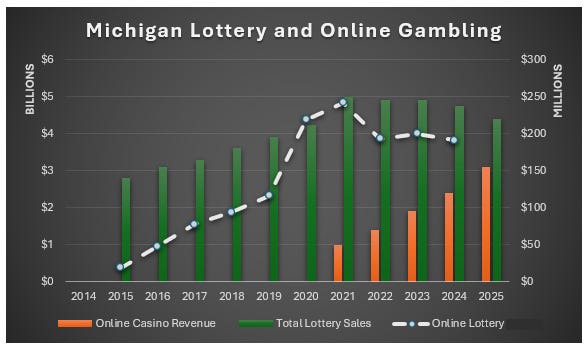
Last week I looked into Michigan’s online lottery numbers after seeing an X thread between Steve Bittenbender and Jessica Welman on the potential impact of online casinos coming to Virginia (an iLottery state), given the state has a lottery hold-harmless fund in its online casino legislation.

Let’s just say the results were not what I expected. I expected to see online lottery growth slow or stagnate, as instant win tickets are a close (but inferior) cousin of online slots. What I was confronted with was a 20% drop-off from 2021 to 2022 (the Michigan Lottery hasn’t released 2025’s online numbers yet).
So I decided to look at the same numbers from another online lottery/online casino state: Pennsylvania.
The comparison will be a little different for two reasons:
Michigan reports instant win games as online net revenue (not sales), and the numbers do not include draw games purchased online — Pennsylvania breaks out retail and online sales.
Pennsylvania’s online lottery games were launched roughly one year before its online casino offerings, which will make it harder to see online lottery demand shift/substitution/cannibalization.
That said, the numbers in terms of overall lottery sales are pretty consistent between the two states, with online lottery sales initially taking total lottery revenue to record heights, but online casino’s growth seeming to slowly whittle those gains away.
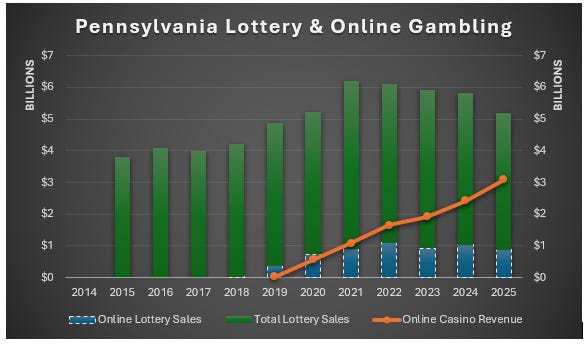
All that said, online casino isn’t the only potential reason for the decline, particularly in 2025, which was a bad year for lotteries across the country, as total US lottery sales were $109 billion in 2025, a 3.6% year-over-year decline.
Those reasons include:
Fewer Large Jackpots
Post-COVID Normalization
Economic Pressures
Competition from Other Forms of Gambling (sweepstakes, sports betting, prediction markets, and more).
Around the Watercooler
Social media conversations, rumors, and gossip.
As I’ve previously noted, Kalshi has been trying to create a line of distinction between itself and offshore prediction markets not under CFTC oversight.
Yesterday Kalshi and the CFTC announced two insider trading incidents had been uncovered. One was a well-publicized case involving a California politician that Dustin Gouker covered in real-time back in May, and the other involved a MrBeast editor (full story at NPR).

First, kudos to Kalshi for actually doing something about this, and kudos to the CFTC for issuing an advisory on the two cases, threatening potential criminal charges.
That said, there is a lot more smoke emanating from other markets, not to mention the markets with built-in information asymmetries, where results are known to a select group (which I’ve detailed in the past), and which Kalshi CEO Tarek Mansour tried to differentiate from insider trading in a post-Super Bowl interview on CNBC.
The latest example of these after-the-fact markets is the winner of Survivor 50 (covered in Axios), which wrapped up filming in June:
“The landmark 50th season of the CBS reality show "Survivor" is set to premiere on Wednesday, but Polymarket and Kalshi traders have already coalesced around a single contestant as the probable winner among the 24 all-star returnees.”
“[…]
“If an outcome has already been decided, betting on it starts to look less like prediction and more like knowledge arbitrage — raising questions about whether these markets can prevent insiders from cashing in on nonpublic information.”
As I said in a past newsletter:
“This type of trading is not finding the wisdom of crowds, it’s creating a piggy bank for informed elites, who can exploit everyone else… If markets need secret knowledge to work, they’re not aggregating truth; they’re laundering asymmetries.”
Stray Thoughts
It’s nice to see people catching up with some of the prediction market questions I’ve been asking for nearly a year:
Is the CFTC capable of overseeing sports contracts?
Are sports the short-term bridge to prediction markets’ long-term goals?
Will prediction markets become a political issue?
The CFTC’s capacity to oversee the sports betting industry is something I’ve been asking since at least May 2025, and something the Boston Globe Editorial Board recently wrote about:
“The problem is that even if the CFTC under the Trump administration was serious about imposing rules on prediction markets, the agency probably does not have the capacity to enforce those regulations. As Timothy Massad, the former CFTC chair during the Obama administration, recently told Politico, the agency does not ‘have the expertise or staff that they need to police these markets.’”
And the latest new question that I’ve been asking for quite some time: Where is the financial opportunity in prediction markets? There is also a second part to that question that I’ve put forth: If they win, there is a very real possibility that the federal government eventually and drastically increases the financial burdens on prediction markets down the road.
As I said in August 2025, Are Prediction Markets Really the Future?
“There are numerous structural problems with the sports contracts at prediction markets, or as they have been known for over two decades, betting exchanges.”
As I noted, there are:
The legal and regulatory uncertainties
Customer preferences (sportsbooks or prediction markets)
Peer-to-peer gambling’s unique challenges
The rising cost of competition
And, contrary to popular belief, gambling is not a license to print money
“On Point #2, evidence from mature markets such as the UK and Australia suggests that where betting exchanges and traditional sportsbooks coexist, the market is typically dominated by traditional sportsbooks. These products cater to various customer segments and meet different betting needs. As Regulus said in a recent note, the model hasn’t set the world on fire in other corners of the globe, despite having the same structural advantages: “We believe that the biggest danger for prediction markets is that they are structurally small and weak without professional layers to provide liquidity, especially delivering the longer-odds bets and parlays that mass market customers (and many whales) like.” Everyone thinks prediction markets will figure it out and offer these products, but broad adoption beyond niche users remains unproven.
“[…]
“On Point #4, the competitive landscape is shrouded in uncertainty… if Kalshi wins in court and the CFTC maintains its current hands-off approach, you can expect dozens of companies to get involved… and more competition means less meat on the bone... Another factor is that if prediction markets are authorized, it won’t be long before everyone and their cousin shows up with their hand out asking to wet their beak.
“On Point #5, running a gambling operation — whether a casino, a traditional sportsbook, or a prediction market — is far from a guaranteed profit machine… The major players in the US online sports betting market have yet to post a profitable quarter despite more than $500 billion in lifetime handle, as high customer acquisition costs and compliance burdens continue to weigh them down.”
Or in November 2025, when I wrote:
“Financially, the math doesn’t always add up. Prediction markets promise efficient pricing through crowd wisdom, but just because something is popular doesn’t mean there’s a financial opportunity. There are questions about how sustainable the revenue model is beyond fees, and if every customer is price-sensitive, that’s a problem — and is directly at odds with the previous header.
“If margins are razor-thin and user acquisition costs skyrocket, how do these platforms turn a profit?”
So if you want to know what people will be talking in six months, make sure you’re subscribed to the newsletter.