

Same Tactics; Same Results
A marathon hearing on online gambling in Washington DC exposed the flaws in the pro-legalization side's arguments.
The Bulletin Board
THE LEDE: DC online gambling hearing sets the stage for next year’s battles.
QUICK HITTER: FanDuel takes on market maker role; Amy Howe out as CEO.
VIEWS: Land-based gaming is largely insulated from online competition.
AROUND the WATERCOOLER: He (the article) who must not be named.
STRAY THOUGHTS: The Forecast tier is getting an upgrade.

Sponsor’s Message: Promoting a sustainable, entertainment-first global gaming industry.
Play’n GO is celebrating its 20th anniversary in 2025. Drawing on that experience from the dawn of the iGaming industry through to today, Play’n GO designs and creates world-class slot games in the online casino space.
Play’n GO wants to see a sustainable industry that puts players first. To realize that vision, Play’n GO:
Creates games designed to be entertaining and fun first
Actively lobbies for increased regulation to keep players safe
Refuses to make games that feature mechanics that we believe to be predatory, such as those that allow players to pay hundreds of times their normal stake to buy into the bonus round directly (‘Bonus Buy’ games)
Now live in over 35 regulated territories around the world, including all US and Canadian iGaming jurisdictions, Play’n GO is the leading provider of entertainment to the online casino industry.
For more info, visit www.playngo.com
The Lede: DC Online Gambling Faces Familiar Challenges
A four-hour online gambling hearing in Washington DC saw the usual suspects make the usual arguments with the usual results. What it did offer is a glimpse into next year’s battles over online casinos as each side crystallizes their talking points.
The legislation, B 26-0656, sponsored by Councilmember Wendell Felder and introduced on April 9, 2026, would legalize online casino gambling in DC, with licensing fees set at $2 million and a tax rate of 25%, with an additional 2% local fee. There is no explicit cap on licenses, but preference is given to existing mobile sports betting licensees.
The hearing took place on Monday in front of the City Council Committee on Human Services, which did not take a vote on the bill after the marathon hearing.
Online gambling legalization advocates pointed to lost revenue and the current availability of online gambling in the district.


Critics cautioned about increased social harms, job loss, and the cannibalization of existing gambling revenue.


Critics also highlighted a talking point that has been floating under the surface for a while now: The resiliency of the black market. They already have a strong counter to the revenue argument (cannibalization and job loss) and now they are undercutting the other core reasons for legalization: shifting players from the unregulated to the regulated market:
Oliver Barie, Government Relations Director for the National Association Against iGaming, brought up something he previously said on my podcast: noting that based on the industry’s estimates illegal gambling revenue is growing, despite more states legalizing the activity.
Keith Whyte (also a former podcast guest), the former executive director of the National Council on Problem Gambling and now an industry consultant said he was neutral on the bill but did note that data he has seen indicates that post-legalization, a third of customers will bet in regulated markets, a third will bet in unregulated markets, and a third will use a mixture of the two.
Brianne Doura-Schawohl (a two-time podcast guest, here and here) pointed to a study from Penn State University that indicates the illegal market usage rose from 6% to 10% from 2024 to 2025.
As I’ve been saying for quite some time, the pro-legalization side is losing the narrative battle:
“As I said in the past, “Intuition overrides evidence when evidence isn’t overwhelming.”
“Lawmakers, swayed by constituent complaints and advocacy groups highlighting rising addiction rates or moral concerns, often lean on their gut feelings rather than the industry’s economic arguments. While tax revenue and consumer protections are wins, optics are just as important.
“The industry’s push to expand markets ignores this, assuming states prioritize total market size over social and political stability. While others are citing rising addiction rates and a glut of advertisements, the industry is touting growth and future growth. Cross-selling to increase customer spend might sound good to investors and shareholders, but it doesn’t sit well with lawmakers and advocacy groups. When there’s a weekly newspaper article on rising addiction rates, a 25% year-over-year revenue increase starts to look like the problem, not the solution.”
So how do you convince lawmakers to expand gambling? A messaging reset. My inbox is open.
Quick Hitter: FanDuel’s Eventful Day
The news of the day was Amy Howe being “ousted” as FanDuel CEO, mere hours before the company’s Q1 earnings call.

“FanDuel CEO Amy Howe has been ousted from that post after five years at the company, people familiar with the matter told CNBC.
“Christian Genetski, FanDuel president, will step in to lead the company, according to the people, who asked not to be named in order to speak about internal matters.”
STTP will have some more thoughts on this, and how it fits into the bigger picture, in the coming days.
Also of interest was the news that FanDuel has become a market maker for at least one third-party prediction market. From InGame:
“Flutter revealed that it is market-making on prediction markets — putting up prices for other users to take — but this was on a “third party platform” rather than on CME’s exchange, which FanDuel offers to its own customers. Rival sportsbooks DraftKings and Fanatics have also launched market makers.
“Market making is an exciting opportunity and I think it’s a great way that we can showcase the quality of our pricing opportunities,” Jackson said. “We’re going to be market making on as many platforms as we can.”
The market maker news caused a few raised eyebrows on X, including from recent podcast guest Charles Fain Lehman:

Views: Don’t Sleep on Land-Based Gambling
Online is getting the bulk of the attention, but the reports of the demise of land-based gambling are greatly exaggerated.
I write a lot about Las Vegas’s struggles, but one thing I don’t argue is that Las Vegas is on the decline because of online gambling, which I see as a trivial competitor, and a potential asset no brick-and-mortar operator has truly harnessed yet.
As I wrote in September 2024, and it still holds true today:
“Even the most ardent supporters of online gambling in the casino industry have yet to fully embrace or fully integrate online gambling into their land-based offerings.
“Companies that embrace online offerings will have thriving online businesses and the capabilities (most notably, money) to reinvent their land-based properties, leveraging their online successes to create successful land-based counterparts. One example I often use is a “find your game” function that allows online players to locate the land-based version of their favorite online games — whether it’s blackjack, baccarat, or a branded slot — when they visit a casino.”
The bottom line is this: Las Vegas’s recent struggles aren’t from external forces; they are largely self-inflicted.
Beyond Las Vegas, I recently visited several regional casinos and when it comes to visitation, I didn’t notice a difference from when I first started frequenting casinos in the late 1990s. They’ve evolved with the times (for the better, in my opinion), and the industry as a whole is as busy as ever.
More evidence can be found even further down the gambling ladder, considering slot route operator Accel Entertainment’s recent earnings call.
As Citizens put it in a note, Accel may not be flashy, but it produces quarter after quarter:
“ACEL is not the most attractive growth company across the consumer discretionary space, yet years of experience operating across hyper-local gaming markets have proven it is one of the more consistent, with a highly desired balance sheet. While most companies in the gaming space are experiencing low or no EBITDA growth, ACEL has increased quarterly EBITDA for the last four years, including 9% growth in 1Q26.”
During the call, COO Mark Phelan rebranded Accel as something more than a slot route operator, saying, “A logistics business competes on efficiency, scale, and cost. The gaming and hospitality business competes on experience, content, relationships, and differentiation and it commands meaningfully better economics as a result.”
And it’s precisely those three things — experience, content, and relationships — that tend to be absent online, where a customer’s loyalty doesn’t have geographic restrictions, and is only as deep as the competition’s bonus offer. Casinos, and even slot route operators, understand this. The online cheerleaders don’t. Land-based gambling was never just about the bet, and it’s becoming less about the bet every day.
Around the Watercooler
Social media conversations, rumors, and gossip.
The column that will not go away:
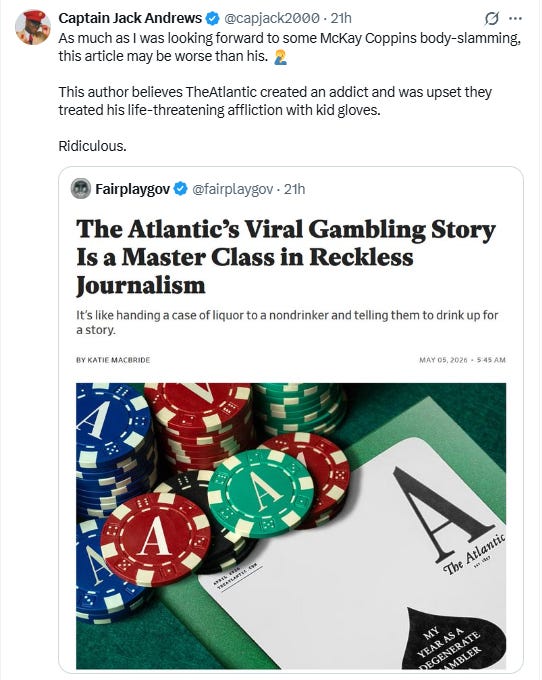

So what does the new Slate column (paywall) argue? Essentially, that The Atlantic was reckless in assigning McKay Coppins (a non-gambler) an article about gambling. As the subhead reads, “It’s like handing a case of liquor to a nondrinker and telling them to drink up for a story.”
You can read my previous thoughts on the Coppins’ article here:

And some more of my thoughts on why the article has had such a long shelf life (which, yes, I know I’m contributing to) from a follow-up entry here:
“I understand why it might feel maddening, as Coppins is turning up everywhere, but I wonder if all this criticism is actually giving the article more legs than it would have had otherwise, and boosting Coppins’ profile as a guest.
“Again, this is not a defense of the column, and Coppins doesn’t do himself any favors when he says silly things like, I would hide in the pantry to place bets, but I’m having a difficult time understanding why we are giving this so much oxygen. This was a small grease fire that could have been put out with a small towel but for some reason, the sports betting community decided to douse it with water and turn it into a three-alarm blaze.”
Stray Thoughts
Some very exciting updates are coming to The Forecast tier… stay tuned.