

Super Duper!
I'm not sure why Putting on the Ritz from Young Frankenstein popped into my head when I heard about DraftKings new Super App, but here we are, and I'm running with it.
The Bulletin Board
THE LEDE: DraftKings announces new Super App.
NEWS: A slow news day: Only a half-dozen prediction market stories.
VIEWS: Flutter’s earnings call highlights the problem with focusing on handle.
QUICK HITTER: MA budget partially restores Community Mitigation Fund.
AROUND the WATERCOOLER: X walks back restriction on paid gambling ads.
STRAY THOUGHTS:

Sponsor’s Message: Increase Operator Margins with EDGE Boost Today!
EDGE Boost is the first dedicated bank account for bettors.
Increase Cash Access: On/Offline with $250k/day debit limits
No Integration or Costs: Compatible today with all operators via VISA debit rails
Incremental Non-Gaming Revenue: Up to 1% operator rebate on transactions
Lower Costs: Increase debit throughput to reduce costs against ACH/Wallets
Eliminate Chargebacks and Disputes
Eliminate Debit Declines
Built-in Responsible Gaming tools
To learn more, contact Matthew Cullen, Chief Strategy Officer, Matthew@edgemarkets.io
The Lede:
During its Investors Day presentation, DraftKings announced a new Super App that will bring all of its disparate products under one roof: Sports betting, casino games, prediction markets, and lottery, with the actual offerings varying by state, as Covers.com’s Geoff Zochodne noted on X.

Notice everything is the same, except in New York CeeDee Lamb’s prop market is called an SGP, and in California it’s called a “Combo.” But remember, it’s not sports betting.
Or, as Ryan Butler put it on X, “DraftKings integrating its prediction market into its sports betting app means that all Americans (pending potential future state-level legal challenges and sports event contract bans) will have (what is now) legal access to something that looks and feels like a mobile sportsbook.”
In the press release that preceded the Investors Day presentation, DraftKings said the new Super App “brings together Sportsbook, Predictions, Casino and Lottery into one seamless, integrated experience through a single account and wallet, with access tailored to each jurisdiction. Phase one of the integration is expected by March Madness, with additional upgrades planned throughout the year.”
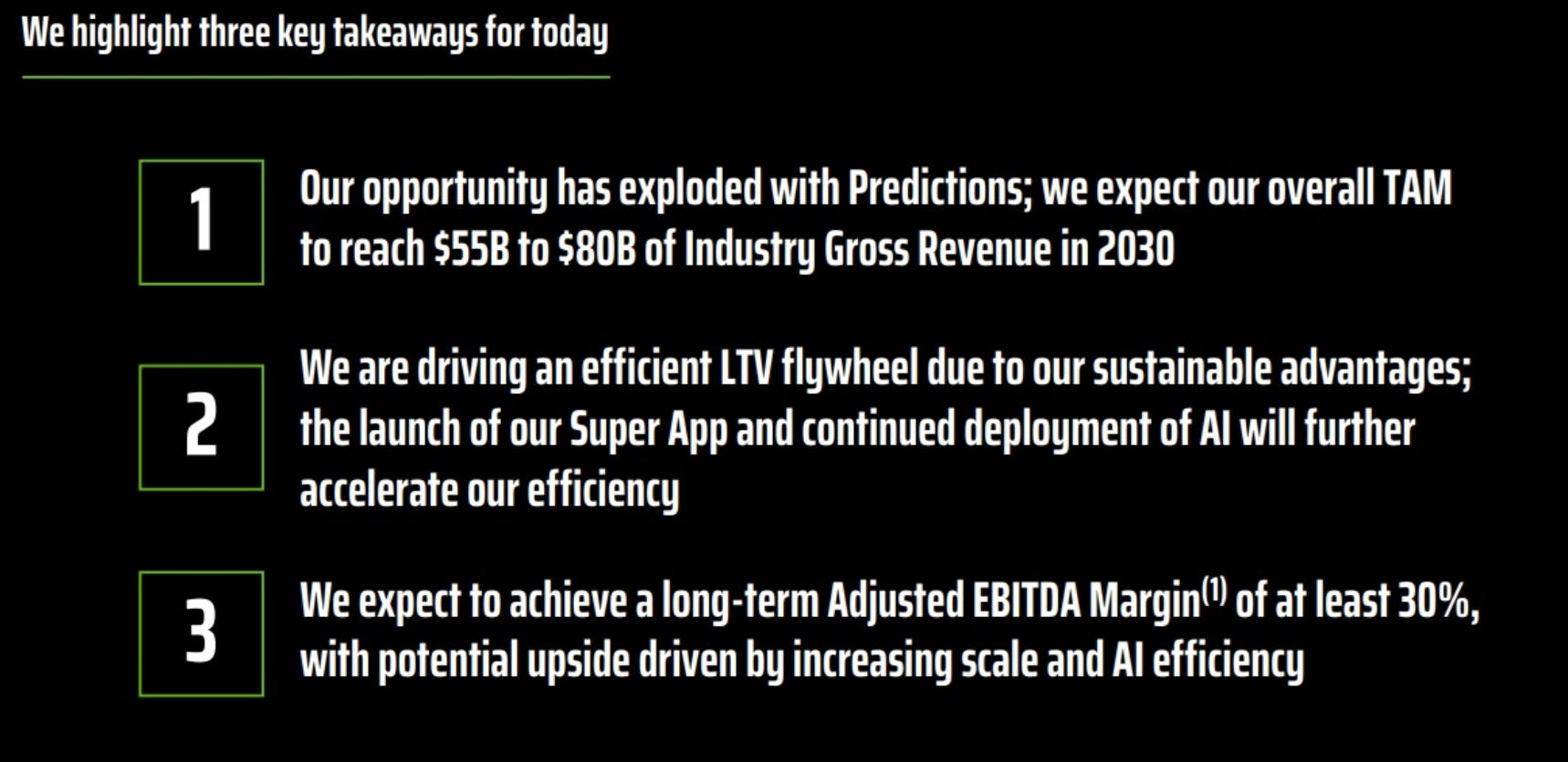
The press release also offered some forward-looking estimates, with DraftKings pointing to a $55 billion to $80 billion gross revenue opportunity in 2030. However, that projection will require everything to go swimmingly over the next 3-4 years:
“The expected 2030 industry gross revenue opportunity reflects continued state legalization of Sportsbook and Casino, growth in existing jurisdictions, and the expansion of DraftKings Predictions.”
Those three things happening — new online casino and sports betting states, continued growth, and prediction markets continuing along their current trajectory — would be a winning streak similar to the Boston Celtics 1959-1966 run.
If everything works out perfectly, here’s what DraftKings expects:
Some other questions to consider:
How will state regulators feel about the new Super App, with shared wallets and offerings (even if they are in other states) they may not be comfortable with?
How will customers feel about it? Yes, many people like convenience, but there are cohorts who want their sports or lottery wallet separate from their casino wallet — DraftKings did say the standalone apps will remain available for users who want a single vertical experience.
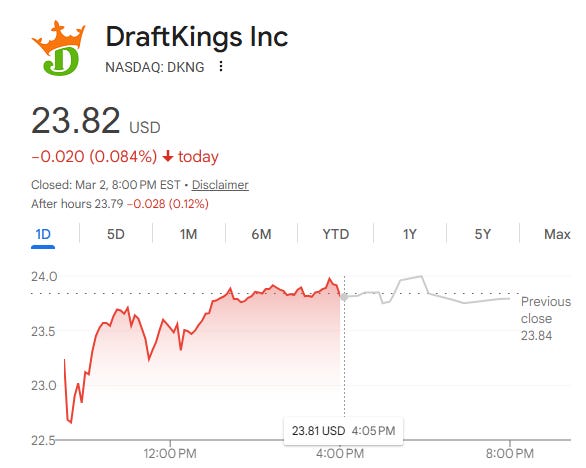
How do investors feel about it? Lukewarm might be the most generous description. Despite what should have been seen as a major announcement, DraftKings’ stock price barely changed yesterday.
Further, as Citizens said in a note, “Management noted it is possible prediction market spend could be a drag on the P&L in 2027.”
With that as the backdrop, here’s what I said in a column last month:
“To date, DraftKings has excelled at one thing: raising and deploying capital aggressively. The financial spend on sports betting was supposed to be the gateway to online casinos, but as that stalled, investors started to question the strategy, particularly as states continued to raise taxes and restrict markets.
“The shift to prediction markets is another example of chasing the ball into the road. It’s unlikely to be the road to profitability in the near-term. Instead, it will extend the runway to profitability by several years, perhaps buying more time for online casino legalization to take hold, which will kick off yet another spending spree, all in the name of growth and customer acquisition.”
News: 2 3 4 5 Significant Pieces of Prediction Market News
Two extremely significant pieces of news dealing with prediction markets emerged yesterday.
First, we have former CFTC interim Chair, Caroline Pham’s prediction markets comments at the Stanford Bass Summit held in Denver a couple weeks ago.
The big headline everyone will focus on is Pham’s statement that prediction markets are 100% headed to the Supreme Court (which everyone, including STTP, has been saying from the outset). But I was drawn in by two other parts of the discussion.
First, Pham seems to contradict herself at one point, saying:
"There's a lot of people talking about economic purpose. Those are actually old frameworks that the Congress abolished from the CFTC's statute back in 2000."
She then defines swaps as:
"The occurrence or non-occurrence of an event associated with a potential financial, economic or commercial consequence."
Equally interesting is something American Gaming Association President and CEO Bill Miller brought up on my podcast (Bonus Episode), which is, while the game’s occurrence might have economic consequence for local businesses, the outcome is unlikely to have any consequence.
Pham didn’t make that distinction, arguing:
"If you are local business owners or you're a sports team or any of those types of things, stadium owner, there are financial, economic, and commercial consequences associated with the occurrence or non-occurrence of that event."
The video below is cued up to the prediction market discussion, which lasts about 10 minutes.
The second story is the launch of Gambling is Not Investing, a coalition of consumer advocates, led by the former Chief of Staff for Donald Trump, Mick Mulvaney, who is serving as the group’s executive director. There is no word on who is funding this group as of yet.
From the press release announcing the launch, the group believes, “these platforms operate outside established state and tribal gaming frameworks, bypassing safeguards voters and elected leaders have put in place across the country.”
According to the press release, Gambling is Not Investing will “advocate for consistent consumer protections and regulatory accountability by enforcing existing state and tribal gaming laws for prediction markets that facilitate illicit sports betting through event contracts.”
The formation of GINI highlights a split among conservatives over prediction markets (which hit on two core conservative principles: gambling and state’s rights), and with Democrats likely to oppose PMs over the Trump family’s ties, there is a growing feeling that Congress may eventually step in. As I’ve been saying, don’t sleep on Congressional action.
“Gambling products – regardless of what you call them – must follow established state and tribal laws,” said Congressman Mick Mulvaney, Executive Director of Gambling is Not Investing. “Rebranding sports wagering as ‘trading’ or ‘investing’ or ‘predicting’ misleads consumers, undermines responsible gaming protections, and weakens the state and tribal systems built to protect the public and fund vital community services.”
And since it’s prediction markets, there are no shortage of stories coming across the transom:
And a bonus news bite:


SPONSOR’S MESSAGE: Friction at sign-up. Multiple vendors to manage. Fraud patterns that don’t look like anywhere else in the world. Brazil’s iGaming market is full of opportunity — but off-the-shelf solutions aren’t built for it.
So GeoComply built something different — a Unified Identity Platform that helps Brazil iGaming operators increase pass rates while strengthening fraud protection.
It brings KYC, anti-fraud, and geolocation together in a single platform purpose-built for Brazil’s regulated market.
You get:
- A managed KYC waterfall with local Brazilian data sources and docless flows that leverage CPF validation
- Real-time device, location, and behavioral intelligence that catches fraud at registration and beyond
- ML models trained specifically for the problems Brazil operators are facing
- Up to 99.7% geolocation pass rates and 99.999% uptime
This same framework has delivered 95%+ KYC pass rates in the U.S. and 90%+ in the U.K. Now it’s tuned for Brazil.
Read the full announcement — or visit GeoComply at SBC Rio (booth #A850) to see the platform in action this week.
Views: Handle Is Still the Worst Metric for Sports Betting
Flutter CEO Peter Jackson explained this in the company’s earnings call, but no one wants to take the time to understand the nuance.
During the company’s earnings call, Jackson used some gobbledygook language to explain its less-than-expected handle growth, terming it, “unfavorable recycling impact from sustained, bookmaker-friendly sports results.” In layman’s terms, that means bettors had a rough go of it, and the books cleaned up.
The problem isn’t less-than-expected handle growth, it’s the emphasis people put on handle in the first place. 3% handle growth (or even decline) should be a nothingburger part of the story, except the industry has made handle a core KPI.
What Jackson means by recycling impact is that most customers have a deposit threshold (an amount of money they are willing to lose over a certain period of time), and in Q4, those bettors lost their money a lot faster than usual.
Normally, someone depositing $100 will win about half their bets and lose half their bets. That leaves them with half their original deposit to bet again, and the process repeats until they go down to zero. Their $100 deposit might get “recycled” 2-3 times before that happens, resulting in $200-$300 in handle.
More importantly, the customer gets a full month of bets from that single deposit.
If variance is with the books, and the person loses 8-out-of-10 of their original bets, they may only generate $120-$150 in handle from their $100 deposit, and only get two or three weeks of bets from their deposit.
Now, here is the part professionals and many industry observers don’t get; many of these bettors will not blindly throw more money into their account. They’ll take a quick break, and skip a week or two, then deposit again. Betting isn’t something they have to do; it’s something they like to do.
Like I said in Friday’s column, “Betting, for most people, is an indulgence; it’s their cheat day when they’re on a diet; the extra drinks when they reunite with high school friends; the limo to the show. It’s not number crunching and a means to put food on the table.”
The sportsbook’s revenue hasn’t changed. The amount the customer deposits in a given period of time hasn’t changed. The only thing that has changed is the amount of handle the person produced. (I’m not talking about people who might chase losses and bet more than they intended to, that is a discussion for another day).
And handle is not a great indicator of success or growth. I’ve been saying for years that deposit bonuses have pumped the handle numbers into the stratosphere, but it’s all fake money. And as I previously wrote in a rant about trading volumes at prediction markets being a garbage number:
“Handle is cleaner, as every $1 represents a wager from a customer. Still, it’s far from clean. Reason being, bets get recycled, and with hundreds of millions in promo dollars floating around, it’s hard to know what is deposited and wagered dollars, and what is phantom money.
“The numbers that would tell us if the ecosystem is 1) sustainable and 2) thriving are net gaming revenue (NGR) and customer deposits.”
This is common in poker. A lot of casuals show up with a buy-in or two, and once that money is lost they stop playing, “When the money’s gone; it’s time to move on,” as Worm put it in Rounders. How quickly they lose the money doesn’t change how much fresh money they’ve injected into the poker ecosystem. And if they win, that same money is used the next time they sit at a poker table.
Bottom line: What Jackson termed “unfavorable recycling impact” is a masterclass in soft language, but at the end of the day, until we move away from handle (and hold operators’ feet to the fire for better metrics), we are going to keep getting newly minted terms.
As an aside:

Quick Hitter: MA Budget Would Restore (some) Community Mitigation Funds
A story Straight to the Point has been following is the casino mitigation fund in Massachusetts, as it highlights that states don’t just change the rules on online gambling operators when they need cash.
“When Massachusetts looked into legalizing casinos, one of the biggest concerns was community harm. To counteract that, the state created the Community Mitigation Fund when it legalized casino gambling in 2011. Funds and grants began in 2015, following the opening of the state’s first casino in Plainville (Plainridge Park Casino, operated by Penn).
“And everything was working as it should… until recently.
“The CMF receives 6.5% of the tax revenue paid by casinos, which is supposed to be set aside for local grants in host and surrounding communities. However, CMF funds are being rerouted for the second year in a row, as the Massachusetts legislature is keeping the money that should go to the CMF for the state’s general fund.
“As the Commonwealth Beacon reported, ‘In the 2025 state budget, lawmakers allowed a temporary redirection of those gaming revenues – a move Gov. Maura Healey branded as a one-time maneuver to free up $100 million for state spending during a tight budget year. But the 2026 state budget saw the Legislature again redirect the funds to priorities like transportation, education, economic development, and tourism.’”
Through Gov. Maura Healey’s proposed budget, some of that money could find its way back into local communities.
“Governor Maura T. Healey’s proposed budget restored some, but not all, the casino mitigation fund Springfield and its neighbors have relied on for public safety, parks, streets and other projects on since MGM Springfield opened. It’s estimated to be about $550,000 in the upcoming budget year, according to documents prepared by the governor’s budget team.”
Around the Watercooler
Social media conversations, rumors, and gossip.
Influencers and affiliates can breathe a sigh of relief (at least for now) as cryptocurrency and gambling have been removed from the list of prohibited industries for paid promotions on X, as the official policy page for X no longer lists them as ineligible.

Recall, the X policy was put in place just a week or so ago: “There are also the Google (2025) and X (2026) policy changes, with X recently restricting gambling from influencer and paid partnerships and the overhanging possibility of regulators taking a closer look at the affiliate sector.”
The change allows influencers and content creators to engage in sponsored content for these categories, provided they use proper “Paid Partnership” labels.
Stray Thoughts
If you’re trying to get a little ego boost, it’s easier to tear someone down than prop yourself up. Pointing out flaws in others requires zero self-reflection or effort. It’s the ego-boost equivalent of a sugary snack; a quick high that’s fleeting and loaded with long-term downsides. On the other hand, propping yourself up demands real work, like skill-building, achievements, or personal growth.