

The Bulletin Board
THE LEDE: Michigan Gaming Control Board parts ways with NCPG.
ROUNDUP: A look at the stories you may have missed.
VIEWS: Penn knows where its bread is buttered: Land-based casinos.
VIEWS: A spate of prediction market news from the federal government.
AROUND the WATERCOOLER: Is there any there, there?
STRAY THOUGHTS: Show me the basics.

Sponsor’s Message: Play’n GO is launching into land-based casinos.
After more than 20 years at the forefront of iGaming, Play’n GO is bringing its world-famous games to land-based spaces, too.
Play’n GO’s unrivalled portfolio of some of the world’s most played online casino games is now available for physical casinos, giving operators the opportunity to harness the power and growth of online casino to bring a new demographic of players into their brick and mortar spaces for the very first time.
With cabinets already placed with one of the biggest casino chains in the world, Play’n GO’s CEO Johan Tornqvist said “We are bringing the best of online casino content and features to casino floors worldwide.”
For more info, visit www.playngo.com
The Lede: Michigan Gaming Control Board Leaves NCPG
I don’t want to say I told you so, but, the chickens are in fact coming home to roost:

And this is not a symbolic gesture, as the letter explains:
“Accordingly, MGCB is formally withdrawing its membership from NCPG. Please remove all references to the MGCB’s membership or affiliation with NCPG immediately. Additionally, MGCB employees will no longer serve on any board or committee of NCPG and will no longer attend any NCPG events, including the annual conference.
“Finally, please note the MGCB is cancelling its paid sponsorship for the conference scheduled at the end of July. We will follow up separately to address any steps necessary to ensure all references to MGCB sponsorship are removed.
“I regret that this action is necessary but trust you understand the MGCB’s need to ensure that it is not associated with organizations that are affiliated with companies engaged in illegal gambling.”
The NCPG has tried to do damage control on at least two separate occasions, but as I previously wrote, it appears to think the answer is to keep digging.
On June 15, the organization published an article on its website titled: Understanding NCPG’s New Financial Services & Trading Membership Subcategory, where it tried to explain Kalshi’s membership:
“At NCPG, our mission remains unchanged: to lead awareness and advocacy efforts to reduce gambling-related harm. NCPG has a responsibility to understand emerging products and platforms which methodologies present as gambling and thus may present risks to consumers. Today’s environment extends beyond traditional forms of gambling and increasingly includes online sports betting, gaming, cryptocurrency, financial trading platforms, prediction markets, and other activities that may function similarly to gambling.”
On June 29, it published: Membership and Donations Do Not Equal Endorsement, which reads in part:
“With full transparency, membership in NCPG does not constitute an endorsement of any organization or their products, services, business practices, or policy positions.”
By this logic, Stake or Billy the corner bookie could join tomorrow.
I would argue that you are judged by the company you keep, especially if that company is a major donor.
I’m sure I’m persona non grata at the NCPG, but maybe, just maybe, it’s time to get rid of whoever is currently advising you and talk to the people who seem to get things right? I (and a few other people on the pay-no-mind list) are here to help.
I’m happy to help. The Geoff Freeman-led AGA took me off their mailing list and ignored any request I made for two years when I called out some of their polling BS and questioned their position on sports betting vis-a-vis online casinos. We reconciled.
And I have to include this S-tier tweet from Richard Schuetz:

Roundup: So Much News; So Little Newsletter Space
A must read on Meta’s foray into prediction markets [NPR]: “Before Meta CEO Mark Zuckerberg directed employees to build a standalone prediction market app, he proposed buying Kalshi… according to three people with knowledge of the discussions who were not authorized to speak publicly.” Per NPR, Zuckerberg met with Kalshi CEO Tarek Mansour last year “but the negotiations never advanced,” with NPR reporting that Kalshi was too messy, legally and ethically.
Kalshi motion to dismiss in NM cites ‘where a bet takes place’ [InGame]: “Arguing that it doesn’t fall under tribal jurisdiction because it is not a member and federal law preempts tribal law, Kalshi filed a motion June 24 to dismiss a case against it brought by New Mexico’s Mescalero Apache Tribe.” Kalshi’s motion to dismiss in New Mexico cites the still unresolved ‘where does a bet take place’ argument — This argument has come up in previous lawsuits with tribes: “Kalshi argues that the exception would only come into play if the action in question is “on or relates to” Indian Country. The company goes on to say that as a New York-based entity, the exception is not relevant.” More on the ‘where does a bet take place’ argument from STTP, here, here, and here.
Lawsuits filed after Missouri VLT crackdown [Missouri Independent]: “Two lawsuits filed in Cole County accuse Missouri Attorney General Catherine Hanaway of unlawfully using threats of criminal prosecution to force bars and gas stations to shut down slot machine games. The latest case, filed Friday by an entity founded last year called the Missouri Licensing Advocacy Group based in Osage Beach, argues Hanaway and the Division of Alcohol and Tobacco Control are threatening the liquor and other licenses of businesses that host the machines.” Recent STTP updates on the VLT fight in Missouri here and here.
Regulators get to work on Colorado credit card ban [InGame]: After the legislature passed a sweeping gambling reform bill, SB 26-131, Colorado regulators have started the process of banning credit cards. “All language that allows for credit card funding of gambling accounts is set to be removed from Colorado’s regulations in order to comply with a new law focused on responsible gaming. Colorado Division of Gaming Deputy Director William Hiserodt explained the plan at an emergency rulemaking session Tuesday [June 30] morning.”
Foxwoods adds reserved tables and gameplay lessons [Mass Live]: “It can be intimidating to join strangers at a poker table when one has never played before. Foxwoods Resort Casino has found a way around that. One often unknown option is the reservation of tables for groups, allowing friends to learn together without the pressure of competing against strangers. Terry Chiaradio, the director of poker operations at Foxwoods, said this option is often used for celebrations such as bachelor and bachelorette parties.”
Views: Penn’s Refocus on Land-Based Casinos Pays Off
The poster child for getting out over your skis (and also overpromising and underdelivering) during the post-PASPA sports betting boom has to be Penn Entertainment.
“Lacking a national brand, Penn hitched its sports betting wagon to Barstool Sports in January 2020. It completed the acquisition in February 2023 at a final price tag in the $500 million range. In 2021, Penn also purchased a tech stack, theScore, for $2 billion.
“In August 2023, Penn ended its relationship with Barstool Sports, selling the company back to Dave Portnoy for $1 and some concessions, and inked a $2 billion deal with ESPN.”
That partnership also ended unceremoniously in November 2025:
“The failure of the Barstool Sportsbook was a bad look for the company and left the spotlight shining on a now-empty stage, and Penn decided to bring on the biggest, cleanest act it could find: ESPN. It was bringing on Jerry Seinfeld to quell a religious crowd after they were offended by Sam Kinison’s set. Barstool’s brand didn’t materialize into a competitive sportsbook, but surely ESPN would?
“ESPN’s corporate culture was a better fit, yet the result was essentially the same.”
As Penn CEO Jay Snowden said at the time: ‘We are realigning our digital focus to leverage the strength of our U.S. iCasino and Canadian operations, while continuing to use OSB to drive both the acquisition of customers with significant lifetime value and unique cross-sell opportunities across PENN’s retail and digital assets.’
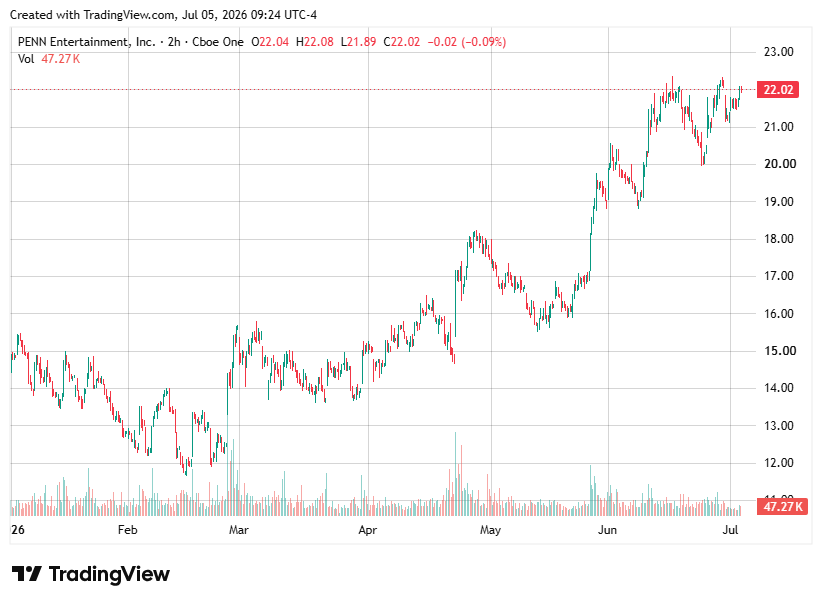
That approach, along with some very intense battles with activist investor HG Vora, seems to be working, with share prices up about 45% in 2026:
As the team at Citizens noted after touring Penn’s Illinois property, Hollywood Casino Aurora, the refocus on retail doesn’t seem to have been a flash-in-the-pan:
“We believe the company is positioned to see retail EBITDAR growth accelerate in 2H26, supported by the completion of its four retail projects… Additionally, digital losses should continue to subside into 2027, and favorable comparisons, combined with limited new supply, position the company as one of the more attractive regional gaming operators in our view… Finally, the company noted four to five potential sites for incremental riverboat-to-landside conversions in the coming years, providing a solid pipeline of growth projects.”
News: 4 (Federal-Level) Prediction Market Updates
After some time off, I have several prediction market letters and actions to get everyone caught up on.
No Funds for CFTC Lawsuits
Sens. Richard Blumenthal and Jeff Merkley are leading a group of Democratic lawmakers trying to get the Appropriations Subcommittee on Financial Services and General Government to “prohibit the Commodity Futures Trading Commission (CFTC) from using federal funding to prevent states and Tribes from enforcing their gambling laws and gaming compacts with respect to prediction markets.”
“Online prediction markets, which have rapidly grown in popularity, are drastically different from the original intent of event contracts, which those companies claim to offer. Serving to hedge against financial risks, event contracts were largely limited to the agricultural sector and economic matters. Prediction markets, however, have distorted this purpose and infiltrated the world of sports, politics, and even foreign affairs.”
The full text of the letter is available here.
Investigate Polymarket’s Marketing Practices
“US Senators John Curtis and Adam Schiff sent a letter to Commodity Futures Trading Commission (CFTC) Chairman Michael S. Selig requesting answers following recent reports that prediction market operator Polymarket used deceptive marketing tactics to promote gambling-style products to US audiences.
“In their letter, the senators argue that the alleged conduct underscores growing concerns that prediction markets are functioning more like gambling than legitimate financial instruments.”
The press release is available here.
The Public Service Accountability Act
Congresswoman Maggie Goodlander has introduced the Public Service Accountability Act, which prohibits “senior officials across all three branches of our government from trading individual stocks or betting on prediction markets for the duration of their federal service.”
Click here for a one-pager on the Public Service Accountability Act.
CFTC Rulemaking on Data Reporting
The Commodity Futures Trading Commission published a Notice of Proposed Rulemaking seeking public comment on data reporting requirements for certain event contracts.
“Under my leadership, the CFTC will no longer regulate market participants through a patchwork of no-action letters, which serve as band-aids for unworkable regulations. This proposal is an important step in future-proofing the regulatory framework for event contracts,” said Chairman Michael S. Selig. “Our responsibility is to provide clear, workable regulations, and I’m committed to doing just that.”

Around the Watercooler
Social media conversations, rumors, and gossip.
This is a question I’ve raised on several occasions: Do people really want prediction markets?

As I argued in the past, we are being told prediction markets are popular, but so was poker:
“There is definitely some long-term potential, but that needs to survive court battles, public outcry that leads to tightening regulatory guardrails and steeper financial burdens, and of course, a CFTC that is likely to have many different makeups in the future.”
And I’d bet dollars to donuts that the prediction market ceiling isn’t as high as many people would like you to believe, because sports betting isn’t even all that popular an activity:
“Essentially, about 10% of adults will regularly place sports bets or trade stocks — If I were conducting this poll I would have asked the highlighted respondents what their average trading amount and betting volume is, because my guess is a majority of those customers are dealing in small (relatively speaking) amounts, with only a small percentage of weekly/daily bettors/traders accounting for most of the volume.”
Braziel, a distressed asset investor, went on to say, “The problem is taking an interesting forecasting tool, pouring hundreds of millions of venture dollars into it, and then applying the Silicon Valley ‘growth at all costs’ playbook... Philip Tetlock and the superforecasters have spent years studying forecasting. The results are genuinely interesting. But forecasting tournaments never became a mass-market consumer product because most people don't actually want to forecast. They want to gamble.”
Yes, prediction markets are new (to most people) and exciting, and they are filling a regulatory gap in many states that do not have legal sports betting, but their time in the sun could be fleeting.
“My theory all along is that the product only resonates with a niche market. Like trying the new restaurant in town, if the product isn’t up to snuff, they’ll move on rather quickly... While I’m a prediction market fan (for certain things), I’m not a prediction market fanboy who sees them as revolutionary, like social media or mobile apps. Especially when it comes to sports betting.
“Sure, there is a price-sensitive cohort pining for a product like prediction markets, but for the most part, people like to gamble, not treat betting on sports like they’re comparing health insurance plans or retirement funds. The price-sensitive crowd is not a cohort you can build a successful betting company on.”
In a lengthier Business Insider article Braziel touched on another point Straight to the Point has made in the past: “We've seen all kinds of businesses fail like that, a cool idea with new technology, but it just ends up destroying their equity value and then somebody buys them for peanuts.”
As I said in the November 2025 column, “Just because something is popular doesn’t mean there’s a financial opportunity… It’s a classic hype trap: great in theory, shaky in execution.”
Stray Thoughts
I can tell what kind of martial artist you are (your skill level and how you will perform difficult movements) based on how you execute two very simple drills that even untrained people can attempt:
Move Around and Throw Punches and Kicks (basically, shadow boxing)
Fall Down and Get Up
If your footwork is correct and athletic, you can throw crisp, clean strikes, and gracefully breakfall and perform a technical standup, I’m 99% confident you are a well-rounded, highly capable martial artist.
As I say to my students: A black belt is judged on the techniques they learned at white belt.